-
Crowned in Tradition: The Cayuco and Jamboree Queens of the Canal Zone
In the Canal Zone, community life was shaped as much by celebration and tradition as it was by work and geography. Events like the Ocean to Ocean Cayuco Race and the annual football Jamboree were more than just competitions; they were cultural norms. At the center of these traditions were two important figures: the Cayuco Queen and the Jamboree Queen. Though different in roles and events, both served as meaningful symbols of identity, memory, and community pride. The Cayuco Queen and the Jamboree Queen functioned as public-facing ambassadors. They appeared at ceremonies, parades, and celebrations, embodying the spirit of their respective events and teams. Their presence reinforced a strong sense of identity among Zonians, especially among alumni of schools like Cristobal High School, Balboa High School, and Canal Zone College. These roles illustrate how sport and celebration blended with tradition and social life, being that the queens were central to how these events were experienced, remembered, and passed down. Whether standing beside a victorious cayuco crew or riding in a parade before a football game, they symbolized the collective pride of their communities.
The Jamboree Queen: Pageantry and School Spirit
The Jamboree Queen emerged from the lively traditions surrounding the Canal Zone football Jamboree, an annual event dating back to 1950. Held at Cristobal High School, the Jamboree marked the beginning of the football season and brought together students, families, and entire communities from both sides of the isthmus.
A previous Object of the Day blog post shared some insight on the Jamboree event through comments left by former Zonians. Mary Alice Williford remembered that there was a fourth team called the “Working Boys”, in which all four teams played a quarter against each other and the team with the most accumulated points won the Jamboree. The parade consisted of the cheerleaders from each school and a Jamboree queen representing each team. Mrs. Williford herself was a Cristobal cheerleader from 1958 until she graduated in 1961.

Her Majesty Ruth Anne 1 presents football to Jamboree co-captain Jim Will as co-captain Don Bruce looks on. –Caribbean,1960. (CHS yearbook) Another comment left by Hal Wade mentions that the Jamboree event was the idea of Luke C. Palumbo, a coach and science teacher at CHS. He recalls that by the late 1960s only CHS, BHS and Canal Zone College played in it. BHS and the Canal Zone College chartered a special Football Train to travel to the Atlantic side. On it were the teams, cheerleaders, bands, students, and parents from the Pacific side. Mr. Wade’s recollection is a beautiful example of the fond memories tied to the event, a time when Canal Zone schools and communities were able to come together and support their respective teams during the all-American game.
The young women chosen as queens were usually heavily involved in school and community activities, making the role of Jamboree Queen an extension of their participation in Canal Zone culture.
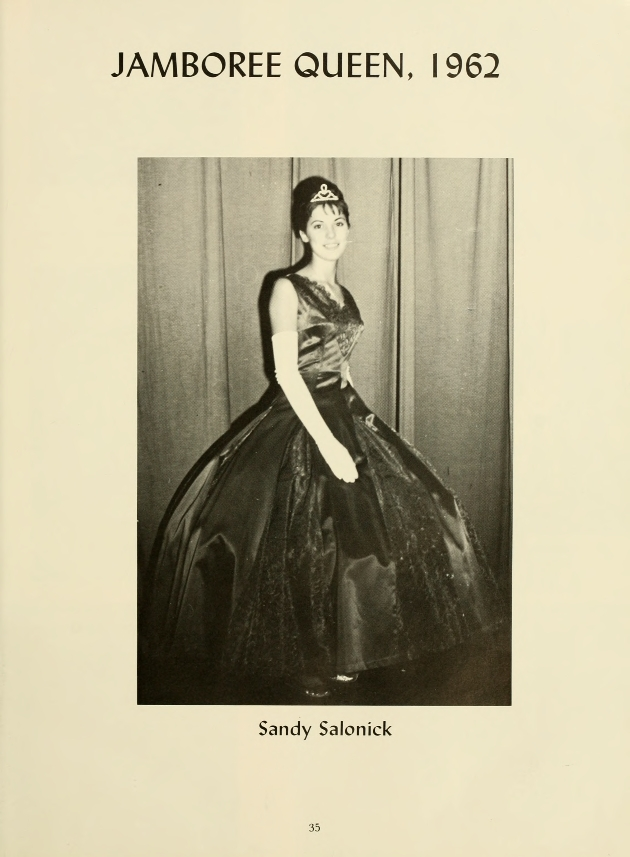
Sandy Salonick was also part of Delta Psi Omega,; national honorary dramatics fraternity, the Panama Canal Cast, staff member for The Tropical Collegian, the school’s literary magazine, and participated in “Little Mary Sunshine”. -1963 Conquistador, Canal Zone Junior College yearbook. 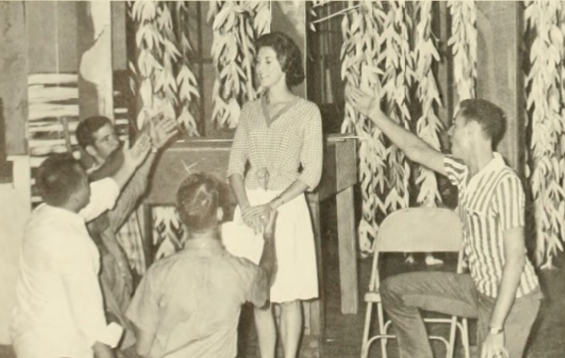
The Jamboree queens themselves stood as embodiments of school spirit and unity, and their presence in the enthusiastic parade helped transform the jamboree into a full-scale cultural celebration. She reflects the importance of pageantry in mid-century Canal Zone life. She represented ideals of poise, popularity, and community belonging, offering a visible role for young women within a largely male-dominated sports culture. At the same time, her role reveals the gendered expectations of the era, where women’s participation was often framed through ceremonial visibility rather than athletic competition.
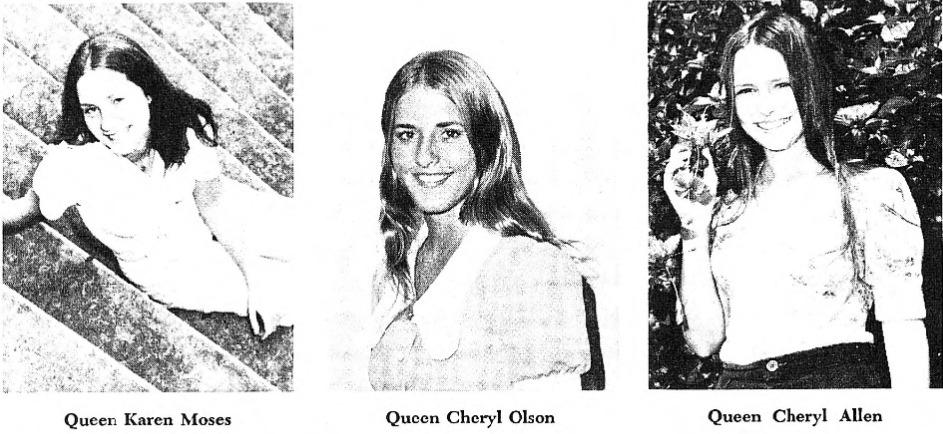
The Panama Canal Spillway, 1973 “The excitement of football will fill the air tonight as the annual Jamboree at Tiger Stadium officially heralds in a new gridiron season in the Canal Zone. The traditional event takes on added significance this year as it is dedicated to Luke C. Palumbo, founder of the classic football game which has been a highlight of Atlantic side activities since 1950. Palumbo, a counselor at Cristobal Junior-Senior High School will be retiring in the near future. Festivities begin with pregame activities at 6:15 p.m. with the assembly of competing teams followed by the parade of cheerleaders and the Jamboree Queens led by Queen Cheryl Olson of Cristobal High School accompanied by Queen Cheryl Allen of Balboa High School and Canal Zone College Queen Karen Moses. They will be followed by the parade of colors by the Cristobal High School ROTC color guard and the playing of the National Anthem. A ceremony honoring Palumbo will follow the playing of the National Anthem. The queens will then be escorted to the grandstands by the team captains and the first contest gets underway at 7 p.m. with the Cristobal High Tigers meeting the Balboa High Bulldogs. Balboa High will play Canal Zone College in the second contest and Cristobal High will oppose the Green Devils of Canal Zone College in the last contest. The team winning the most contests will be declared Jamboree champion and be awarded the Jamboree trophy.”
The Panama Canal Spillway, 1973In 1975 Balboa split into two teams, the Red Machine and the Bulldogs. All BHS athletes whose last names began with A through K were on the Red and those from L through Z were Bulldogs. Below are their respective queens for the 1977 jamboree season.

Bulldog Queen Tammy Dickson. -1978 Zonian 
Red Machine Queen Kim Swardell While the Jamboree Queen represented the very essence of school spirit, the Cayuco Queen was another significant cultural role in Canal Zone life that was tied to the iconic Ocean to Ocean Cayuco Race.
The Cayuco Queen: From Ceremony to Legacy
As the cayuco race grew in popularity, so did the ceremonial traditions tied to the event. Just as the Jamboree Queen was a role representing the Jamboree Football Game, the Cayuco Queen was a representative of one of the Canal Zone’s most iconic endurance events: the Ocean to Ocean Cayuco Race. This grueling, multi-stage race retraced historic routes across Panama, connecting the Atlantic and Pacific coasts and evoking earlier forms of trans-isthmian travel.

1960 was the first year that Race Princesses were introduced. Pat Shouts, sponsored by winning crew post 3 Balboa became the “1960 Race Queen”. –Panama American, April 1960 CAYUCO PRINCESSES-Six more pretty princesses representing teams in the coast to coast Cayuco Race were announced today by the Canal Zone Scout Council. Each girl represents an Explorer or Scout unit. The queen, the girl whose crew wins the race, will be crowned at a tea dance Sunday afternoon at the American Legion Club at Fort Amador. From left are Ginny Jansen, daughter of Maj. and Mrs. Frank J. Jansen of Fort Kobbe, the choice of Explorer Post Four, Diablo; Debbie Bathke, daughter of Capt. and Mrs. Ernest Bathke of the 15th Naval District, Explorer Ship Eight, Balboa: Pat Shouts, daughter of Navy Petty Officer and Mrs. Howard Shouts of Rodman, Post Three, Balboa; Donna Grady, daughter of Capt. and Mrs. William H. Grady of Fort Kobbe, Troop 16, Fort Kobbe; Nancy Turner, laughter of Mr. and Mrs. Joseph C. Turner of Balboa, Explorer Post 20; Charlotte Schultz, daughter of Mr. and Mrs. Robert U. Schultz of Ancon, Explorer Post Five.
–Panama American, April 1960Our collection includes the 1961 queen entry forms, as seen below:

Throughout the 1960s and 1970s, photographs and newspaper coverage continued to place the Cayuco Queen at the center of race celebrations.

March Adair, 1965 Queen. Winners of cayuco race-Post No. 21, boat No. 1. From left to right: Ken Phillips, Phil Stewart, Ronnie Carroll, Rick Williams, March Adair, Queen of the Cayuco Race; Mr. Henry J. Williams, adviser; Mr. Richard Williams, post committee chairman; Admiral Bryan, presenting the award. –The Parrakeet 
“Sharon Mann Crowned Queen, Bejuco Receives Trophy”. The award ceremony of the American Legion Cayuco Race Trophy is pictured. From left to right, Mr. George Vieto, from the American Legion; Mr. Richard Williams, chairman of the post committee; Mr. Henry Williams, Post adviser (Yeah!); Sharon Mann, 1967 Cayuco Race Queen and a senior at BHS; R. Donley, W. Albritton, M. Harris and R. Harris. –The Parrakeet, 1967 Here is Lee Harwell, 1968 Cayuco Queen with the winners:

Trophy presentation to 1968 Cayuco Race Winners. Crew left to right: Dennis Dore receiving trophy, Harry Stinsonk, Miss Lee Harwell (Queen), Tom McLean, Jim La Febvre. Presenting trophy is Charles Adair, U.S. Ambassador to Panama. 2008.005.048.006 The Cayuco Queen stood alongside the winning team, participating in award ceremonies and becoming part of the race’s legacy. Archival photographs frequently show her holding trophies, crowned and smiling beside paddlers who had completed the demanding journey. In 1978 for example, Cayuco Queen Lisa Soltesz appears with the victorious crew of the “Dear Dick,” marking the race’s 25th anniversary.

“Smiles are in order for the crew and queen of the “Dear Dick”, winners of the 25th Silver Anniversary Ocean-to-Ocean Cayuco Race. Holding the first place trophies are from left: Mark Urback, Mike Wilson, Cayuco Queen Lisa Soltesz, Manuel Stinson, and captain William Feller. The crew will also be guardians of a revolving trophy passed from winner to winner each year.” -The Panama Canal Spillway, March 23, 1978. 
Ms. Soltesz’s 1978 yearbook photo – September 8, 1960 – Ft. Wayne, Indiana; Jr .- Sr. Prom Committee 3; Red Machine Football Manager 4; Sports. Even the smaller ceremonial details like the queens’ crowns show how meaningful this role was, with Frank Townsend mentioning in his Cayuco Race Early Years Collection that they were originally purchased from La Luna in Santa Ana Plaza. When early organizers suggested passing down the crowns each year, the queens refused, insisting that each crown belonged to its recipient. As a result, new crowns were awarded annually, reinforcing the individuality and honor of the title.
Over time, the Cayuco Queen became more closely associated with the race’s evolving identity. While still ceremonial, her role existed alongside the growing inclusion of women in cayuco racing itself, signaling a gradual shift from symbolic representation toward active participation.
A Shared Legacy
Today, photos of both Cayuco and Jamboree Queens serve as important archival records. They capture moments of celebration, social life, and values of the Canal Zone. The contrast between the posed ceremonial images of queens, and the usual action shots of the racers represent the gender roles of the time. Still, the queens’ role show cultural shifts, with the Jamboree Queen representing an earlier figure of school spirit, while the Cayuco Queen shows a transition towards the eventual inclusion of female racers. Through crowns, parades, and photographs, their legacy endures!
You May Also Like

George Stratford Seymour Cockburn
-
Stars & Stripes Forever

Red, White, and Blue Troupe, Balboa Swimming Pool. Coach Grieser is standing to the far right. 2002.029.022.001, courtesy of Evelyn Brunswick. “A person who cannot swim, can become a menace not only to himself, but to others.”
– Coach Henry J. Grieser
Growing up along the Panama Canal, the children there became acquainted with an aquatic way of life. From boating to water sports to swimming, a Zonian would come to know the waterways, and to some it became almost a second home. Such is the case of the Red, White, and Blue Troupe, a co-ed group of young, talented swimmers, ranging from ages 5 to 16, who would perform and compete nationwide.
Trained and led by Balboa High School’s own Coach Henry J. Grieser, their exhibitions incorporated a series of fancy high dives, synchronized swimming, and other performances. One swimmer, Angela Klemmer (also a Balboa High School alum), even swam handcuffed and would then unshackle herself underwater. They would perform in a variety of ways, including an annual swim meet, hosting benefits for various charities, and special performances for celebrities and VIPs, often with thousands of onlookers.

Girl’s Athletic Team, Balboa High School, The Zonian, 1918. Coach Grieser stands with likely the water polo team. Founded in 1918, the Red, White and Blue Troupe was the product of Coach Grieser’s tutelage, with the Troupe’s first appearance in Balboa High School yearbook in 1922. Coach Grieser originally began at Balboa High coaching the girls’ and boys’ water polo team in 1918, who quickly rose as champions of their craft. At the time, Grieser is cited as working at the Balboa YMCA. Later, Grieser would become coach of the Balboa Pool, eventually receiving the title of Government Swimming Director and Child Developer of the Canal Zone.

Red, White, and Blue Troupe Victory Swimming Meet Certificate, 1945, 2000.063.001, courtesy of Craig and Scott McAulay. I first discovered the Red, White, and Blue Troupe through the achievements of the Balboa High swimming athletes. The Zonian yearbooks often bragged about many of the students’ achievements, including Olympic feats and breaking of world records. Among the BHS alumni in the Troupe are Angela Klemmer, Robert Pearson, Alma Mann, Lyla “Lou” Womack, Ester Greene, and Arline Schmidt. The co-educational aspect of the Troupe was unique in that boys and girls were encouraged to swim and exercise. The Red, White and Blue Troupe signifies the success with which the Panama Canal Zone Schools incorporated co-ed physical education into their curriculum. As the photo below suggests, many of the youngest swimmers of the Troupe would eventually become students at Balboa High School.

‘Coach Grieser and the Red, White, and Blue Troupe. “Future Students of Balboa High,”‘ Balboa High School, The Zonian, 1922. Many alumni of the Troupe remember their adventures fondly. Lou Womack remembers being part of the Troupe as “unbelievable,” describing the swimmers as “part fish,” due to their incredible swimming abilities. They would grow up swimming in the locks, sharing the waterways with large cargo boats passing through the Canal. Often performing at the Balboa Pool, they would have crowds of thousands attending their performances. The Red, White, and Blue Troupe was an incredible experience and cultivated a number of top-notch athletes.

Photograph of Arline Schmidt and Swimming Trophies at Balboa High School, c. 1950-1954, Gift of Canal Zone College. 2005.048.037.003 
Coach Grieser and Balboa High boy’s swimming team, The Zonian, 1926, p. 66. 
BHS Girl’s swimming team. Troupe member, Angela Klemmer stands on far right, the Zonian, 1927. 
Arline Schmidt, a member of both the Troupe and BHS competes as a champion of swimming, the Zonian, 1953.
Word of the Troupe’s abilities spread, and they often were the main attraction for guests visiting the Canal. The Troupe performed for important politicians and officials such as Charles Lindbergh, Admiral Richard Byrd, General John Pershing, former Secretary of State William Jennings Bryan, and President Franklin D. Roosevelt. Photos from some of these celebrities’ visits are shown here.


President Franklin Roosevelt waving at the Red, White, and Blue Troupe at the Balboa Clubhouse. The Red, White, and Blue Troupe were shining stars of the Panama Canal, demonstrating an aquatic way of life and a commitment to sharing their craft with the community and larger, the nation.
You May Also Like
George Stratford Seymour Cockburn
-
The Stories Behind Cayuco Names
Starting in 1954, the Ocean-to-Ocean Cayuco Race became a tradition in the Canal Zone embodied by school pride, competition, and unforgettable memories. A unique part of this tradition is the naming of the cayucos, which usually came from fun Spanish phrases and inside jokes, and reflected the stories behind the crews.
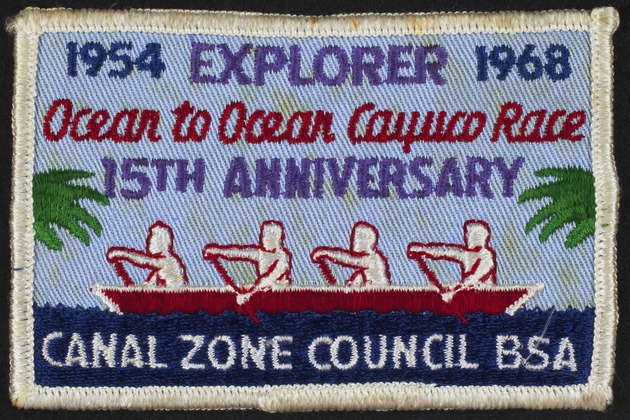
Here is a race patch from 1968 commemorating the event’s 15th anniversary:
According to race histories, the first known named cayuco was the Tequila in 1958, named after the popular song at the time. As the annual competition grew in popularity, so too did the naming of the cayucos, with some becoming legendary and their stories well known.

The crew members of Tequila are from front to rear: Jay Bialkowski, Danny Smith, Gary Irving, and Frank McLeod. The picture was taken in front of the Cristobal Yacht Club (American Legion) by A.B. Cooper CZ Police Sgt. Some of the early popular names came from Wes “Red” Townsend, who started the Ocean-to-Ocean Cayuco Race and was the Post 3 advisor. Frank Townsend shares that his father loved to name things and he spoke Spanish, so naming the cayucos was a fun activity that came naturally to him. Two of these cayuco names were the Cojeme si Puedes (“Catch me if you can”) and the Te Coji (“I caught you”). The glory days of Cojeme si Puedes came early on when Eddie Dolan, Steve Gorham, John Turner, Bobby Adams, and later Mike Rudge helped lead the cayuco to victories in 1959 and 1960.

Some cayucos even carried names that were deeply personal, like the Homer’s Folly. This cayuco was raced in 1962 with a Gamboa Ship 10 crew. Harvey Watkins later explained that his father Homer spent months working on this cayuco to get it into a shape where it was unbeatable with the right crew. Henry’s brother Norman recalls that people in town thought the cayuco was “Homer’s folly,” especially since Gamboa hadn’t placed in the race in years, but teammate Mit Parsons though it’d be a great name for the boat so it stuck. Because 1962 was going to be the last race for them because three of the crew were seniors, they decided to go all out and practiced almost every day after school including weekends. Their hard work paid off and the crew went on to win the race! Unfortunately, the cayuco mysteriously disappeared after and was never to be seen again.
Though the races were full of triumphant memories, it didn’t always go the way the crew planned. Another former Zonian and racer, Ted Albritton, recalls that also in 1962 while leading the race (presumably in the Diablo), he passed out several times on the second day and had to be loaded onto one of the escort boats. Then at Gamboa, while awaiting the arrival of the rest of his crew, he broke out in a rash all over his body and was diagnosed with chicken pox. He says that it was “one of my saddest experiences during any of the five races I participated in.” Nevertheless, according to race records, the crew of Diablo still placed 2nd!

1st place banner for the 1965 Ocean to Ocean Cayuco Race Other cayucos became tied to the memories of the race itself. During the 1967 race, El Toro became known for constantly swamping in the water. Race coverage joked that the crew claimed to have swamped their cayuco 30 times throughout the race! Another notorious cayuco was the Slave Galley, a whopping 43-foot patch boat which had a crew of 14 boys, making it the largest cayuco entered in the race. It ended up placing first in the patch boats.

The crew pictured from left to right: John Borrero, Wesley Braswel, Alex Esparsa, Hap Pruit, Coleman Anderson, Stanley Wright, Paul Vino, Jim Thompson, Larry Quinn, Mike Beattie, Ray Beattie, Fred Webster, and Pat Donaldson. The cayuco, El Bejuco, dominated for several years, winning for the 4th consecutive time with a time of 6:36:40. It was manned by Wayne Albritton, Robert Donley, Marshall Harris, and Robert Hughes. Boats like El Ron Corredor came in second right behind El Bejuco.

The crew of El Bejuco and El Ron Corredor pictured from left to right: Pat Fallon, Robert Donley, Wayne Albritton, Ron Farnsworth, and Barry Douglas. In The Story of the Due Process, Hobey Richey explains that for the 1975 race, Mr. B. Paul and Mrs. Beatriz Broussard volunteered to have their home in Balboa serve as headquarters for all things related to the cayuco race for Ship 8 Explorers. Their kids became involved, with Carlos, Mary, and Craig having their own cayuco and crew. Hobey Richey recalls that Carlos practiced in and presumably planning to race in El Bejuco. But Mr. Broussard, with the help of an Indigenous Embera friend, was working on a new boat that would be longer and narrower than the usual cayuco. It wasn’t until about a month before the race that the cayuco arrived at the Broussard household, but it still needed major work so everyone was hands-on working on it until it was race-ready. This vessel was much faster than El Bejuco, and Mr. Broussard named it the Due Process, explaining that by “doing the right thing, along with hard work and perseverance, just rewards would prevail.”
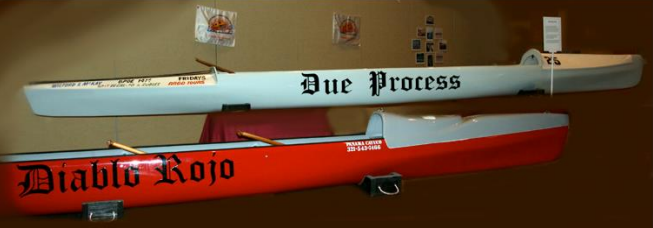
The Due Process and Diablo Rojo cayucos on display. By the 1980s and 1990s, cayuco names became even more creative and reflected the humor and personality of the crews, with names like Situation Hopeless, Misconception, High Anxiety, Chaos, Command Performance, Utmost, and Dear Dick. The 1980s was also a turning point for female racers as more were participating, with Situation Hopeless winning the all-girl crew trophy in 1986. And in 1993, Dear Dick defeated High Anxiety in the women’s competition. A separate blog post highlighting women racers can be found here.
Here is a fun photo from the 1989 race in the 1990 Zonian yearbook of a female crew (crew name and boat name unknown):

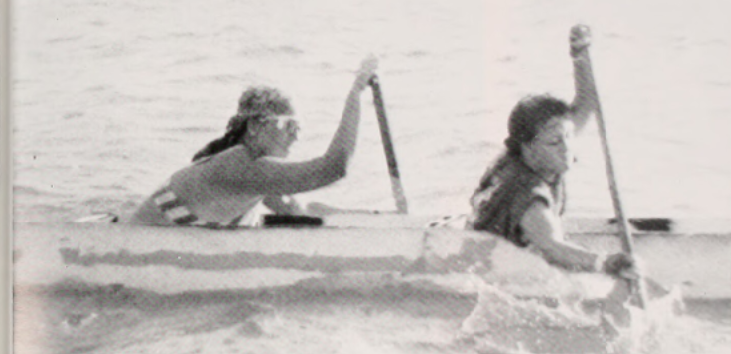
Dear Dick: Stephanie Helin paddles as Katie Goodwin “draws” to turn a corner. –Zonian, 1991 The same year, Spontaneous Combustion won the timed sprints race with a record-breaking time of 2:04:16 and celebrated becoming part of cayuco history.
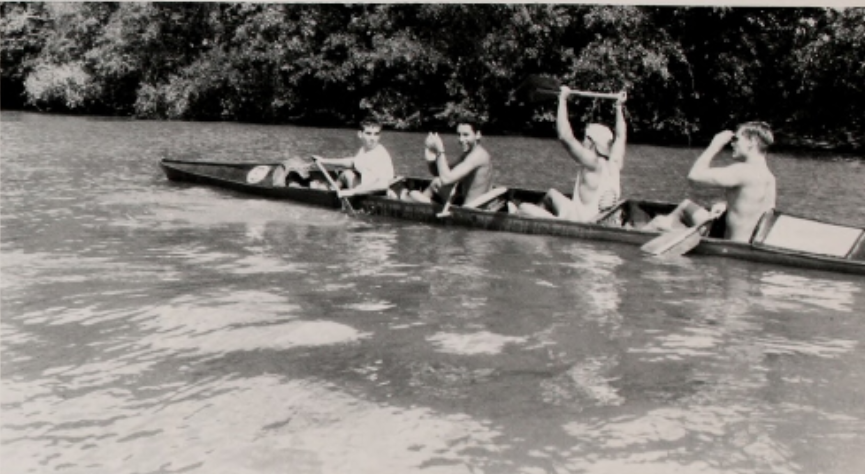
The Crew of Spontaneous Combustion celebrates after breaking the record. Scott Leffler, Ivan Rodriguez, Tim Michelle, and Tony Bieker felt triumphant. (Photo courtesy of Tropic Times) Here is a collage of the 1997 race along with cayuco names from the Zonian yearbook:
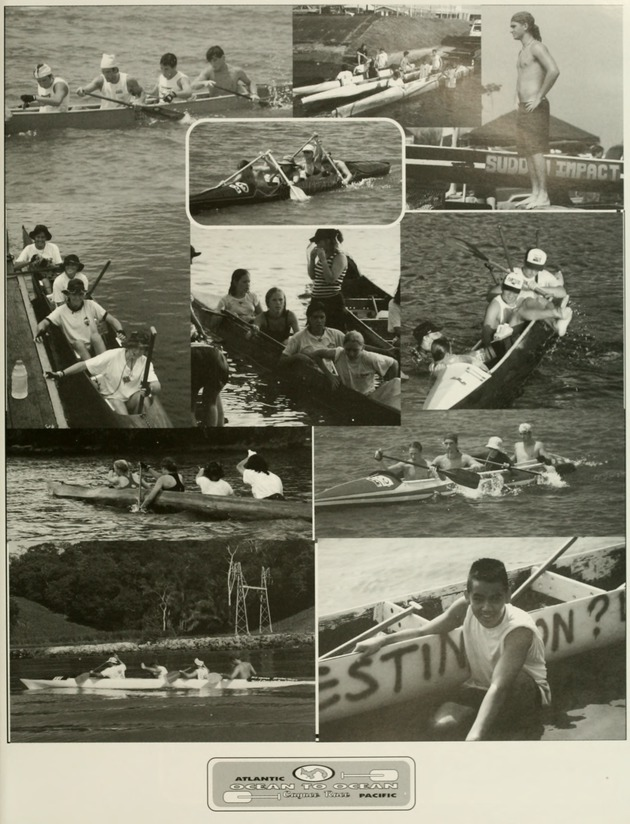

It is clear through the memories of the Ocean-to-Ocean Cayuco Race, that cayuco names are humorous, competitive, dramatic, and playful, and each became a part of Canal Zone life. Even years after these races, many of those involved still remember the winners, cayuco names, and the memories they hold.
You May Also Like
George Stratford Seymour Cockburn
