
Sidney Young
This post is part of a pilot student project created for the University of Florida class, Raising History from the Grave: Primary Historical Research in Literary Analysis and Public Humanities taught by Dr. Leah Rosenberg. The students focused on members of the Black Caribbean diaspora who worked on the Panama Canal or in the Canal Zone, the U.S. territory that surrounded the Panama Canal for much of the 20th century. These employees were originally classified as Silver employees because they were paid in silver currency as opposed to the Gold employees who were American citizens paid in gold currency. The term is still used today by both the community and scholars. The students worked with Pan Caribbean Sankofa, a community organization dedicated to preserving the history of Caribbean people in Panama, who identified community leaders as subjects for the project. Students consulted a wide array of archival materials in the Panama Canal Museum Collection and other institutions and learned how to use these resources to highlight individual accomplishments and connect lives to their larger communities through the digital humanities. For other posts, see Raising History from the Grave.

Childhood and Education
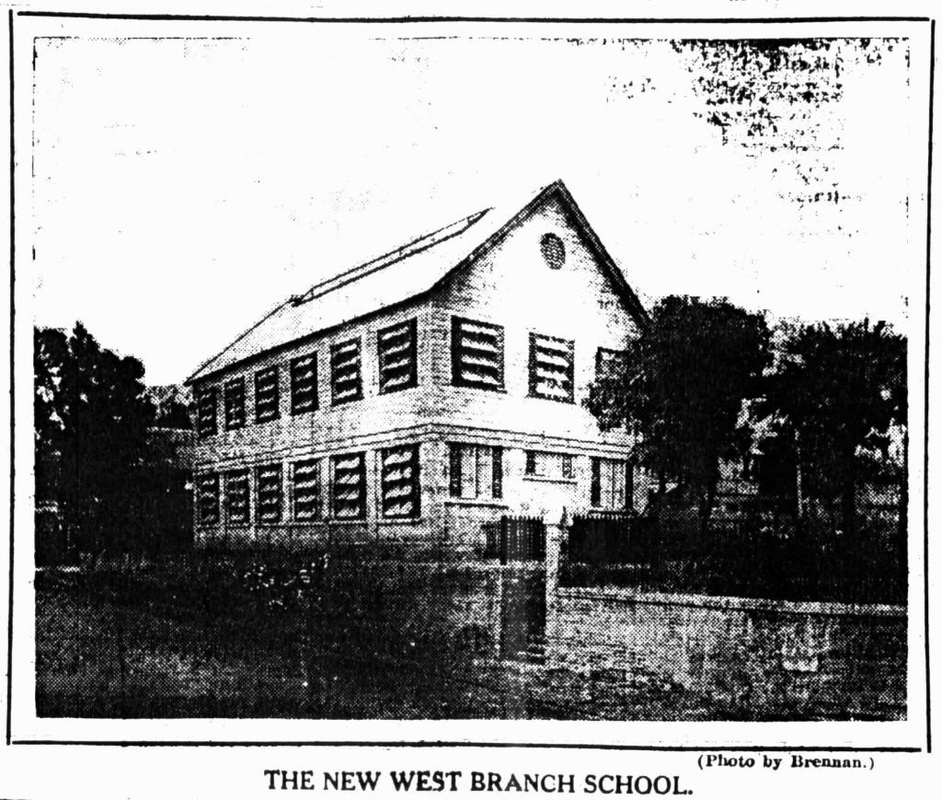
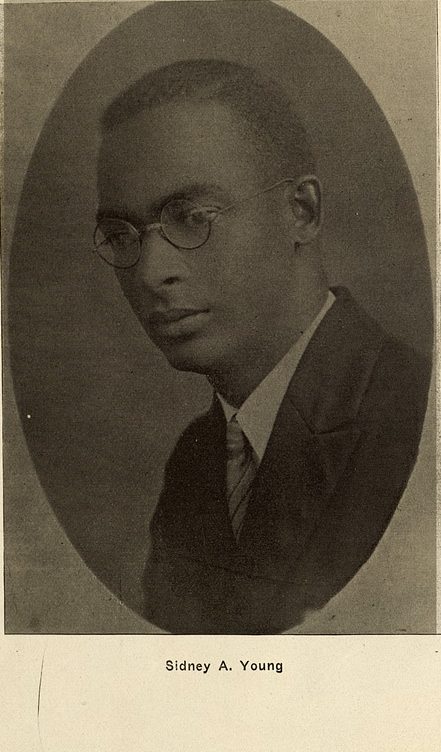
Sidney Adolphus Young was born in December 1898 in Kingston, Jamaica, to Thaddeus Augustus Young (a cabinet maker) and Sarah Elizabeth Young (a farmer’s daughter). He and his parents moved to Panama in 1906, but his parents sent Sidney back to Jamaica for education. He attended West Branch Elementary School from 1908 to 1911, pursuing private studies in Classics and Social Studies (“Sidney Young” 1-2).
West Branch Elementary was “if not the foremost, one of the foremost schools in the Island” (“Mr. A.L. Walcott” 6) in Jamaica. While Sidney was in attendance, West Branch was under the leadership of A.L. Walcott and had “a first class position” as well as the “largest [attendance] in the island” (“An Honoured Son of the Soil” 8). The school held concerts, competitions, and celebrations, both for the cultural enrichment of the pupils and the benefit of the larger community (“West Branch School” 11, “West Branch, Kingston” 9). The fact that Sidney went to school here speaks to the socio-economic status of his family and explains why he was sent to Jamaica for schooling.
While the school Sidney attended was quite exceptional, the elementary educational system in Jamaica was less than ideal. The pupil-teacher system, where teachers would apprentice students, led to a lackluster standard of education. These apprentices, often around 13 years of age, would observe teachers and eventually teach younger students in the hopes of becoming elementary school teachers one day. This system neither provided adequate training nor produced effective teachers. Teachers were authoritative, and the curriculum was mainly comprised of rote memorization of the 3 R’s: reading, writing, and ‘rithmetic (Jeffrey 202-3). Additionally, the schooling system was fraught with racial and class divisions. Lower-class black children were taught less material than middle-class children (the social group to which Sidney Young’s family belonged).
For the lower class, elementary schooling was more a method of social control than a way of instruction. Their education was intended to occupy them and discourage them from criminal activity (228). The education of upper-class children was designed to infuse them with loyalty to England and “intellectual, cultural, and technological orientation to the mother country” (200). Middle-class children like Sidney were caught in the middle. He would have been treated better than his black peers and thus be instilled with a sense of superiority. He would also have been suffused with loyalty to England and all that entailed, but he and his family were still far from the upper class in regard to power and wealth.
Career Before Journalism
In his teens, Sidney Young returned to Panama. He worked in the canal zone as a messenger, his first and only job in the canal zone. In 1916, he apprenticed at a printing business as a printer’s devil. He also worked for both a mercantile company and a bakery (Putnam, Sidney Young 2). He was also heavily involved in civic life in the West Indian community. He was for instance, a Boy Scout. Throughout his life, he remained a staunch supporter of scouting in Panama. He became a scout leader, and later on, he even made a space for the regular publication of scout-related articles in the Panama Tribune’s weekly “Scout Corner” when he founded his own newspaper (Putnam, Sidney Young 2, To Study the Fragments 624).
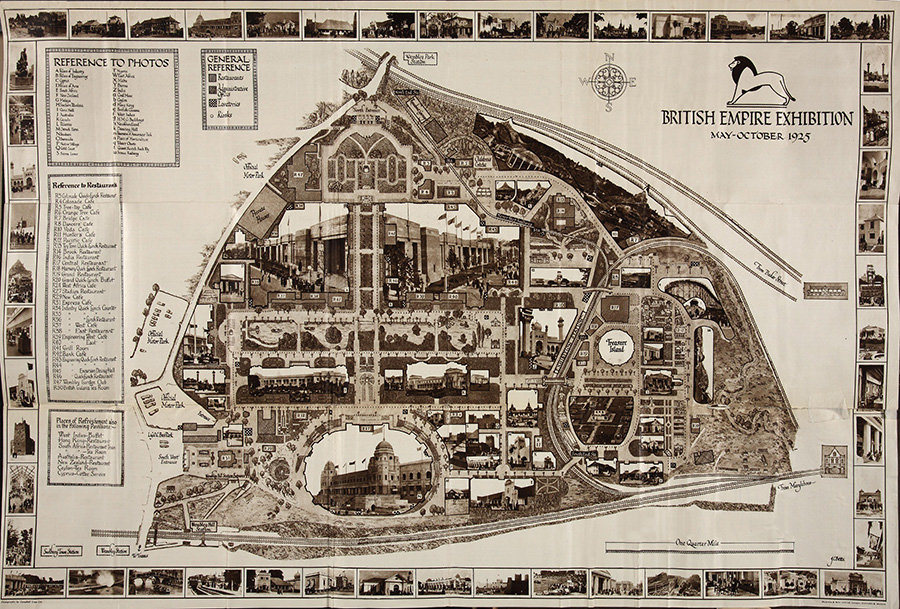
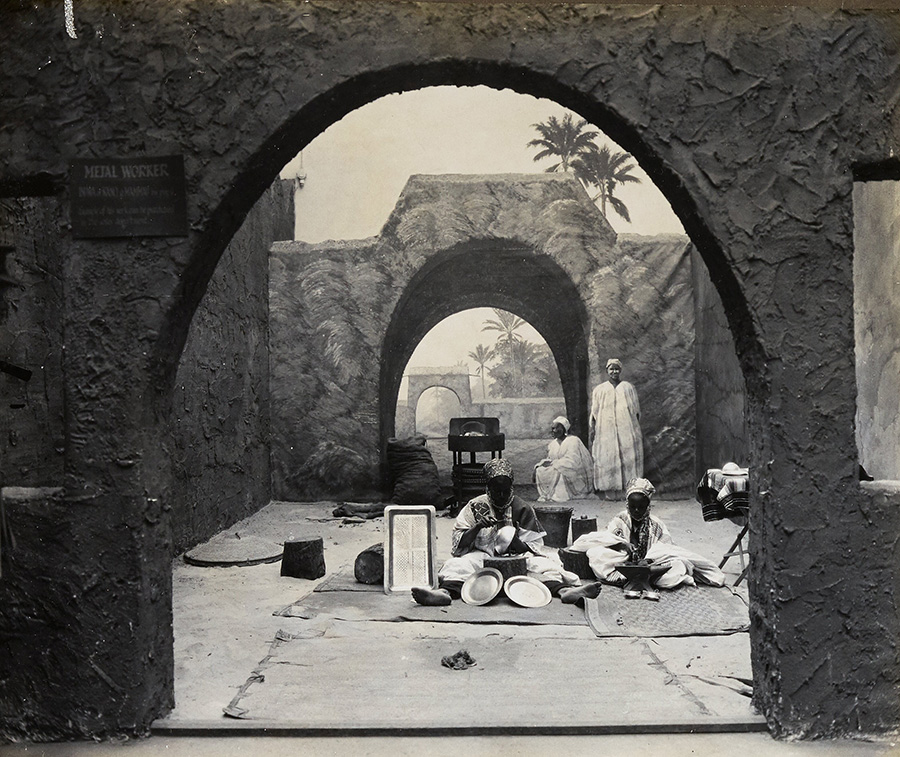
In 1924, Sidney Young led a group of 17 scouts to the Scouts Imperial Jamboree at the Wembley British Empire Exhibition. A newsreel by Topical Budget entitled “Greatest Jamboree, Wembley”, depicts the celebration. On his trip, Young was part of a parade of 640 scouts who were greeted by and congratulated by King George V for their appearance and discipline. In his speech, he communicated that being a scout makes a boy a better citizen of the empire and that the children would learn more in one week at the exhibition than one year back home. The Chief Scout, Sir Robert Baden Powell, spoke after him. He encouraged the boys to learn as much as possible about England, taking home the good parts and keeping the bad parts to themselves (“British King Addresses Over Seas Boy Scouts” 1, 8). The entire purpose of the British Empire Exhibition was to reinforce colonial racial hierarchies. Through the education of youth, they hoped to strengthen trade ties and build connections within the empire, enhancing Britain’s hold over their colonies (Ryu 55).
Journalism Career
According to Lara Putnam, Young’s journalism career began in 1924 with Central American News, where he worked as a proofreader and an assistant manager. In 1925, he switched to being a reporter in the Panama Star & Herald where he remained until 1926. He also got married to Mita Spencer in 1926. They had a son, David Antonio Young, as well as an adoptive daughter, Claudia Wilson. After working at the Panama Star & Herald, he became the cable editor of the Panama American and the chief editor of the “West Indian Page.” Young was the person who suggested the Panama American should have a “West Indian Page” and insisted they create one for the newspaper. Young was also involved in the management of the Panama Times’ “West Indian Page,” of which he was the editor from 1926 to 1927 (Sidney Young 2, 3).
During his time at the Panama American, Young published Isthmian Echoes in 1927. The book was a compilation of articles from the “West Indian Page” of the Panama American. This means that Sidney Young personally edited and picked these articles himself. He also added articles from his column “Sid Says,” where he expressed his opinions about the West Indian communities in Panama and their treatment to all his readers.
SID SAYS
In this particular section, we are able to find many of Young’s political views. After seeing “El Ch*mbo es un engañadizo y todo el mundo lo engaña.” written on a building (Translation: “The West Indian is a fool and all the world fools him.”), Young wrote “Engañadizo” in response. In this editorial, he agrees that West Indians are foolish, but he redefines the phrase to prove a point about economic solidarity in the West Indian community. Young states that West Indians spend all of their money on useless trinkets and raffles from people outside of their community rather than spending it on people in their community. He claims that people, “Nordics, Jews, Chinese and Hindus,” are infiltrating their spaces and may even begin taking businesses from them (224). Young calls for West Indians to spend their money more wisely and to go out of their way to support West Indian businesses rather than disparaging them. He later includes in his newspaper, The Panama Tribune, “BE READY TO BUY PANAMA TRIBUNE STOCK For Community Progress and Personal Profit” which emphasizes his belief that the community should literally be investing in West Indian Businesses to support them. In this way, West Indians would support only the people that support them and cycle money throughout their community
“On the other hand let any ambitious West Indian, willing to start from the bottom up, display a like enterprise and he would be spurned by his own people with the remark that ‘Him want to get rich quick.’”
– Isthmian Echoes, 224
Young has another editorial named “Pastures New,” which expresses his worry about what will happen to the West Indian community if their most talented youth all leave. This was following the writer Winslow Gaskin’s departure. He claims talented and skillful young people abandoning their hometowns leave their communities stagnant. Young, nonetheless, wishes Gaskin the best and says he knows he will be a valued writer in New York. This displays Young’s focus on creating progress for his people. Young wants to help his people progress politically, socially, and culturally.
“I do not know what will happen to our community, friends and countrymen, if all out talented youngmen leave the old homestead for pastures new and greener fields”
– Isthmian Echoes, 232, 233
In “The Federation of West Indians,” Young writes about a possible federation created to unite the islands in the West Indies. He supports the idea and believes that this unification will be a step towards progress. This assertion demonstrates his belief that people across the British West Indies should come together and fight for their rights and move towards progress as a unit rather than divided. He expressed his disappointment in West Indians on the Isthmus who continue to be jealous and insult one another and acknowledged that these prejudices would make it difficult to create a federation, but held strongly that it would be the path to a better future for British West Indians. From this editorial, we know that Young disapproved of island rivalries and believed in a cohesive front against the oppressive powers.
“Federation would bring about a uniform system of government, education, customs, tariffs, closer commercial interchange and social intercourse, which without the slightest shadow of a doubt would redound to the prosperity and progress of the islands”
– Isthmian Echoes, 291
His editorials give you a very clear look into what Young thought about his community and how he envisioned progress would look like. Overall, they focus on the betterment of the people and cooperation with one another that he called for. He called for West Indians to uplift each other rather than feeling like they were competing.
Panama Tribune
In 1928, Sidney Young founded the Panama Tribune, a West Indian Newspaper, as a response to racist Panamanian policies being passed at the time and to receiving unequal pay in comparison to his white counterparts while working at the Panama American (Corinealdi 32). He wanted this newspaper to empower the black community in Panama. However, the reach of the Panama Tribune was much greater than just Panama. The paper managed to make its way to the US, Jamaica, Guatemala, Honduras, Costa Rica, and Peru (Corinealdi 35). It also became the “longest-running Black Newsweekly in Central America” (Corinealdi 1).
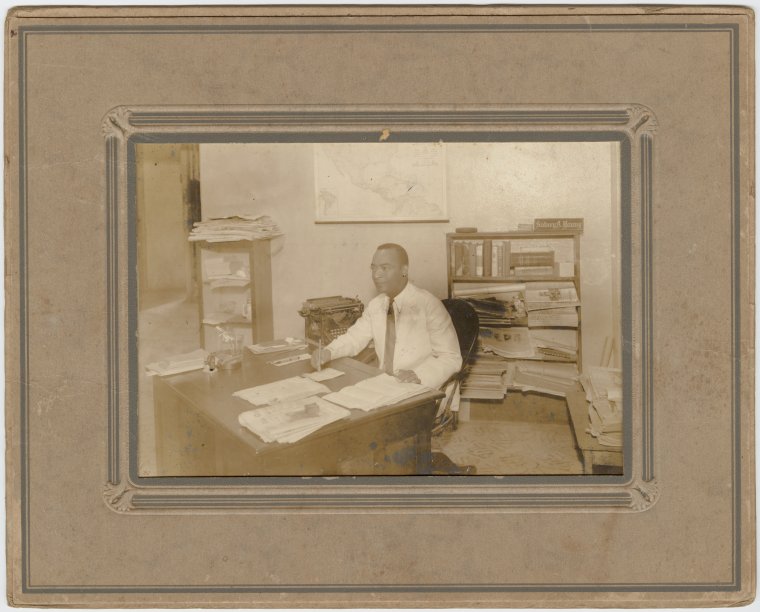
This paper was also unique in that it was staffed by immigrants from the Caribbean and their descendants (Corinealdi, 31). The newspaper was made by Caribbean immigrants and for Caribbean immigrants. This allowed the paper to cover the news from Panama and black diasporas worldwide that West Indians in Panama wanted to hear about (Corinealdi, 30). Only one page devoted to West Indian affairs like the Panama American was insufficient due to the lack of space and could not cover both local and international news. Through these papers, the African diaspora could connect and keep up with each other. Communities within Panama also had the opportunity to be spotlighted in the paper (Corinealdi, 37). More minor news regarding local occurrences pertaining to the West Indian community was added, which further let these communities connect with one another. Readers could also send letters and be published regardless of whether they agreed with the paper or where they were from. If they could send it to Panama, there was a chance it would get published. Young spread news, educated and helped those who read his paper connect with one another. This created a sense of community between everyone and helped empower people across the diaspora.
Panama Tribune Exhibit
(All images of the Panama Tribune were taken from the Library of Congress)
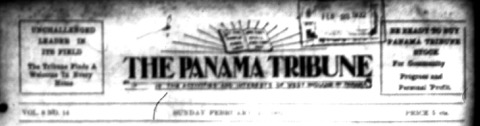
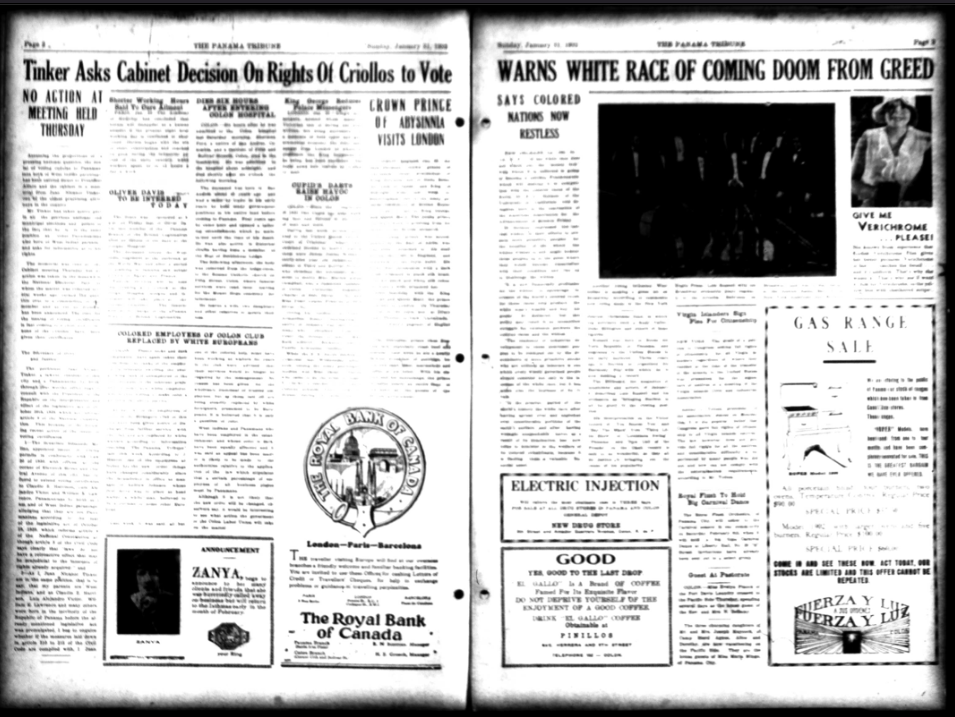
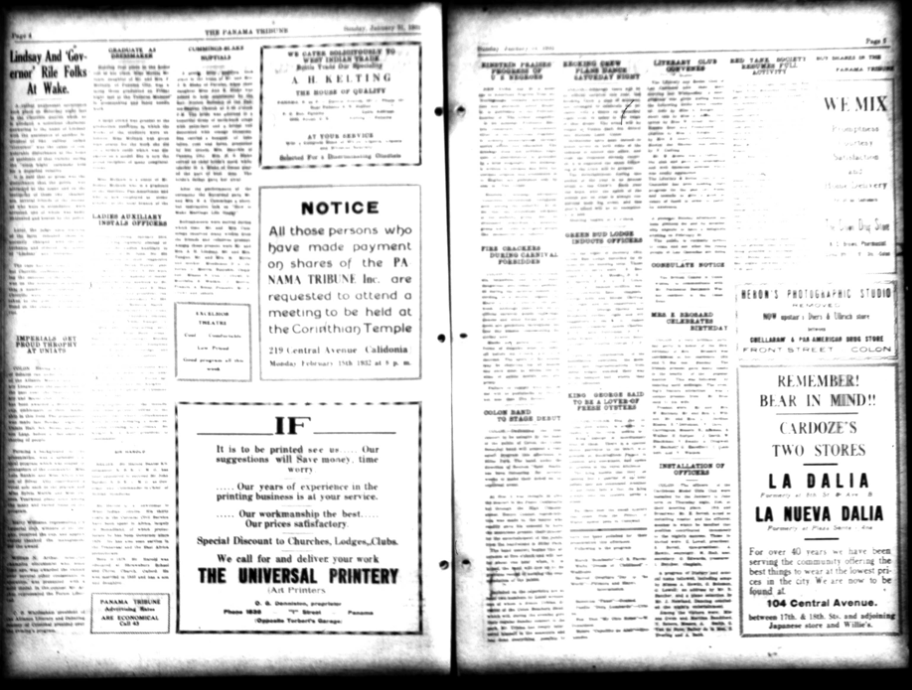
Pages one through five are typically general stories that could focus on a range of topics, for example, Panamanian significant issues, international news, and noteworthy events within the African diaspora. These stories have no specific trend, unlike those in other sections. Some examples of headlines include “Tinker Asks Cabinet Decision On Rights Of Criollos To Vote,” “Crown Prince Of Abysinnia Visits London,” and “Lindsay and ‘Governor’ Rile Folks At Wake”

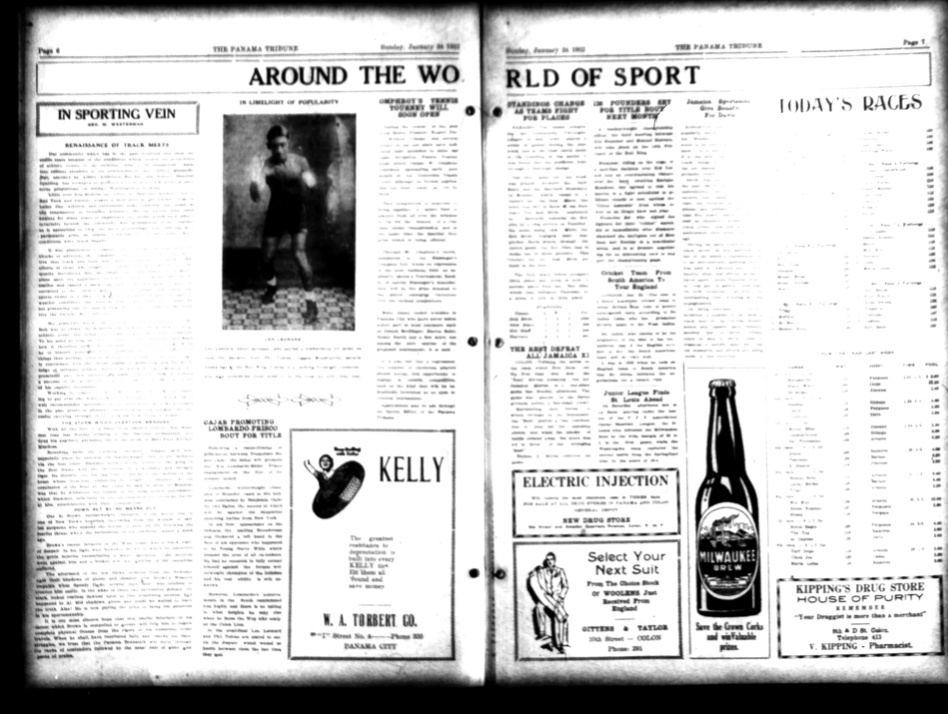
Pages six through seven are called “Around the World of Sports.” Some sports mentioned were baseball, track, boxing, tennis, horse races, and cricket. The newspaper will also sometimes choose to highlight an athlete in a mini section called “In Limelight of Popularity.” If you look below the word Around, you will see an image of one of these athletes. They also include a section called “Today’s Races.” Races here refer to horse races. They include the horse name, weight, jockey, time, and pool for the race that week and the prior week.

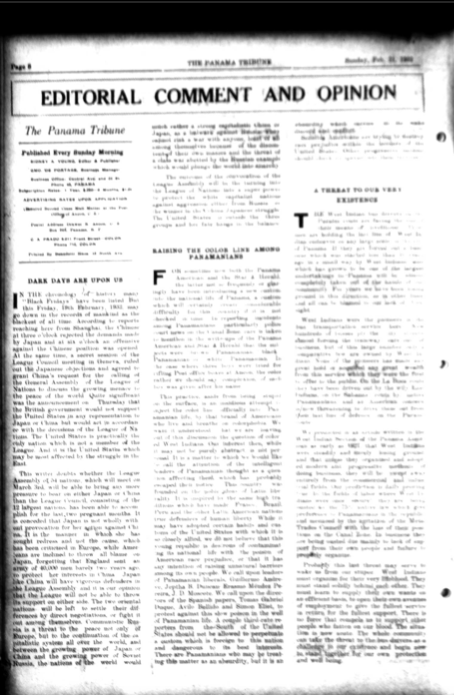
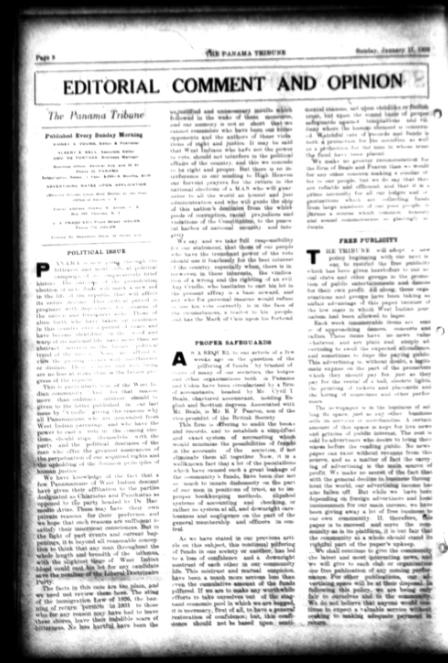
Page eight is called “Editorial Comment and Opinion.” This largely echoes his column Sid Says since this would be where he added his political and social views. Some titles from this include “Dark Days Are Upon Us” and “Free Publicity.”

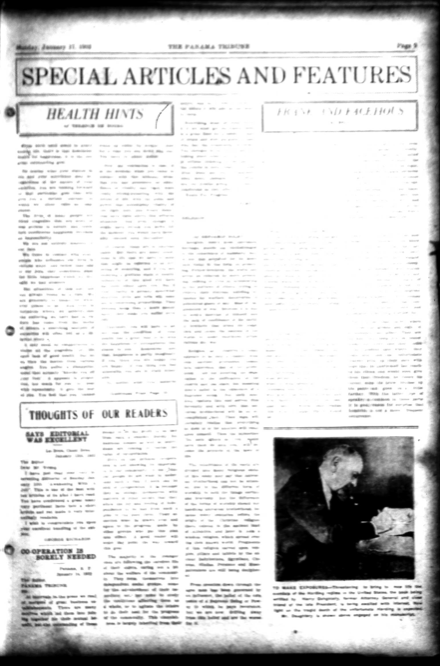
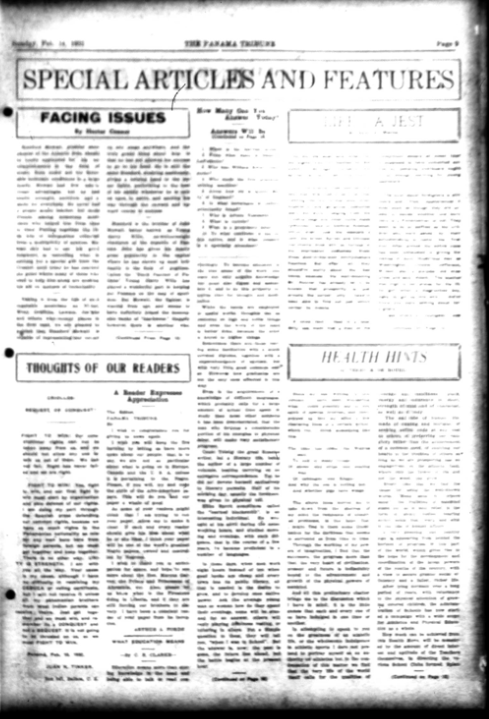
The next page is “Special Articles and Features.” This page has a few rolling topics. They seemingly always have “Health Hints” and “Thoughts of Readers.” In the latter, they publish letters sent to them by readers. Their letters could stretch out as far as New York or be from Panama. This demonstrates the paper’s reach at the time of printing. An example of one of the sections that came and went would be “Our Weekly English Lessons.”

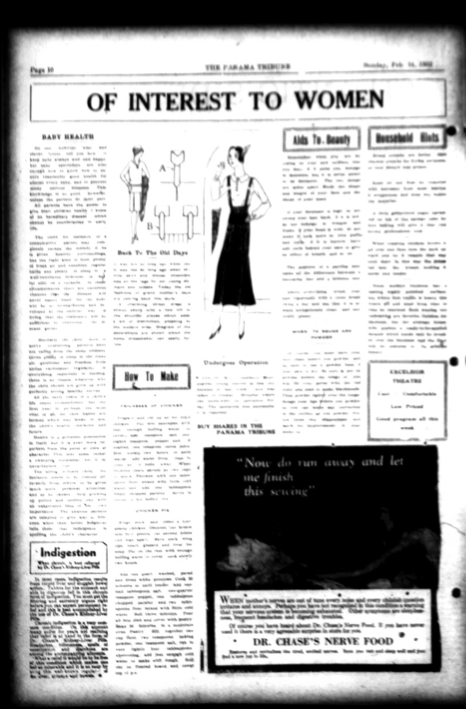
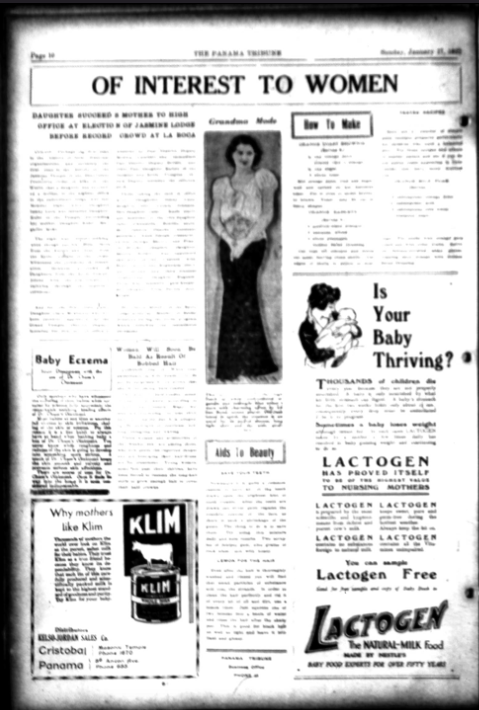
Page 10 is referred to as “Of Interest to Women.” Some articles found in this section were “Aids to Beauty,” “How to Make” (recipes), “Household Hints,” etc. This page largely concerns parenting, beauty, housekeeping, and style. While this seems stereotypical, we see this newspaper highlight the accomplishments of Black women around the world, for example, the potential Olympic entrance of a “colored” girl (Tribune, 10).

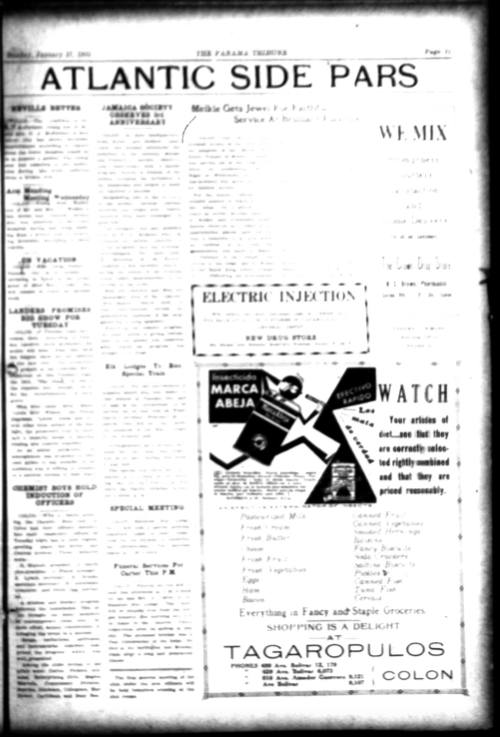
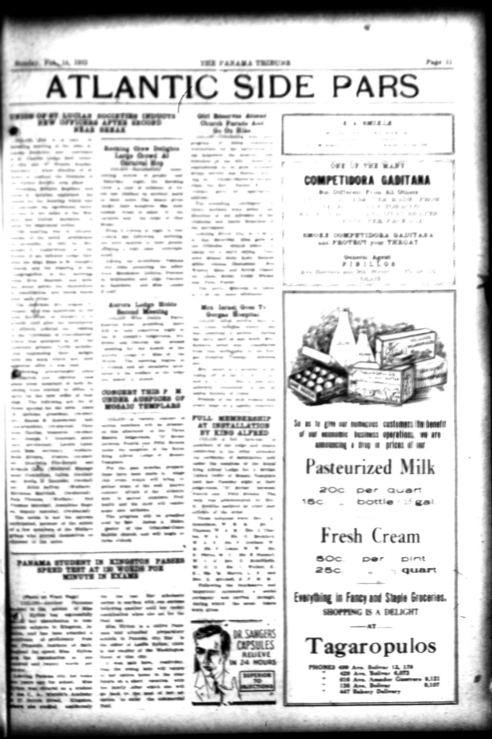
Page 11 is called “Atlantic Side Pars” and appears to be about what is happening around Colón. This would make sense since Colón has Panama’s largest African descendent population (Corinealdi).

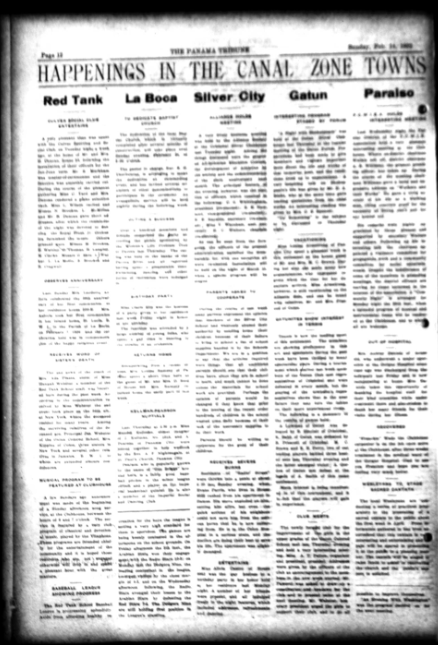
The 12th page contains the “Happenings in the Canal Zone Towns.” The subsections here are referred to by the name of the towns they are talking about. They talk about meetings, news, balls, etc., in Gatun, La Boca, Silver City, Paraiso, and Red Tank villages.
Page 13, with no heading at the top, usually contains a continuation of “Health Hints” and “Thoughts of Readers.”

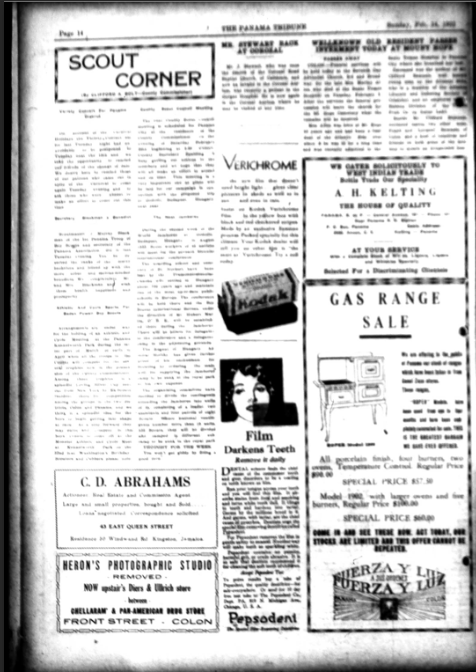
Page 14 was called “Scout Corner.” This seems to be general club meetings and community affairs, not all having to do with Boy Scouts.

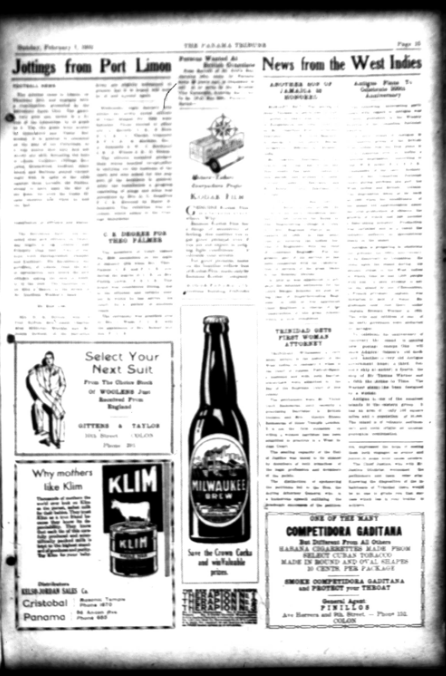
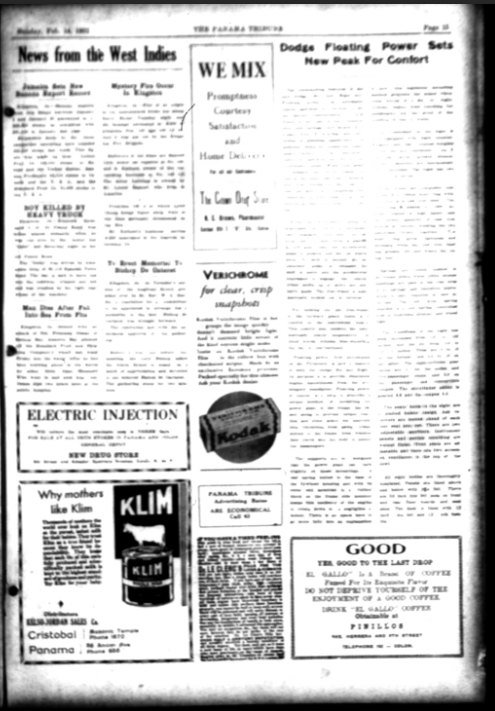
“News From the West Indies” appeared on page 15. This makes sense since the majority of the Panama Tribune’s readers are typically from the West Indies and likely have family there. The “News From the West Indies” section can include death notices and reports of local occurrences in West Indian islands. Page 15 also sometimes includes “Jottings from Port Limon,” which similarly documents local occurrences within the West Indian community in Costa Rica, where Port Limon is.

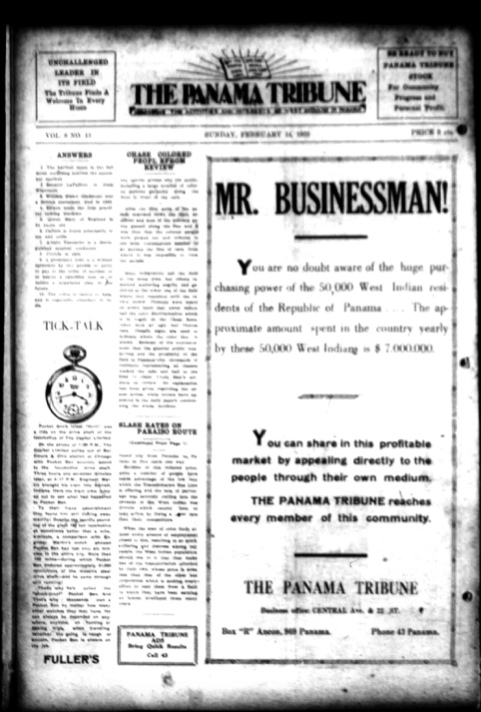
The final page contains continuations from the first page.
Timeline

Legacy
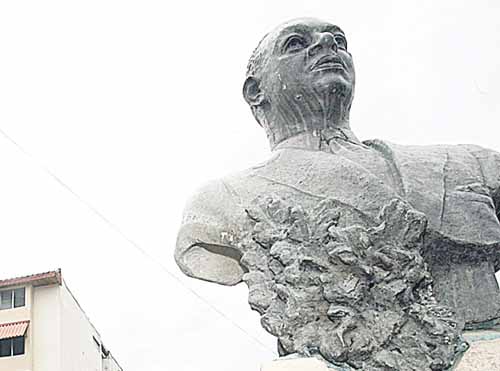
After a long career devoted to West Indian journalism, Sidney Young died in Panama City in 1959 at the age of 61, leaving behind a rich legacy. His reach was incredible, and it is no wonder why he is still talked about to this day. He described himself and those working with him as people who would “ bring light” to help their communities move towards “progress” (Corinealdi, 29). He did this through fostering a strong community with his newspaper.
Sidney Young has had an incredibly large impact in Panama with a park named after him with a bronze bust in Rio Abajo. The park and bust signify his lasting impact in the black diaspora in Panama. The dedication he showed to his community throughout his life lives on through the beneficial impact this park has had on the citizens in Rio Abajo.
There is also a community center in his name called el “Centro De Desarrollo Comunitario Sidney Young.” This center can be rented out for parties, hosts cultural festivals, and even has free classes for children and adults. A mural was recently painted on the side in 2022 where young kids helped a painter to create a beautiful quetzal.
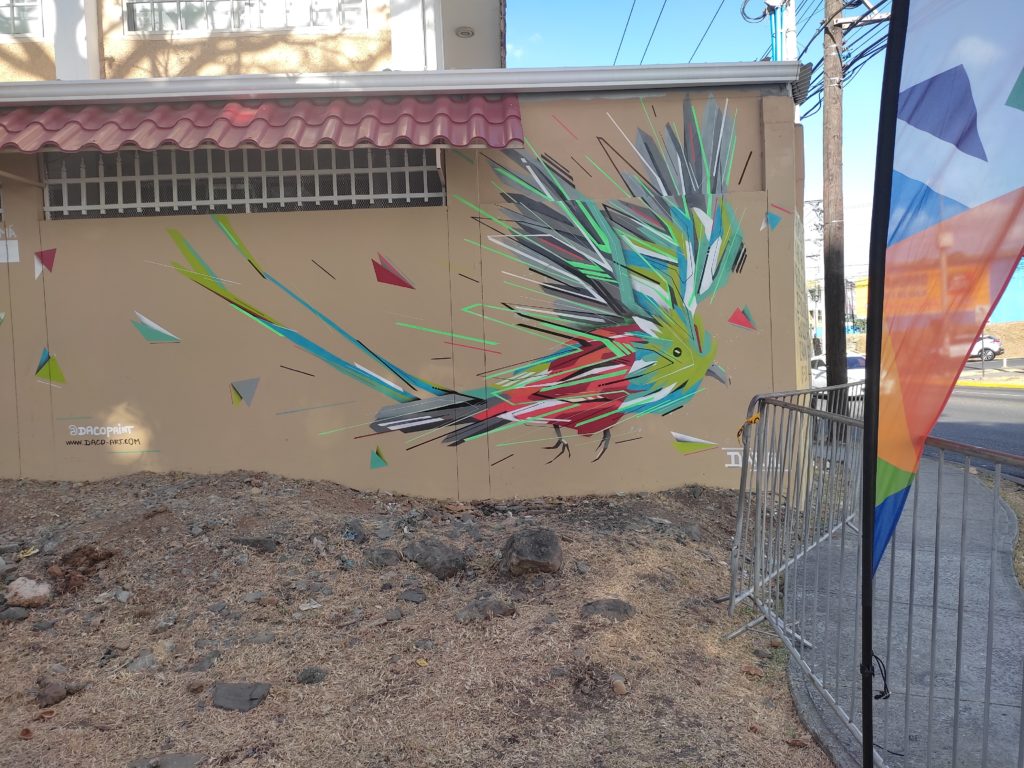
It is very apt for this center to be attached to his name since his feelings around the importance of community rang loudly in his writing. His articles around West Indians in Panama called for a tight knit community that worked for the interests of everyone and the Panama Tribune played a large role in pulling together and informing the West Indian community. This plays a larger part in the empowerment of black people all over the world since the Tribune made it to black diasporas around the world. The sharing of information across the world allowed communities to feel more connected to one another. He brought light to communities that were largely ignored by white audiences and pushed for them to help themselves.
Works Cited
“An Honoured Son of the Soil.” Jamaica Gleaner, 6 Apr. 1897, p. 8.
“British King Addresses Over Seas Boy Scouts.” The Workman, Vol. 13 No. 2, 23 Aug. 2024, pp. 1–8. DLOC.
Brennan, James William Charles. “The New West Branch School.” Jamaica History, https://jamaica-history.weebly.com/west-branch.html. 11 April 2024.
Corinealdi, Kaysha. Panama in Black: Afro-Caribbean World Making in the Twentieth Century. Duke University Press, 2022, https://doi.org/10.1515/9781478023128.
Howells, Katherine. “‘A Vast Window Display’: The British Empire Exhibition of 1924-5.” The National Archives, 23 Feb. 2022, https://blog.nationalarchives.gov.uk/20speople-a-vast-window-display-the-british-empire-exhibition-of-1924-5/.
Jeffrey, Duncan. EDUCATION ECONOMY AND CLASS IN COLONIAL JAMAICA 1700-1944. 1980. McMaster University, https://macsphere.mcmaster.ca/bitstream/11375/7659/1/fulltext.pdf. macsphere.
Kingston. Marriage Records 1892 • FamilySearch. familySearch, 22 Dec. 1892, https://www.familysearch.org/ark:/61903/3:1:33S7-95JB-9SLW?view=index&personArk=%2Fark%3A%2F61903%2F1%3A1%3AKP1W-MXT&action=view.
Martin, Henry. ‘One, Two, Three, Four, Colon Man a Come.’ 28 Sept. 2014, https://jamaica-gleaner.com/article/focus/20140928/%E2%80%98one-two-three-four-colon-man-come%E2%80%99.
Mgpp .::. The Marcus Garvey and UNIA Papers Project, UCLA. UCLA Africa Studies Center. https://www.international.ucla.edu/asc/mgpp/sample07. Accessed 1 Mar. 2024.
Mojica, Yaritza. “Recuperarán Parque Sidney Young.” Panama America, 16 Jan. 2008, https://www.panamaamerica.com.pa/nacion/recuperaran-parque-sidney-young-370261.
“Mr. AL Walcott: A Character Sketch.” Jamaica Gleaner, 17 Oct. 1901, p. 6.
“Mural Street Art Con Daco Paint.” Cultura, Municipio de Panamá, cultura.mupa.gob.pa/mural-street-art-con-daco-paint/. Accessed 2024.
The Panama Tribune, vol. 8, no. 9, 17 Jan. 1932, p. 1-16. Library of Congress
The Panama Tribune, vol. 8, no. 10, 24 Jan. 1932, p. 1-16. Library of Congress
The Panama Tribune, vol. 8, no. 11, 31 Jan. 1932, p. 1-16. Library of Congress
The Panama Tribune, vol. 8, no. 12, 7 Feb. 1932, p. 1-16. Library of Congress
The Panama Tribune, vol. 8, no. 13, 14 Feb. 1932, p. 1-16. Library of Congress
The Panama Tribune, vol. 8, no. 14, 21 Feb. 1932, p. 1-16. Library of Congress
Port Royal. Birth Registers 1899 • FamilySearch. familySearch, Jan. 1899, https://www.familysearch.org/ark:/61903/3:1:9Q97-YS89-MTXM?view=index&personArk=%2Fark%3A%2F61903%2F1%3A1%3AXNM9-NX9&action=view.
Putnam, Lara. “To Study the Fragments/Whole: Microhistory and the Atlantic World.” Journal of Social History, vol. 39, no. 3, 2006, pp. 615–30.
Putnam, Lara (2014) Sidney Young, the Panama Tribune, and the Geography of Black Belonging. In: American Historical Association Annual Meeting, January 2014 – January 2014, Washington DC. (Unpublished)
Ryu, JIyi. Visualising and Experiencing the British Imperial World: The British Empire Exhibition at Wembley (1924/25). 2018. The University of York, https://etheses.whiterose.ac.uk/21902/.
Schomburg Center for Research in Black Culture, Photographs and Prints Division, The New York Public Library. “Sidney Young, publisher, Panama Tribune” The New York Public Library Digital Collections. 1930. https://digitalcollections.nypl.org/items/a7d0e925-f8c4-eff6-e040-e00a18060357
“Sidney Young, Publisher, Panama Tribune.” NYPL Digital Collections, created 1930, https://digitalcollections.nypl.org/items/a7d0e925-f8c4-eff6-e040-e00a18060357.
Sidney Young Travel Documents (April 4th, 1946). https://www.ancestry.com/discoveryui-content/view/2530446:8842?tid=&pid=&queryId=e1474f80-8e32-4daf-95f0-6f3b90822de2&_phsrc=zzI1&_phstart=successSource. Accessed 26 Feb. 2024.
“West Branch, Kingston.” Jamaica Gleaner, May 29, 1908, p. 9.
“West Branch School.” Kingston Gleaner, 8 Nov. 1906, p. 11.
Young, Sidney. Isthmian Echoes: UFDC. printed by Benedetti hnos., 1927, https://ufdc.ufl.edu/aa00014955/00001/images.
—. “The Panama American, West Indian Section.” Panama American, 915th ed., 21 Apr. 1928, p. 6. dLOC.
Authors


You May Also Like
