-
Charting the Course – Part One
In 1971, an unassuming sailboat was towed into Panama Canal waters. Little did anyone know that it would cause quite a stir, take blood, sweat, and tears, and win the hearts of the Canal Zone community.

Chief Aptakisic on Lake Erie off Toledo, Ohio on the way to Halifax Nova Scotia and beyond. September, 1970. II.2019.999.439 There is a bit of mystery surrounding the exact details of its arrival, arrest (yes, arrest), and change of ownership. Stories and documents don’t always line up, so the “truth” could be lost to us, but this year’s fall blog series will do a deep dive into the collection to explore the journey of the Chief Aptakisic, a 53-foot ferro-cement schooner, from construction, to its restoration and second life in the Canal Zone, and finally its participation in Operation Sail ’76 to celebrate the Bicentennial of the United States.

Chief Aptakisic and crew in the waters off Balboa, 1976. Chief Aptakisic Scrapbook. II.2020.10.1 But lets start at beginning of Chief Aptakisic‘s story, 2019 nautical miles from the Panama Canal, in Illinois.
Chief Aptakisic was launched near Chicago in 1970 by Russell Thomas Ekelman and his son Tom. They were both carpenters and built the boat themselves. While working on this blog post we tracked down an August 1968 article from the Highland Park Herald, their local newspaper, that revealed a great deal about their project.
Expand to learn about the naming of Chief Aptakisic.
In a newspaper article from the Highland Park Herald on August 6, 1969, Russell explained his understanding that schooners were traditionally named after Native Americans.
In a letter from our collection dated April 26, 1976, Russell Ekelman described the story of naming the boat after Chief Aptakisic. Included in our files with the letter were pages from the book Indian Place Names in Illinois by Virgil J. Vogel that offer additional information. The village Aptakisic in Lake County, Illinois near Chicago was “named for a Potawatomi chief who lived in various localities west and north of Chicago. He had a reuptation as an orator, and his name appears in five treaties between 1827 and 1846. His name means “Half Day,” alternatively rendered as “sun at meridian” or “center of the sky.” The name was reportedly given him because he performed in a half day some tasks or journey normally requiring a full day.”
In a news story posted on their website for National Native American Heritage Month on the website of Trinity University elaborates even further:
The main campus of Trinity International University is situated on Half Day Road in Deerfield, Illinois. If you ask most locals, they’ll tell you its name comes from the days of horse-drawn transportation when it took half a day’s ride to get there from Chicago. Actually, the name is much more significant. Half Day Road was named for Chief Aptakisic, a Native American leader of the Potawatomi Nation. His name was translated literally as “Center of the Sky,” “Sun at Meridian,” or “Half Day,” so he became known to early Illinois settlers as Half Day. Lake County’s first permanent white settler, Daniel Wright, wrote that Chief Half Day and his tribe were kind and welcoming. They helped the settlers build their homes, plant and tend their crops, and even care for ill family members. Chief Half Day embodied the traditional Indigenous value of welcoming others. Henry Blodgett, the son of an early Illinois pioneer, wrote that Chief Half Day saved the lives of his family and other settlers from an attack during the Black Hawk War in 1832. He wrote the following:
There had been a council held that night at West Valley where Aurora now stands, between Black Hawk and a band of chiefs of the Potawatomi and Winnebago. They had been urged to join with Black Hawk’s tribe in a general attack upon the white settlements in northern Illinois, but they refused. As soon as the council broke up, [Chief Half Day] had mounted his horse and [rode] as fast as he could by way of Naper Settlement to give the alarm so we might get away.Chief Aptakisic (“Half Day”) was also present at the signing of the Treaty of Chicago, negotiating for his people and reluctantly accepting the terms to move them to lands west of the Mississippi River. This treaty forced Indigenous people from three nations to give up their homelands. While they were promised compensation, this final land grab was a mortal blow to the heart and soul of the regions’ Indigenous peoples. Blodgett recalled the painful goodbye he and his family exchanged with the chief before the tribes were removed, writing, “I well remember the sad face of the old chief as he came to bid our family goodbye…we all shed tears of genuine sorrow.” First Nation leader Chief Half Day is remembered this National Native American Heritage Month. Trinity International University stands today upon traditional Potawatomi land. We’re honored that our main campus is located in a place that bears the name of the remarkable chief. – https://www.tiu.edu/news/chief-half-day-a-friend-to-northern-illinois-settlers/
Letter to Dr. Chuck Latimer April 26, 1976. Alice McGann Collection, Panama Canal Museum Collection. 2003.076.001.013


Caption from the August 6, 1969 Highland Park Herald article: Groundwork. Russel Ekelmann began researching the design of the 53 foot gaff rigged schooner while his son was in the Navy. 
Caption from the August 6, 1969 Highland Park Herald article: Sewing dreams. Tom Ekelmann works on one of the sails which range in size from 110 square feet up to 560 square feet. Russell had started researching boat design when Tom was stationed in Vietnam during the war. Although their original plan was to build their boat of wood, after Russell wrote to builders and designers all over the world, they shifted to a ferro-cement construction. They felt the cost savings during construction and long-term maintenance was worth the switch.
Ferro-cement refers to a method of boat building that uses steel wires covered with a sand and cement plaster. It is a cheap and easy form of construction that results in an incredibly strong but heavy hull. The steel wire mesh differentiates it from reinforced concrete which contains steel tie-rods.
Our collection includes a copy of the original plans and this little bit of information explains why they refer to the vessel as a “wood boat.”

Right: Plans for Chief Aptakisic. The plans date from 1954 to 1967. George Brisbin Papers. II.2020.10.1


Mesh application above deck. August 6, 1969, Highland Park Herald. The letters father and son exchanged while Tom was stationed with the Navy were filled almost exclusively with “talk about boats.” After Tom returned, they officially began work in August 1968. Tom spent every free moment and spare dollar on the boat building. The article states that their plan was to launch Chief Aptakisic and sail either through the St. Lawrence Seaway or the Mississippi River to the Gulf of Mexico where they planned to begin a journey around the world. However a note attached to our copies of the original construction plans for the vessel describes a different purpose.
The note reads: “She was designed by Thomas Colvin. I have met Mr. Colvin and talked about the thinking of the original contract and design selected for the boat. He related that the intent was that she be a small cargo schooner for use in the South Pacific among small remote islands where larger vessels could not call. The purpose would be to pick up copra and take it to larger ports for shipment to processing plants. Her design capacity was to be 10 to 15 tons.” The information is from George Brisin, future captain of the Chief Aptakisic once it began its Canal Zone era.
Copra is dried coconut meat used to extract coconut oil.
Do you know if one version is more accurate than the other?
Their hard work was finally realized when the boat was launched in 1970. Use the arrows to scroll through the slideshow of photographs from Chief Aptakisic‘s launch.
After this happy moment, our trail of Chief Aptakisic goes cold until March 1971 when it pops up on our radar on the Pacific side of the Panama Canal heading to the Galapagos Islands.
A group of documents in our collection give detailed descriptions that piece together a series of events. Click through the tabs below to follow the story.
Somewhere west of the Azuero Peninsula of Panama Chief Aptakisic suffered damage to it’s rudder after encountering winds of 70 miles per hour. With a temporary rudder and under auxiliary power, Chief Aptakisic proceeded back towards Balboa.
The ship Spanish Main responded to the distress call of Chief Aptakisic.
“The owner of the Aptakisic (Thomas Russell Ekelmann) indicated before being taken in tow that he would be willing to pay $250 towing fee. The captain of the Spanish Main asked that the Aptakisic take the tow and come aboard and that ‘arrangements would be worked out later.’ The Aptakisic owner considered this acceptance of the $250 fee, accepted the tow, and went aboard the Spanish Main.”
After the Spanish Main put Aptakisic into a “safe haven”, Aptakisic was not anchored properly and drifted away. The Spanish Main re-located the Aptakisic and towed it to Taboga Island, not Balboa which was the agreed upon destination.
The owner had Chief Aptakisic towed from Taboga to the Balboa Yacht Club by a U.S. Navy launch.
The Spanish Main subsequently sued the owner of Chief Apatakisic for a $19,000 towing fee.
The owner donated the boat to Sea Explorer Ship No. 8 and returned to Illinois.
Dr. Charles Latimer, Deputy Superintendent of Schools in the Canal Zone and Scoutmaster for Ship 8, is the key figure in the next few years. He is the one that worked with the owner and took legal possession of Chief Aptakisic.
Can you share any additional information with us about Dr. Charles Latimer, Jr.?

Letter of transfer of ownership from Thomas Ekelman to Dr. Charles Latimer, Jr. March 19, 1971. George Brisbin papers relating to Chief Aptakisic. Gift of George Brisbin. II.2020.10.1 Did you know that vessels get arrested?

Public Notice of Attachment of a Warrant of Arrest for the Yacht Chief Aptakisic, June 4, 1971. George Brisbin Papers relating to Chief Aptakisic. Gift of George Brisbin. II.2020.10.1 This brings us to Chief Aptakisic‘s residency in the Canal Zone under the umbrella of Sea Explorer Ship 8 but also opens the door for two new questions.
- What is a Sea Explorer Ship?
- What happened between 1971 and 1974 when the Sea Explorer’s restoration started and why did it need to get fixed?
Question 1: What is a Sea Explorer Ship? A Sea Explorer Ship refers to a local group of Boy Scouts or Sea Scouts that focus on maritime activities. Ship 8, the group that took ownership of Chief Aptakisic was based in Balboa.
Right: Scout Membership Certificate for Merritt Bender. Sea Explorer Ship 10, Gamboa, Canal Zone. Gift of Merritt Bender. 2007.57.8

This 1955 booklet from a Scoutcapade identifies the locations of other Sea Explorer Ships in the Canal Zone. Use the arrows on the sides to move through the two Sea Explorer slideshows below.

Sea Scouts laying a wreath at sea on Memorial Day, c.1952. Gift of Donald Johnson. 2003.68.1.14 
Sea Scouts Christening New Sailboats, Cristobal, Canal Zone, c. 1952. Gift of Donald Johnson. 2003.068.001.006 
Sea Explorer Ship 2, Gamboa, Canal Zone. Names on the back are Captain Rick, J. Maloney, Bathomew with at caption that says “Taken Sea Scout shack 1943 across from “The Ridge”. Gift of Pat Beall. 2002.038.014 
Sea Explorer Ship 9, Cristobal, Canal Zone, c.1952. Names written on the back are Scout Leader Don Johnson, Malcom Stone, Elway, Dick Cunningham, Kenny Stone, David Stone. Gift of Donald Johnson. 2003.068.001.013. The group is holding the flag for their vessel the James M. Days, named after a Canal Zone native killed during World War Two.
Question 2: What happened between 1971 and 1974 when the Sea Explorer’s restoration started and why did it need to get fixed?
In a formal letter written in 1976, well into the Chief Aptakisic‘s revival, this gap in action is addressed, “During the period of dispute the “Chief Aptakisic” was left to rot and at the end of that time was in need of new sails and completely new rigging, in fact, she was just a shell.”
Here the blame is placed squarely on the legal dispute of ownership that began in 1971.
However, this hand-written account suggests a different or perhaps additional issue. It states that the donation of Chief Aptakisic came, “with the stipulation she will be used to train young men in the way of the sea. Not many adults in the program knew how to sail her and through neglect she started to deteriorate.” Basically, there wasn’t anyone capable of sailing it, and it fell into disrepair.
Perhaps it was a little bit of both.

Excerpt from a hand-written document about the history of Chief Aptakisic. Gift of Pam Reid. II.2018.48.30 The last sentence in this excerpt, “Fortunately, George Brisbin, a traffic engineer with the Panama Canal Company, stepped in to help out,” sets the stage for the next leg of our journey.
Right: George Brisbin on board Chief Aptakisic, 1976. Chief Aptakisic Scrapbook. II.2020.10.1

George Brisbin, a lifelong sailor, and his family arrived at the Panama Canal in 1974. His son John Brisbin became a member of the Sea Explorer Ship 8 when they settled into Canal Zone life. George tells the story in his book The Chief and I: A Concrete Dream about John seeing Chief Aptakisic bobbing in the water at a dock at Rodman Naval Base and encouraging him to consider captaining it for the Scouts.
Father and son set their minds on a trial sail and one sunny afternoon raised the sails to dry them out. These original sails were made of cotton and the tropical climate had taken a toll on their integrity. A sudden wind shift caused the mainsail to split! The Chief was now completely un-sailable.
George talked to Charles Latimer about a repair, but Charles told him the group of Sea Scouts simply didn’t have the money. This meant they would have to raise the funds, and needed a worthy cause to justify asking people for their support…Operation Sail 76, a part of the planned celebrations for the bicentennial of the United States, and Project Windjammer became the answer.
Keep an eye out for the next post that will celebrate the community-wide fundraising effort that supported Chief Aptakisic.
This post is the first in our fall blog series that will run between October and December. Our goal is to raise awareness of our digitization campaign and some of the materials that are now available as a direct result of your support.

-
The Pana Mac

Set of Photographs from Panama and the Canal Zone, 1970s. Gift of Joseph Barkowitz. II.2026.50.3 We recently received a set of photographs that includes this image of the inside of a McDonalds in Panama in the 1970s.
The item at the top of the menu is a Pana Mac – do you know what was on a Pana Mac burger? Did you ever eat one? Share your stories with us.
-
Celebrating the Fourth of July at the Canal
“Fourth of July was the biggest celebration of the year in the Canal Zone…there was fairs and athletic events. It was an amazing day. Every little kid lived for the Fourth of July celebration…Now you couldn’t sell fireworks in the Canal Zone, but all we had to do was step over into Panama City and we could buy anything we wanted. Every little kid had loads of firecrackers and little bombs…it was something else.” – Jim DesLondes, 2011
As the United States prepares to celebrate it’s 250th birthday we wanted to take a look back at how the holiday has been commemorated over the years at the Panama Canal.

United States citizens had lived on the Isthmus in significant numbers since the construction of the Panama Railroad in the 1850s. Evidence of their July 4th celebrations can be found in newspapers of that era.
1904 – The U.S. had only just arrived to begin work on the Panama Canal project and no official events were planned that year
1905 – An outbreak of disease kept the desire and willingness to hold official festivities at bay. However, a spark of hope did brighten the day when the new water mains in Panama that had been built as part of the overall sanitation effort of the Isthmian Canal Commission were turned on for the first time on July 4th.
1906 – The first significant Fourth of July celebrations.
1908 – The first description of the July 4th activities in the Canal Record appear in 1908 (the publication began in late 1907 so did not cover that year’s events). In 1908 celebrations were held on both sides of the Isthmus, although at later times they alternated hosting year to year.
These early holidays resembled family picnics and focused on athletic events.
Some highlights of the construction era include: Greased Spar Climbing, Tug-boat Tug-of-war, Fat Man’s Race (200 lbs. or more), Aquatic Wrestling, and the Pipe Race.
AQUATIC WRESTLING
“Free for all to take place on a greased 20-foot floating platform between Piers 8 and 9. Winner to be the last on the platform.” (1914)
PIPE RACE
“The Pipe Race will consist of running 100 yards, picking up a pipe, box of matches, and pack of tobacco that have been placed on the ground about 33 yards apart, the winner being the first man to cross the line with his pipe smoking.” (1911)
On the Pacific side the evening ended with a dance at the Hotel Tivoli.
Left: Fourth of July Dance Card, 1908. Gift of Peggy A. Huff. II.2017.24.9

Click on the image below to flip through the Cristobal 1909 Fourth of July program
In 1911 Chief Engineer Col. Goethals addressed the crowd in Cristobal. You can read the speech Goethals is giving in the photo below in a special edition of the Panama Canal Review.
Ancon went all out with decorations and events in 1912.

Fourth of July in Ancon, 1912. II.2019.21.1. There were baseball games, wall scaling competitions, and more…
1913 was another big year for the Fourth of July celebrations in Cristobal.
The new piers under construction were a featured location for picnic tables, races, swimming competitions, and elaborate decorations.
Right: Panama Canal Fourth of July Celebration Pin. Gift of Yvonne Marrone. 2008.009.032.

Click on the images below to view a series of photographs from the 1913 Fourth of July celebration in Cristobal.


One day earlier, on July 3, 1913, 18-year-old Emmett Zemer arrived on the Isthmus to visit his father, an engineer in the Central Division. He never left, and went on to be the chairman of observance for the holiday for 25 years, earning the nickname “Mr. 4th of July.”
1913 was an important year in the townsite Gorgona. It was the last Independence Day (July 4th) they would share before the mandatory abandonment of the town in preparation for it to be flooded by the waters of Gatun Lake. They marked the day with a banquet complete with a special guest, an extensive menu, and a group performance of songs written just for the occasion.
The copy of the program in the Panama Canal Museum Collection was a special gift from George R. (Al) and Marion Goethals.


The Fourth of July in 1914 provided some additional excitement when a meandering spark accidentally ignited the pile of unexploded fireworks inside the dock and the Crisobal fire department made an appearance.
There was also a navy submarine that thrilled the crowd with two successful dives.
The events of the day were illustrated on the cover of the July 1964 Panama Canal Review.


Submarine Dive, July 4, 1914, Cristobal, Canal Zone. Gift of Brad Wilde. Brad Wilde Postcard Collection. II.2021.36.105.6934 The celebration of the Fourth of July continued to be an important event in community life.
Many of the early “construction days” events became traditional activities for decades to come.

The Panama Canal Spillway, July 3, 1980 Kiddie trains also became an iconic part of the day.


“On the Fourth of July there would be swim meets. We would participate in those. The swimming pools…had a small diving board, a middle diving board, and a tower. The first time you climb that tower and look down at the pool you thought, jeepers, if I jump off this would I hit the pool? That’s how high it seemed to the young kids. It was great fun living in the Canal Zone. As a matter of fact, it was paradise.” – Charles De Tore, 2010

Note Uncle Sam on top of the diving platform.
“One of the things that I was very proud of my grandparents…and particularly my grandfather, was very interested in the community and helping people. His family in the United States were in the notions business, candy and selling decorations for the holidays, which they shipped to him. So he always provided Fourth of July fireworks. And there were some funny stories people have told me over the years of breaking into the crates under his house and swiping fireworks, and sending him an anonymous check when they got their first job.” – Janice Scott, 2011

World War II resulted in a few changes to the then established routines of the Fourth of July. Blackouts limited fireworks and festivities in a number of the war years. These programs from 1939 and 1940 demonstrate that change – the 1939 program has seven pages of events and the 1940 program as two pages of events.


In 1942 the theme of the festivities was “Inter-American Unity.” Boys and Girls from Panama and the Canal Zone marched together in a large parade. That year there were no fireworks and War Savings Stamps and Merit Certificates were given instead of the usual prizes. The theme of Victory was everywhere in the 1943 decorations.
1958 celebrated the Fourth of July with 150 gallons of Free Beer and 1300 hot dogs! 48-gun salutes – one for each State in the Union – sounded off in Fort Gulick, Fort Clayton, and Fort Amador.
With the addition of Alaska to the United States one year later, flags with 49 stars were flown for the first time in 1959. The 50-star flag followed with the addition of Hawaii in 1960.
The U.S. flag as we now know it has been part of the holiday ever since.

Eric and Christian Clarke are ready and waiting for whatever their country’s birthday party may bring. Eric holds the official 50-star flag of the United States while Christian adds a touch of “76” to the scene. The twins are the sons of Mr. and Mrs. Steven D. Clarke of Balboa. The Panama Canal Spillway, July 2, 1976 There were custom paint jobs in 1976 and numerous activities celebrating “The Glorious Fourth,” the 200th birthday of the United States .

Panama Railroad Engine 902, c.1976. Gift of Patricia Bjorneby. 2005.27.240 Which you do like more, the bicentennial train or the bicentennial mule?
1997 boasted a concert by the famous Panamanian duo Sandra Sandoval and her brother Samy as well as a massive 4 x 8′ cake baked by Susan Hensley to celebrate the 50th Anniversary of the Air Force.
In 1999 major festivities took place at Fort Clayton and Howard Air Force Base including the “Last Train Out.”
Happy Fourth of July 2026!
We will continue this look at Fourth of July celebrations during our fall blog post series which will focus on the adventure of Chief Aptakisic during the United States Bicentennial celebrations in 1976.
Did you sail on the Chief Aptakisic or participate in the Canal Zone Project Windjammer ’76 which helped raise the money used to refurbish the 53-foot sailing vessel?

Photo album relating to Chief Aptakisic, May-June 1976. Gift of Sherry Austerfield. II.2017.999.63. -
Behind the Scenes Video
We get questions from time to time about our behind-the-scenes activities, everything from storage to scanning, so two of our Panama Canal Museum Collection graduate students created this video to show a typical workday for them. The video was produced in March 2026 by Caroline Davis and Azariah Rodriguez of the University of Florida Museum Studies Program. Caroline and Azariah have been working for the PCMC since mid-Fall 2025 on projects relating to Balboa High School and the annual Ocean-to-Ocean Cayuco Race at the Panama Canal. Their Interns Gone Wild! video shows some of our PCMC storage areas in the Smathers Library Building, as well as views of the students scanning photos, browsing past PCMC Blog posts created by them, and searching the collection. Enjoy!
Behind the scenes video for the Panama Canal Museum Collection by students Azariah Rodriguez and Caroline Davis. You May Also Like

George Stratford Seymour Cockburn
-
Looking Back to Apollo in the Age of Artemis: How the Canal Celebrated Apollo 11’s Trip to the Moon

Yesterday NASA launched a crewed mission to the moon for the first time in over 50 years. Their vehicle was the Artemis 2.
The stars were aligned because just this week one of our donors, Karin Long, sent us a series of newspaper issues from the days of the Apollo 11 trip to the moon in 1969. We thought it would be fun to share them with you.
Right: The view of the launch from PCMC’s hometown, Gainesville, Florida.

Artemis 2 vs. Saturn V: The Saturn V rocket which was used in the Apollo 11 mission stood 41 feet taller than the Artemis II, but Artemis 2 has 15% more liftoff thrust (8.8 million pounds).
Karin Long’s donation included the Star & Herald, printed in Panama, and the Panama Edition of the Miami Herald. You can track the day-by-day news and excitement and compare the 1969 8-day mission to the currently scheduled 10-day mission of Artemis 2.
Do you know the Panama Edition of the Miami Herald got its start? If so, please share your knowledge with us.
We also learned through other newspapers already in the collection like the Southern Command News that USAFSO (U.S. Air Forces Southern Command) played a supporting role in the Apollo 11 mission. Howard Air Force Base in the Canal Zone was the staging area for specially trained and equipped HC-130 Hercules aircraft and crews that were standing by to help in any sea search or rescue operations.
Do you have any stories about working with NASA while you were at the Canal that you can share with us?

And of course many Panama Canal publications mention the tropical survival training NASA astronauts went through in the Canal Zone, including the Panama Canal Spillway and the Panama Canal Review. To learn more about that training read our previous blog post: Astronauts in the Zone.

Astronauts Visit Locks – John Glenn leads the way across one of the lock gates at Miraflores Locks during a visit last Friday morning before the astronaut party left the Isthmus after receiving training in tropical survival techniques. Glenn, and a vid camera fan, took numerous pictures at the locks to add to those he had taken during the survival training. The astronauts were accompanied on their tour of the locks by members of the Canal Zone Guide Service. Panama Canal Spillway, June 14, 1963.
A special hello to Artemis 2 Mission Commander Reid Wiseman who passed through the Panama Canal while serving in the U.S. Navy.
Right: Social Media post by Reid Wiseman


Still Image taken from Meet the Artemis 2 Astronauts: Mission Commander Reid Wiseman 
An alligator and some wild horses also showed up near the roadside in Paynes Prairie south of Gainesville to watch your historic launch. Photo taken April 1, 2026. T-minus 10 minutes.
-
Overflows and Slop-Overs – Flooding in the Panama Canal Locks
As we were doing some final research for the upcoming exhibit in our Albert H. Nahmad Panama Canal Gallery (dedicated to the BHS class of 1958), we came across a set of three photographs that peaked our interest. Click on the images to enlarge them.


The exhibition, Ebb & Flow (opening at the end of March), explores the vast and important role that water plays in the Panama Canal. We were researching how the Canal has dealt with floods and droughts.
The images were the perfect way to depict the dangers of flooding to Canal operations, BUT we needed to know if the event that caused the flooding in these photographs was natural or human error.
The amazing thing about working on this collection is the incredible resource we have in the community of current and former Panama Canal employees and residents that support us. They lived the experience, and are always more than willing to help us when we reach out for their expertise.
First we contacted a friend whose father was a Lock Master at Gatun, but this event was after his time so she didn’t know. Then we emailed Bill McLaughlin at CZ Images who is a long time member of our PCMC Friends Executive Council and a “go-to” for all things Panama Canal and Canal Zone. We are in frequent communication, sharing interesting things we come across during our respective preservation and research efforts.
Bill cast the community net even wider and within hours that spilled over into days, he shared some wonderful information.
A tremendous thank you for this fabulous lesson in the mechanics of the locks that came from Bob McConaughey, Lew Stabler, Bill Fall, and Bill Benny.
Here is a bit of what they shared with us.
“This is not what locks employees would call a “slop-over”. It looks to me like the control house operator opened the valves from the upper chamber to the middle chamber and the middle chamber water level had not been lowered. So, he was trying to put a full upper chamber into the middle chamber whose water level was too high for the amount going in.” – Bob McConaughey

Unfortunately for the exhibit, they determined that our set of photographs likely depicted a flood at the locks that was caused by an error in the control house and not a natural event (aka a flood from rain). One of the photographs was used as an illustration in a 2020 article some of them had written about an overflow event in the 1970s that was caused by the failure of a Rising Stem Valve to completely close. Because the handles on the control board had been turned in the proper sequence the safety mechanisms were satisfied and activation of the next operation was permitted.
The design of the original Panama Canal lock control boards requires that lock operations are executed in an exact sequence. You can not skip a step. This serves as a safeguard against human error.
Here is a copy of the detailed article: “Overflow of the Chambers at the Locks”. Click to enlarge the images or download the PDF below.


These angels of lock knowledge also clarified for us whether or not flooding over the lock gates and walls due to rain was even possible – meaning the level of the lake is so high that water comes over the the top of the gates of the upper lock chambers.
They told us that in the case of a flood situation like that all 14 gates of Gatun Spillway would be open and they would be locking water down without ships to remove as much water as possible from Gatun Lake. In December of 2010 this scenario played out. They closed the Canal to all ship traffic and opened the culvert at Gatun Locks overnight to dump water directly from the lake into the ocean.
Left: Gatun Spillway. 1990s. II.2024.44.2.2

This must have released a stunning about of water – the culverts in the locks are 18-22 feet in diameter.


Compare the full scale image with a detail of the culvert in the bottom left of the photograph. Pedro Miguel Locks under construction. October 7, 1910. 2016.52.34. 
Flooding of the lock chambers can be very dangerous to personnel and equipment regardless of the cause and witnessing the event would be quite a sight.
Did you ever see a flood event at one of the locks? Share your stories and photographs with us.
Come learn more about the waters of the Panama Canal in the upcoming exhibition. A digital version of this exhibit will be available on our website soon. Click on the image to enlarge it.

You May Also Like

New Online Resources
-
Exploring the Collection
We are excited to announce a brand new section of the PCMC Blog this month: Explorations. From time to time, we discover topics or objects in the collection that inspire us to explore them in greater depth. The digital projects under our Explorations banner will allow us to spotlight particular objects that otherwise might not be as visible, and they will demonstrate the incredible scope of the collection by highlighting a wide variety of subjects relating to the history of the Panama Canal, the Canal Zone, and Panama. We may dive deep on a single object, telling as much about it as we can, or we may explore broad themes and range far and wide to tell interesting stories. Most of our Explorations will be longer and more in-depth than the average blog post but shorter than the average exhibition.
Our inaugural Explorations project focuses on The Panama American newspaper. Of the Panama Canal Museum Collection’s vast catalog of online resources, the Panama American is by far the most-used with nearly 14 million views of newspaper issues over the past decade. It seemed obvious to us that we wanted to explore the history of this paper a bit more and share some of our resources about it. In addition to covering important milestones in the history of the “newspaper of record” for the Canal Zone, this project spotlights some of the important people who worked for the paper such as founder Nelson Rounsevelle, John K. Baxter, Sidney A. Young, Dr. Harmodio Arias, Ted Scott, and Hindi Diamond, among others. The project also incorporates excerpts from oral history interviews, including a special section on paper routes worked by Canal Zone children. We are thrilled that this project was funded by the Janice G. Grimison and Edward “Ted” W. Scott Library Memorial Fund, which also has supported digitization of the newspaper over the years.


Our second project, Panama Canal Playtime, explores a wide variety of toys, puzzles, board games, playing cards, and models in the collection that relate to the Panama Canal, Canal Zone, and Panama. The objects included in this project span more than a century, dating from the early 1900s to the early 2000s. We have grouped the objects into categories: mechanical tin toys, handheld dexterity games, plastic toys, board games, playing cards, and models. While most of these objects were intended for entertainment, some were created as educational tools or as collectibles. Regardless of their purpose, we think they demonstrate the enduring appeal of the Panama Canal over so many decades.
We will add new digital projects to the Explorations page in the future (we’re already working on our third project), so check back frequently and watch for blog posts announcing new Explorations.
-
A Digital Reunion


One major focus of our digitization campaign is to scan as many materials as possible about Canal schools. We have made exciting progress and wanted to share some of the latest additions in our last blog post of this year’s series.
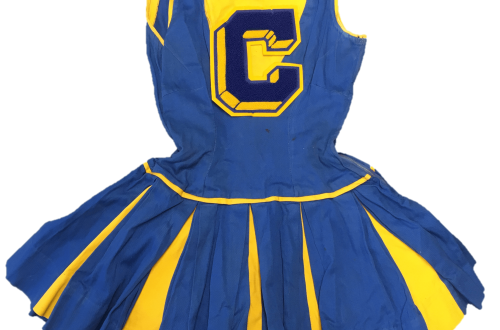
Left: Varsity Sweater from Balboa High School. Gift of Vicki Sizemore. 2006.009.001.
We are compiling a history of the schools and have been hard at work locating information and scanning images. We started with Balboa and have enjoyed mapping the transition from the original wooden school to the concrete school built on the same location in 1917, and the move of the high school to a building nearby.


This wonderful photo album of the construction of the new Balboa High School building that opened in 1942 was recently put up in our digital collection.


Aerial Photograph of Balboa Schools, 1962-1979. Gift of Anne Desmond Abele. II.2019.999.28. 
You can follow Balboa High School all the way to May 15, 1999 and watch a video of the final graduation ceremony. Click here to watch. Or read the May 1999 issue of the Parrakeet.

Balboa High School, The Parakeet Commemorative Edition, May 1999 The collection also illustrates the history of student life – sports, dances, and probably a few days of skipping school. Click on an image to enlarge the slideshow and see some additional captions.


For three years in a row one of the most frequent questions we got was about the Curundu school publications going online and we can finally say, yes, they are online!
Click on the links to look at Cougar’s Cache and Cougar’s Pride. Cougar’s Scratch is coming soon.


Curundu Junior High School Cougars Patch. 2000.35.12. Gift of Richard Williams. In addition to the yearbooks, school publications like newspapers, creative writing journals, and newsletters are also available and text searchable. They include the Balboa School News, the Banquet Bugle (BHS), The Chatterbox (Diablo Heights Elementary), Deviled Ham (Canal Zone College), The Fledgling (Balboa Junior High), Isthmian Inklings (BHS), The Parakeet (BHS), Saltwater Papaya (Canal Zone College), Sun Dial (Cristobal Jr. Sr. High), Tiger Pause (Cristobal Jr. Sr. High), Tiger Tales (Cristobal Jr. Sr. High), Trade Wind (CHS), Zephyr (CHS), and Zephyrus: The Magazine of the Arts (BHS).


Someone recently gifted us the final issue of the Rainbow City Jr. Sr. High School school newsletter Arco Iris. It’s the only issue we have! Do you have any others that you could share with us? We are also looking for additional issues of the Arco Iris or Apex yearbooks.
Left: Arco Iris, 1977.

A number of photo albums and about the schools are also in the digital collection.
Canal Zone Schools Photo History Album, 1904-1953. 2011.999.148.

Latin American Schools Album. 2002.022.008. (This album is only partially digitized as of posting)

Panama Canal College Album, 1980-1989. 2002.022.007. (This album is only partially digitized as of posting)


The next batch of items waiting to be scanned and put online includes hundreds of school related items like photographs and photo sets, scrapbooks, programs, invitations, handbooks, and more publications so keep checking the digital collection for more.
We hope you have enjoyed this year’s fall series on our Digitization Campaign and a big thank you to everyone who has supported us.

Zonian Yearbook, Balboa High School, 1958 -
Welcome to the Team, Isabella!
We are thrilled to introduce you to a new member of the UF team: Isabella Loya.
Isabella has been working with the Panama Canal Museum Collection since August this year, but before that she worked as a student assistant in our Latin American & Caribbean Collection. Isabella is the person responsible for scanning so many amazing treasures and making them available online. Isabella position is fully funded by the generosity of our supporters, so thanks to everyone who has contributed in the past couple of years. And now we’ll let Isabella tell you a bit more about herself and her interests. Thanks!
Hello all!
My name is Isabella Loya and I am the new Imaging Assistant for the Panama Canal Museum Collection. I have been working at the George A. Smathers Libraries system since I began my undergraduate degree at UF. I am currently pursuing two master’s degrees here at UF in Museum Studies and Latin American Studies.
I am originally from Miami, which allowed me to grow around so many different cultures. This further deepened my respect for them and the need to preserve them. I hope that the work I do will uplift and raise awareness for the preservation of these varying cultures.
I am passionate about cultural preservation and making this collection available for public access. This job aligns with what I want to do in the Galleries, Libraries, Archives, and Museums field. I hope that the work being done on this collection will serve as many people as possible. Thank you so much for giving me this opportunity.
-
Welcoming New Team Members!
We are thrilled to be welcoming two new student assistants working on special projects with the collection involving digitization, description of objects, creating videos, and other activities. We want to give them an opportunity to introduce themselves to everyone:

Hi! My name is Caroline Davis and am a second-year graduate student in Museum Studies! I grew up in Jacksonville, Florida, and attended Flagler College in St. Augustine studying Art History for my undergraduate work. I am interested in archival studies and collections management, especially oral history methods.
I have been working in the Smathers Libraries’ Special & Area Studies Collections for almost a year in various projects. Currently, I am working with the PCMC on processing and digitizing collections related to the Balboa High School.

Hello! My name is Azariah Rodriguez and I am a first-year graduate student in the Museum Studies program. For the next few months, I will be working with the Panama Canal Museum Collection here at Smathers Library to curate stories from everyday life in the Canal Zone. My first projects since starting has been finding what I can on the popular Cayuco Race and Canal construction equipment.
I am very excited to continue working with this amazing collection!