
Historic Events
-
Celebrating the Fourth of July at the Canal
“Fourth of July was the biggest celebration of the year in the Canal Zone…there was fairs and athletic events. It was an amazing day. Every little kid lived for the Fourth of July celebration…Now you couldn’t sell fireworks in the Canal Zone, but all we had to do was step over into Panama City and we could buy anything we wanted. Every little kid had loads of firecrackers and little bombs…it was something else.” – Jim DesLondes, 2011
As the United States prepares to celebrate it’s 250th birthday we wanted to take a look back at how the holiday has been commemorated over the years at the Panama Canal.

United States citizens had lived on the Isthmus in significant numbers since the construction of the Panama Railroad in the 1850s. Evidence of their July 4th celebrations can be found in newspapers of that era.
1904 – The U.S. had only just arrived to begin work on the Panama Canal project and no official events were planned that year
1905 – An outbreak of disease kept the desire and willingness to hold official festivities at bay. However, a spark of hope did brighten the day when the new water mains in Panama that had been built as part of the overall sanitation effort of the Isthmian Canal Commission were turned on for the first time on July 4th.
1906 – The first significant Fourth of July celebrations.
1908 – The first description of the July 4th activities in the Canal Record appear in 1908 (the publication began in late 1907 so did not cover that year’s events). In 1908 celebrations were held on both sides of the Isthmus, although at later times they alternated hosting year to year.
These early holidays resembled family picnics and focused on athletic events.
Some highlights of the construction era include: Greased Spar Climbing, Tug-boat Tug-of-war, Fat Man’s Race (200 lbs. or more), Aquatic Wrestling, and the Pipe Race.
AQUATIC WRESTLING
“Free for all to take place on a greased 20-foot floating platform between Piers 8 and 9. Winner to be the last on the platform.” (1914)
PIPE RACE
“The Pipe Race will consist of running 100 yards, picking up a pipe, box of matches, and pack of tobacco that have been placed on the ground about 33 yards apart, the winner being the first man to cross the line with his pipe smoking.” (1911)
On the Pacific side the evening ended with a dance at the Hotel Tivoli.
Left: Fourth of July Dance Card, 1908. Gift of Peggy A. Huff. II.2017.24.9

Click on the image below to flip through the Cristobal 1909 Fourth of July program
In 1911 Chief Engineer Col. Goethals addressed the crowd in Cristobal. You can read the speech Goethals is giving in the photo below in a special edition of the Panama Canal Review.
Ancon went all out with decorations and events in 1912.

Fourth of July in Ancon, 1912. II.2019.21.1. There were baseball games, wall scaling competitions, and more…
1913 was another big year for the Fourth of July celebrations in Cristobal.
The new piers under construction were a featured location for picnic tables, races, swimming competitions, and elaborate decorations.
Right: Panama Canal Fourth of July Celebration Pin. Gift of Yvonne Marrone. 2008.009.032.

Click on the images below to view a series of photographs from the 1913 Fourth of July celebration in Cristobal.


One day earlier, on July 3, 1913, 18-year-old Emmett Zemer arrived on the Isthmus to visit his father, an engineer in the Central Division. He never left, and went on to be the chairman of observance for the holiday for 25 years, earning the nickname “Mr. 4th of July.”
1913 was an important year in the townsite Gorgona. It was the last Independence Day (July 4th) they would share before the mandatory abandonment of the town in preparation for it to be flooded by the waters of Gatun Lake. They marked the day with a banquet complete with a special guest, an extensive menu, and a group performance of songs written just for the occasion.
The copy of the program in the Panama Canal Museum Collection was a special gift from George R. (Al) and Marion Goethals.


The Fourth of July in 1914 provided some additional excitement when a meandering spark accidentally ignited the pile of unexploded fireworks inside the dock and the Crisobal fire department made an appearance.
There was also a navy submarine that thrilled the crowd with two successful dives.
The events of the day were illustrated on the cover of the July 1964 Panama Canal Review.


Submarine Dive, July 4, 1914, Cristobal, Canal Zone. Gift of Brad Wilde. Brad Wilde Postcard Collection. II.2021.36.105.6934 The celebration of the Fourth of July continued to be an important event in community life.
Many of the early “construction days” events became traditional activities for decades to come.

The Panama Canal Spillway, July 3, 1980 Kiddie trains also became an iconic part of the day.


“On the Fourth of July there would be swim meets. We would participate in those. The swimming pools…had a small diving board, a middle diving board, and a tower. The first time you climb that tower and look down at the pool you thought, jeepers, if I jump off this would I hit the pool? That’s how high it seemed to the young kids. It was great fun living in the Canal Zone. As a matter of fact, it was paradise.” – Charles De Tore, 2010

Note Uncle Sam on top of the diving platform.
“One of the things that I was very proud of my grandparents…and particularly my grandfather, was very interested in the community and helping people. His family in the United States were in the notions business, candy and selling decorations for the holidays, which they shipped to him. So he always provided Fourth of July fireworks. And there were some funny stories people have told me over the years of breaking into the crates under his house and swiping fireworks, and sending him an anonymous check when they got their first job.” – Janice Scott, 2011

World War II resulted in a few changes to the then established routines of the Fourth of July. Blackouts limited fireworks and festivities in a number of the war years. These programs from 1939 and 1940 demonstrate that change – the 1939 program has seven pages of events and the 1940 program as two pages of events.


In 1942 the theme of the festivities was “Inter-American Unity.” Boys and Girls from Panama and the Canal Zone marched together in a large parade. That year there were no fireworks and War Savings Stamps and Merit Certificates were given instead of the usual prizes. The theme of Victory was everywhere in the 1943 decorations.
1958 celebrated the Fourth of July with 150 gallons of Free Beer and 1300 hot dogs! 48-gun salutes – one for each State in the Union – sounded off in Fort Gulick, Fort Clayton, and Fort Amador.
With the addition of Alaska to the United States one year later, flags with 49 stars were flown for the first time in 1959. The 50-star flag followed with the addition of Hawaii in 1960.
The U.S. flag as we now know it has been part of the holiday ever since.

Eric and Christian Clarke are ready and waiting for whatever their country’s birthday party may bring. Eric holds the official 50-star flag of the United States while Christian adds a touch of “76” to the scene. The twins are the sons of Mr. and Mrs. Steven D. Clarke of Balboa. The Panama Canal Spillway, July 2, 1976 There were custom paint jobs in 1976 and numerous activities celebrating “The Glorious Fourth,” the 200th birthday of the United States .

Panama Railroad Engine 902, c.1976. Gift of Patricia Bjorneby. 2005.27.240 Which you do like more, the bicentennial train or the bicentennial mule?
1997 boasted a concert by the famous Panamanian duo Sandra Sandoval and her brother Samy as well as a massive 4 x 8′ cake baked by Susan Hensley to celebrate the 50th Anniversary of the Air Force.
In 1999 major festivities took place at Fort Clayton and Howard Air Force Base including the “Last Train Out.”
Happy Fourth of July 2026!
We will continue this look at Fourth of July celebrations during our fall blog post series which will focus on the adventure of Chief Aptakisic during the United States Bicentennial celebrations in 1976.
Did you sail on the Chief Aptakisic or participate in the Canal Zone Project Windjammer ’76 which helped raise the money used to refurbish the 53-foot sailing vessel?

Photo album relating to Chief Aptakisic, May-June 1976. Gift of Sherry Austerfield. II.2017.999.63. -
Looking Back to Apollo in the Age of Artemis: How the Canal Celebrated Apollo 11’s Trip to the Moon

Yesterday NASA launched a crewed mission to the moon for the first time in over 50 years. Their vehicle was the Artemis 2.
The stars were aligned because just this week one of our donors, Karin Long, sent us a series of newspaper issues from the days of the Apollo 11 trip to the moon in 1969. We thought it would be fun to share them with you.
Right: The view of the launch from PCMC’s hometown, Gainesville, Florida.

Artemis 2 vs. Saturn V: The Saturn V rocket which was used in the Apollo 11 mission stood 41 feet taller than the Artemis II, but Artemis 2 has 15% more liftoff thrust (8.8 million pounds).
Karin Long’s donation included the Star & Herald, printed in Panama, and the Panama Edition of the Miami Herald. You can track the day-by-day news and excitement and compare the 1969 8-day mission to the currently scheduled 10-day mission of Artemis 2.
Do you know the Panama Edition of the Miami Herald got its start? If so, please share your knowledge with us.
We also learned through other newspapers already in the collection like the Southern Command News that USAFSO (U.S. Air Forces Southern Command) played a supporting role in the Apollo 11 mission. Howard Air Force Base in the Canal Zone was the staging area for specially trained and equipped HC-130 Hercules aircraft and crews that were standing by to help in any sea search or rescue operations.
Do you have any stories about working with NASA while you were at the Canal that you can share with us?

And of course many Panama Canal publications mention the tropical survival training NASA astronauts went through in the Canal Zone, including the Panama Canal Spillway and the Panama Canal Review. To learn more about that training read our previous blog post: Astronauts in the Zone.

Astronauts Visit Locks – John Glenn leads the way across one of the lock gates at Miraflores Locks during a visit last Friday morning before the astronaut party left the Isthmus after receiving training in tropical survival techniques. Glenn, and a vid camera fan, took numerous pictures at the locks to add to those he had taken during the survival training. The astronauts were accompanied on their tour of the locks by members of the Canal Zone Guide Service. Panama Canal Spillway, June 14, 1963.
A special hello to Artemis 2 Mission Commander Reid Wiseman who passed through the Panama Canal while serving in the U.S. Navy.
Right: Social Media post by Reid Wiseman


Still Image taken from Meet the Artemis 2 Astronauts: Mission Commander Reid Wiseman 
An alligator and some wild horses also showed up near the roadside in Paynes Prairie south of Gainesville to watch your historic launch. Photo taken April 1, 2026. T-minus 10 minutes.
-
110 years ago this month…

S.S. Ancon during the official opening transit of the Panama Canal, August 15, 1914. Gift of Brad Wilde. II.2021.36.106 One hundred and ten years ago this month, the Panama Canal officially opened. On Saturday, August 15, 1914, the S.S. Ancon left Cristobal dock No. 9, and approximately nine hours and 40 minutes later, it arrived five miles out into the Bay at Panama, at the end of the dredged channel. On board were around 200 people including politicians, military officials, and high ranking affiliates of the Panama Canal.
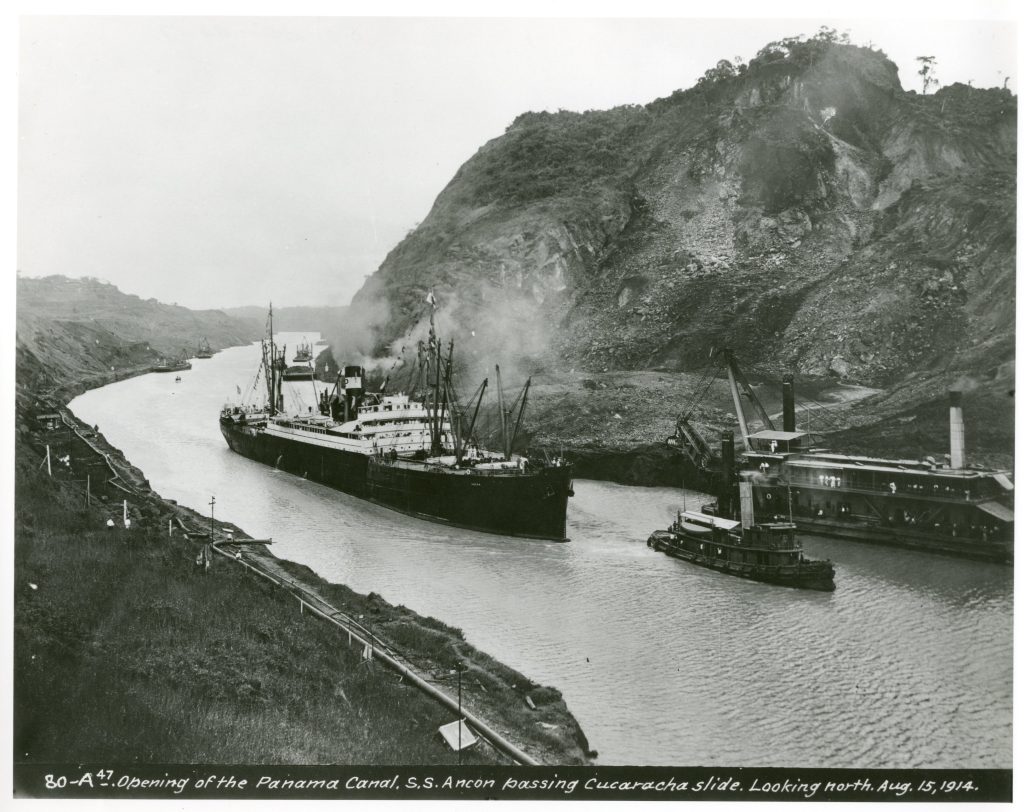
Opening of the Panama Canal, S.S. Ancon passing Cucaracha slide. Looking north. August 15, 1914. Gift of Glenn W. Brandl. 2003.100.44.7. The August 15th, 1914 transit of the S.S. Ancon is the celebrated event, but there were other test voyages and “firsts” that occurred in the weeks and months prior, most notably the the August 3rd, 1914 trip of the S.S. Cristobal. Although it technically (and purposefully) did not sail the full length of the Canal so that the Ancon could claim that prize, Chief Engineer George Goethals wanted a ship to complete a trial run before the eyes of the world were on the Canal and the workforce that had labored for ten years to design and dig this new modern marvel.


A description of the test trip is included in the August 5th issue of the Canal Record.

John O. Collins shared his alternative theory of the August 3rd transit in the Society of the Chagres 1914 Yearbook, speculating that this “test voyage” was to give the individuals who had actually worked on the Canal the opportunity to experience it instead of outside dignitaries and press.
The Society of the Chagres was a organization created to “keep alive the pleasant associations and memories connected with the work in which they have each spent six or more years of their lives…who have earned the Roosevelt Canal Medal and two bars prior to the official opening of the Canal.” Their yearbooks are a great place to learn about some of the Americans from the construction era.
Move through this slideshow of images of the Cristobal‘s trip with the left and right arrows.

S.S. Cristobal in the 1st Chamber, Gatun Locks, August 3, 1914. Gift of Mickey Fitzgerald. II.2024.3.2016 
Goethals looking on as the ship is raised through Gatun Locks. August 3, 1914. Gift of Mickey Fitzgerald. II.2024.3.217. 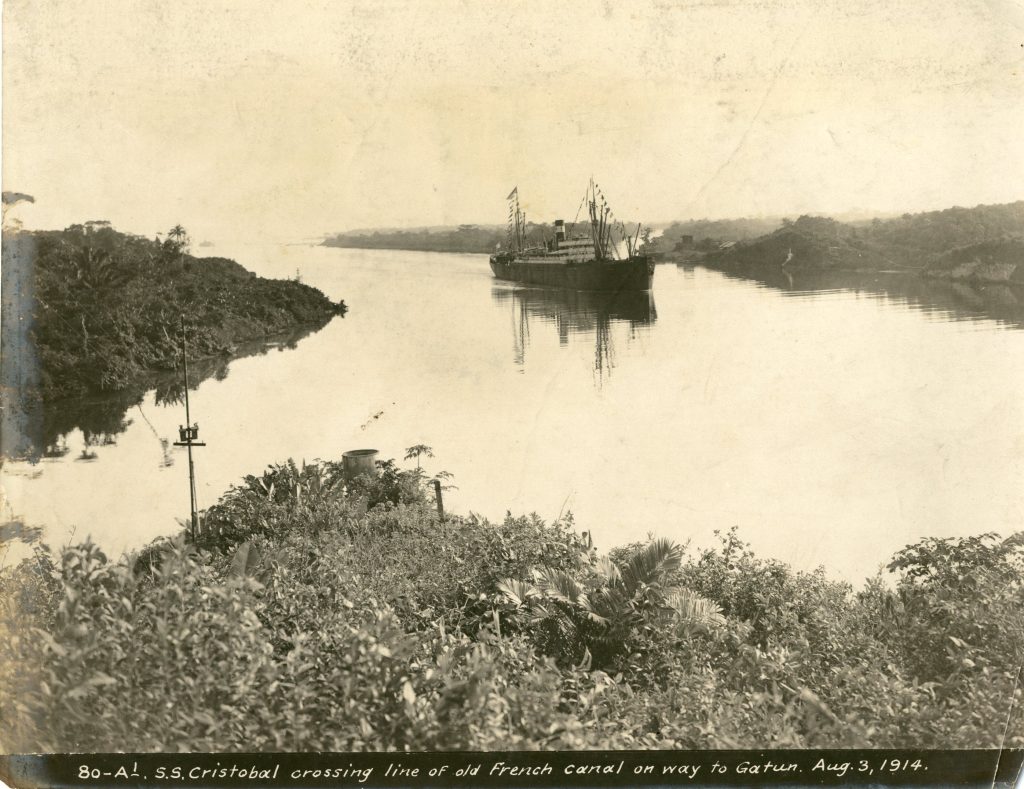
S.S. Cristobal crossing line of old French canal on way to Gatun. August 3, 1914. Gift of Mickey Fitzgerald. II.2024.3.118. 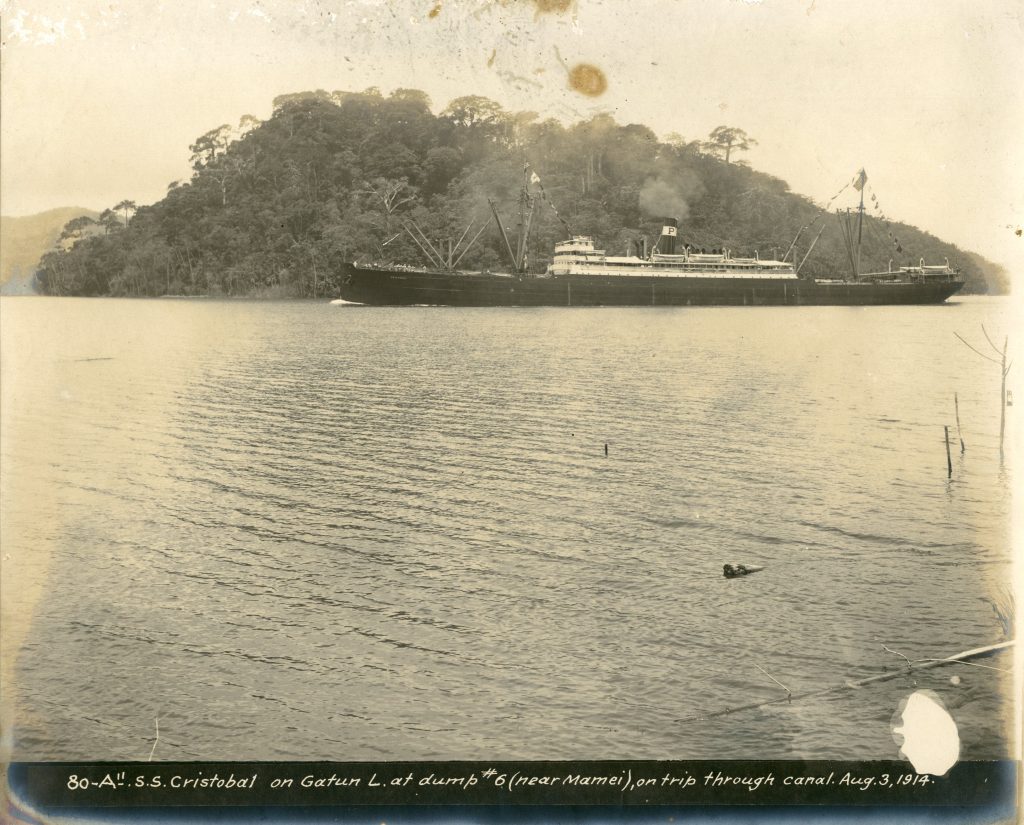
S.S. Cristobal on Gatun Lake at dump #6 (near Mamei), on trip through canal. August 3, 1914. Gift of Karen Nadeau Price. 2012.115.85. 
S.S. Cristobal going through Gatun Locks, August 3, 1914. Gift of Mickey Fitzgerald. II.2024.3.240. 
S.S. Cristobal, Gatun Locks. August 3, 1914. Gift of Mickey Fitzgerald. II.2024.3.238. 
S.S Cristobal in Culebra Cut, Return trip from 1st passage through Panama Canal, August 4, 1914. Collection of Curtis H. Bliss. Gift of Mickey Fitzgerald. II.2024.3.182.
Did you know that there is debate about whether the August 3rd or the August 15th trip carried the 50,000 medals struck to commemorate the completion of the Panama Canal? Although the official opening was the 15th, they are often referred to as the “Cristobal Medal”.


This medal was a gift of Sara Collinge Ulrich, 2002.23.3.
But what about those other “firsts”…
The S.S. Alliance was the first ocean going vessel to make lockage at the Panama Canal. It happened at Gatun Locks on June 8, 1914.

S.S. Alliance in Gatun Lake, June 8, 1914. Gift of Brad Wilde. II.2021.36.106 The Santa Clara tested the lockage through Miraflores and Pedro Miguel later in June, 1914.

The Santa Clara during Northbound First Pacific Lockage, June 18, 1914. Gift of Brad Wilde. II.2021.36.106. 
An account in the Isthmian Historical Society Roosevelt Medal Holders’ Tape Recorder Guest Book references another first. It is unclear if Adrien M. Bouche is conflating two “firsts” or if he was mistaken about the year, but he recounts a unique experience he had watching one of these important events with Goethals himself. At the age of fifteen or sixteen Bouche watched the first lockage of Gatun Locks, a trip made by the tugboat Gatun on September 26, 1913.
Isthmian Historical Society. Roosevelt Medal Holders’ Tape Recorder Guest Book: The Word-for-Word Reminiscences of 35 Oldtimers Who Helped to Dig the Panama Canal. Recorded on Tape November 17, 1958.

Excerpt from the writing of Adrien M. Bouche. Isthmian Historical Society. Roosevelt Medal Holders’ Tape Recorder Guest Book: The Word-for-Word Reminiscences of 35 Oldtimers Who Helped to Dig the Panama Canal. Recorded on Tape November 17, 1958. 
Operation of Gatun Locks. First boat through Tug “Gatun” entering lower lock. September 26, 1913. II.2019.999.554
Do you have any stories about these Panama Canal “firsts”?
If you want to learn more about these and other early “firsts” at the Canal enjoy this series of articles that Bob Karrer, Bill Fall, and Tag Stewart wrote for the Isthmian Collectors Club (ICC) Journal’s in 2011 called “The First Transits”. You can read the articles here or download a copy below.


