Collections
-
Exploring the Collection
We are excited to announce a brand new section of the PCMC Blog this month: Explorations. From time to time, we discover topics or objects in the collection that inspire us to explore them in greater depth. The digital projects under our Explorations banner will allow us to spotlight particular objects that otherwise might not be as visible, and they will demonstrate the incredible scope of the collection by highlighting a wide variety of subjects relating to the history of the Panama Canal, the Canal Zone, and Panama. We may dive deep on a single object, telling as much about it as we can, or we may explore broad themes and range far and wide to tell interesting stories. Most of our Explorations will be longer and more in-depth than the average blog post but shorter than the average exhibition.
Our inaugural Explorations project focuses on The Panama American newspaper. Of the Panama Canal Museum Collection’s vast catalog of online resources, the Panama American is by far the most-used with nearly 14 million views of newspaper issues over the past decade. It seemed obvious to us that we wanted to explore the history of this paper a bit more and share some of our resources about it. In addition to covering important milestones in the history of the “newspaper of record” for the Canal Zone, this project spotlights some of the important people who worked for the paper such as founder Nelson Rounsevelle, John K. Baxter, Sidney A. Young, Dr. Harmodio Arias, Ted Scott, and Hindi Diamond, among others. The project also incorporates excerpts from oral history interviews, including a special section on paper routes worked by Canal Zone children. We are thrilled that this project was funded by the Janice G. Grimison and Edward “Ted” W. Scott Library Memorial Fund, which also has supported digitization of the newspaper over the years.


Our second project, Panama Canal Playtime, explores a wide variety of toys, puzzles, board games, playing cards, and models in the collection that relate to the Panama Canal, Canal Zone, and Panama. The objects included in this project span more than a century, dating from the early 1900s to the early 2000s. We have grouped the objects into categories: mechanical tin toys, handheld dexterity games, plastic toys, board games, playing cards, and models. While most of these objects were intended for entertainment, some were created as educational tools or as collectibles. Regardless of their purpose, we think they demonstrate the enduring appeal of the Panama Canal over so many decades.
We will add new digital projects to the Explorations page in the future (we’re already working on our third project), so check back frequently and watch for blog posts announcing new Explorations.
-
Happy Labor Day


Happy Labor Day! These photos document the 1908 and 1910 Labor Day excursions of a family living at the Panama Canal during construction. Unfortunately, we don’t know their names but are grateful to the donor who made sure these treasures found a good home here with us.
The caption on the back of the photo above reads, “Starting for Old Panama Labor Day 1908 Government Break”. Gift of Barbara L. Daniels. II.2022.80.4.
Take a cue from this family’s celebration and enjoy any trips or relaxing moments you can today. (However, I don’t recommend wool skirts on the beach and ties might not be necessary)

Panama Bay, Old Panama, Labor Day 1908. Gift of Barbara L. Daniels. II.2022.80.4. 
Labor Day, 1910. Gift of Barbara L. Daniels. II.2022.80.4 
Gathering Oysters, Old Panama, Panama Bay, Labor Day, 1908. Gift of Barbara L. Daniels. II.2022.80.4. 
Old Panama, Labor Day, 1908. Gift of Barbara L. Daniels. II.2022.80.4. Do you recognize anyone in the photos? Some captions include references to Mr. W and Mrs. W so that could be a hint to solving the mystery of who this construction era family is.
-
Making Waves with the First Ocean to Ocean Flight over Panama
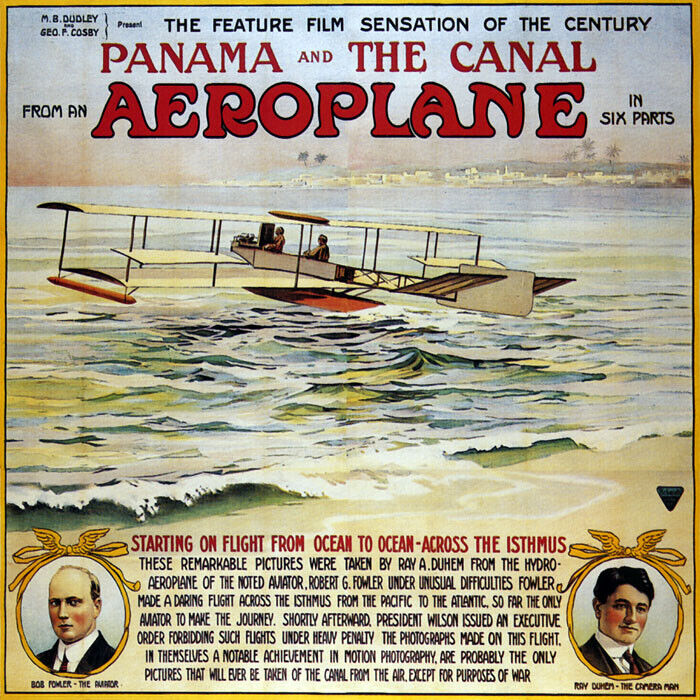
In April 1913 pilot Robert G. Fowler and cameraman Ray Duhem took the first non-stop flight across Panama, all the way from the Pacific to the Atlantic Ocean. Their adventure was big news on the Isthmus, and was covered in the local press for the duration of their three week stay. In addition to being the first to accomplish the flight, they shot six reels of film that were to be released in theaters.
Things didn’t exactly go as planned…but lets start at the beginning.
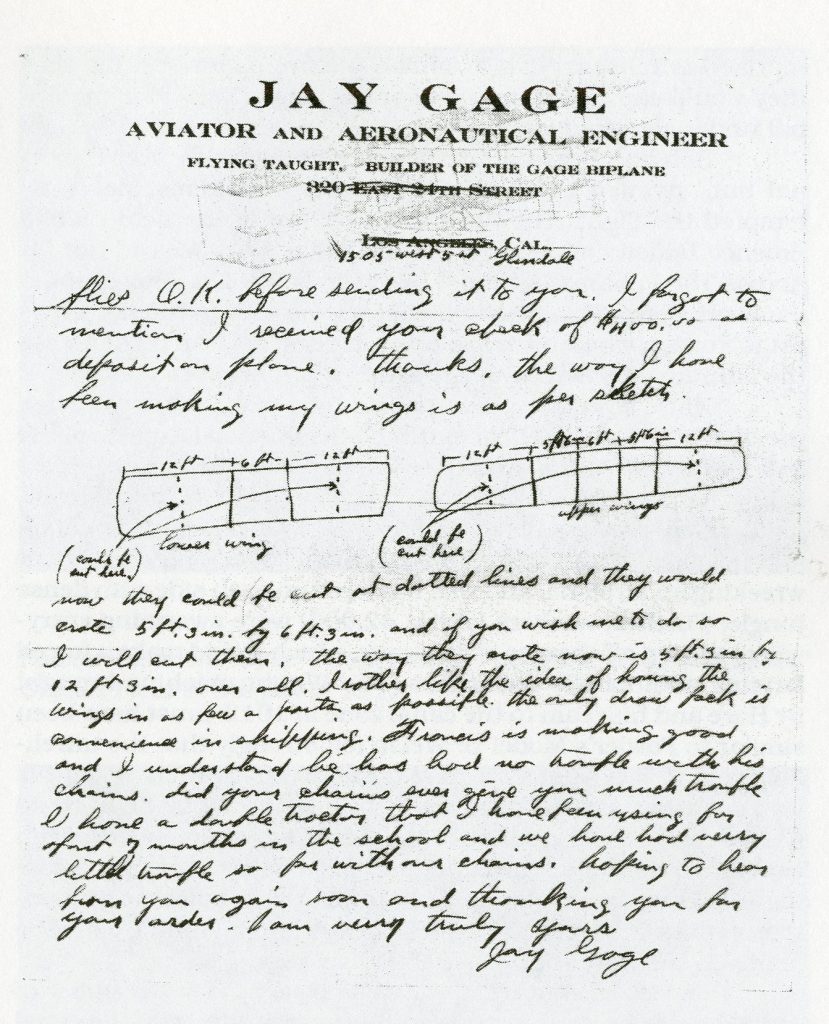
After becoming the first to fly coast-to-coast across the United States in 1912, Fowler started preparing for his flight across Panama. He and Jay Gage, a Los Angeles aeronautical engineer and aviator, collaborated on the design of a more powerful single propeller tractor biplane. Three significant design features were the passenger seat situated in-front of the pilot which would house the cameraman, the greater span of the upper planes on the wings, and the segmented manufacturing so that it could easily be crated for shipping to Panama. Because there were no airfields on either side of the route, wooden pontoons were affixed to the bottom, transforming it in to a hydroplane.
Note the dotted lines in the drawing which indicate where the planes of the wings could be cut for crating.1
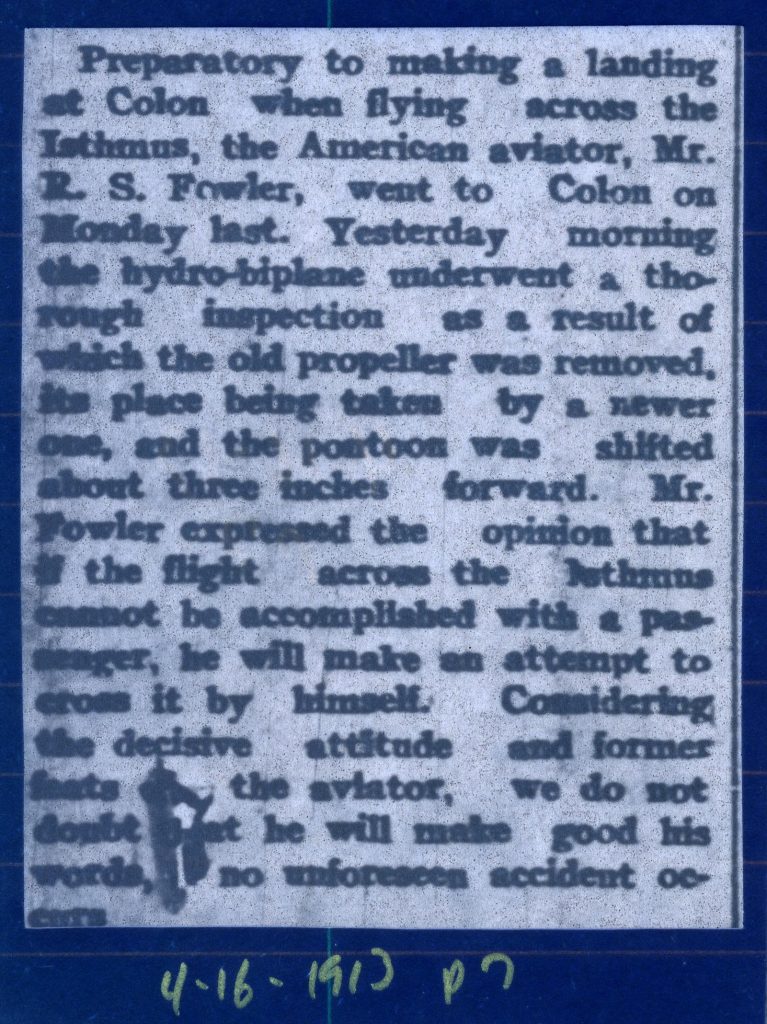
Days before his departure Fowler learned the high-test fuel that the plane needed was not available in Panama. He quickly asked the Union Oil Company of California to ship 50 gallons on one of their tankers headed that way. After his two week trip, Fowler arrived to learn that the heat in the cargo hold had caused the tin cans to rupture and his fuel had evaporated. Luckily, the Panama Fire Department donated some of their own high-test fuel so the flight could continue as planned.

Robert Fowler with his airplane crates after arriving in Panama. One of the wooden pontoons is in the lower left corner. II.2022.22.4. Gift of Brad Wilde The airplane was transported to Bella Vista beach where it was assembled. Fowler commented on the dramatic Pacific side tides, “One big trouble on the beach I had set up as base was the large tide movement. At this point there was a 30 foot tide change – when the tide was out my plane was a quarter mile from the water.”2
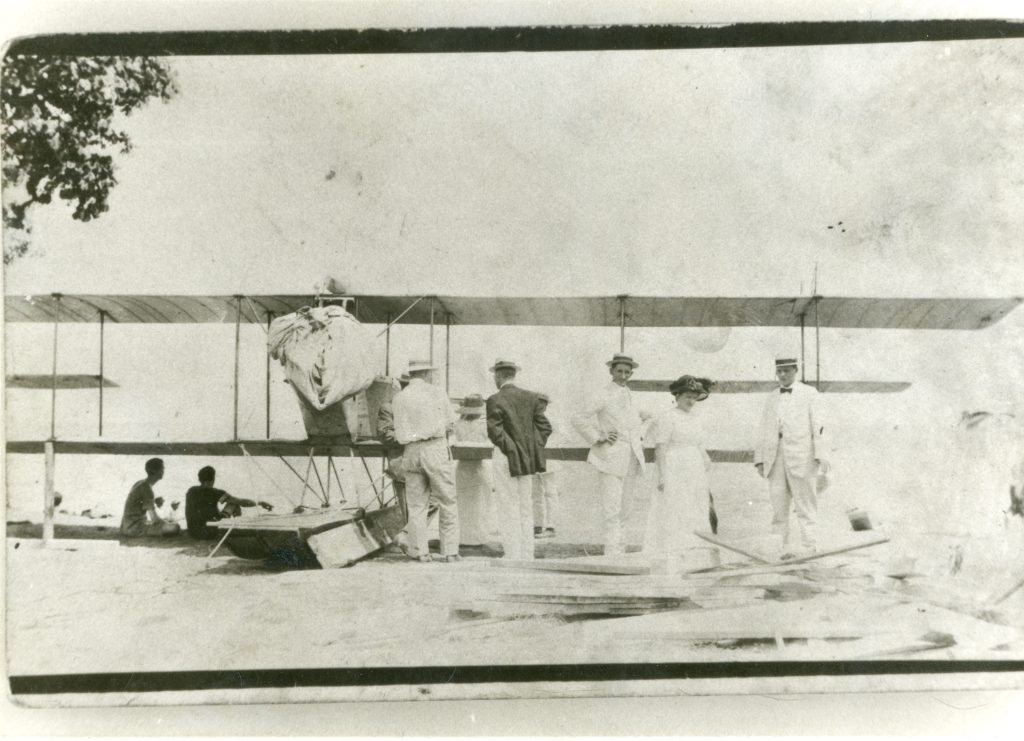
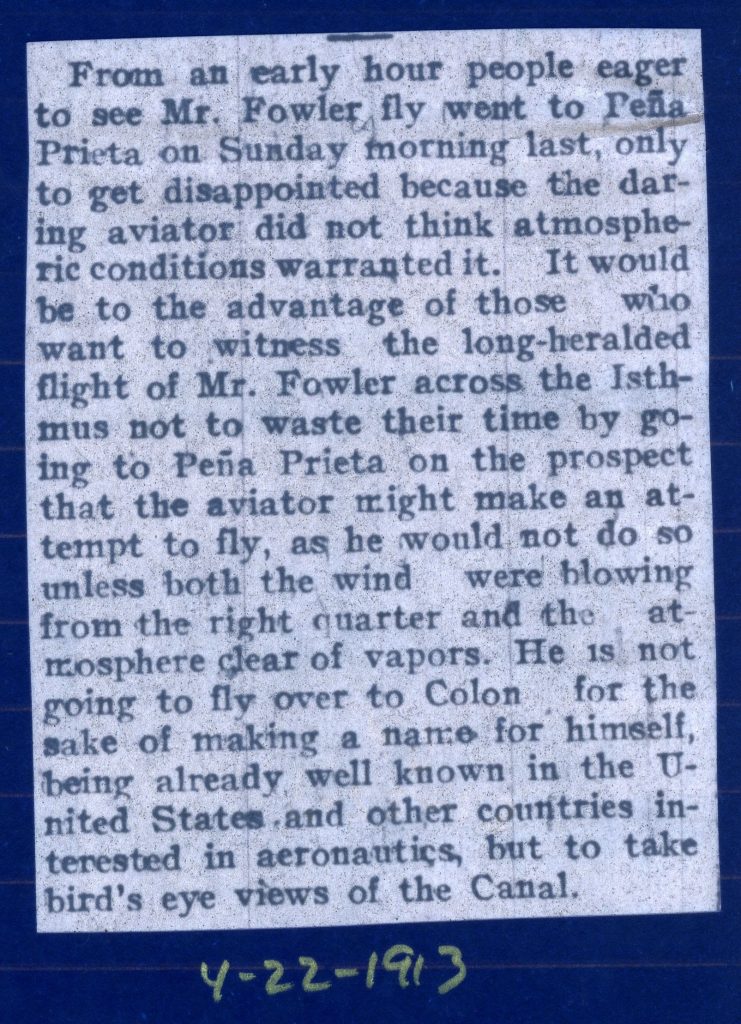
Robert Fowler’s plane being assembled on the beach. II.2021.36.49. Robert J. Karrer Papers Fowler began test flights shortly after his arrival which were reported in local publications. Some flights were more harrowing than others and included mid-air stalls, a flooded and broken engine, near collisions with the shore, and a nude Duhem out on the pontoon spinning the propeller to help Fowler restart the engine. The newspapers didn’t report on many of those details, so to learn more about the test flight mis-adventures read The Life of Robert G. Fowler by Maria Schell Burden.
Use the left and right arrows to move through the slideshow of clippings from the Robert J. Karrer Papers.
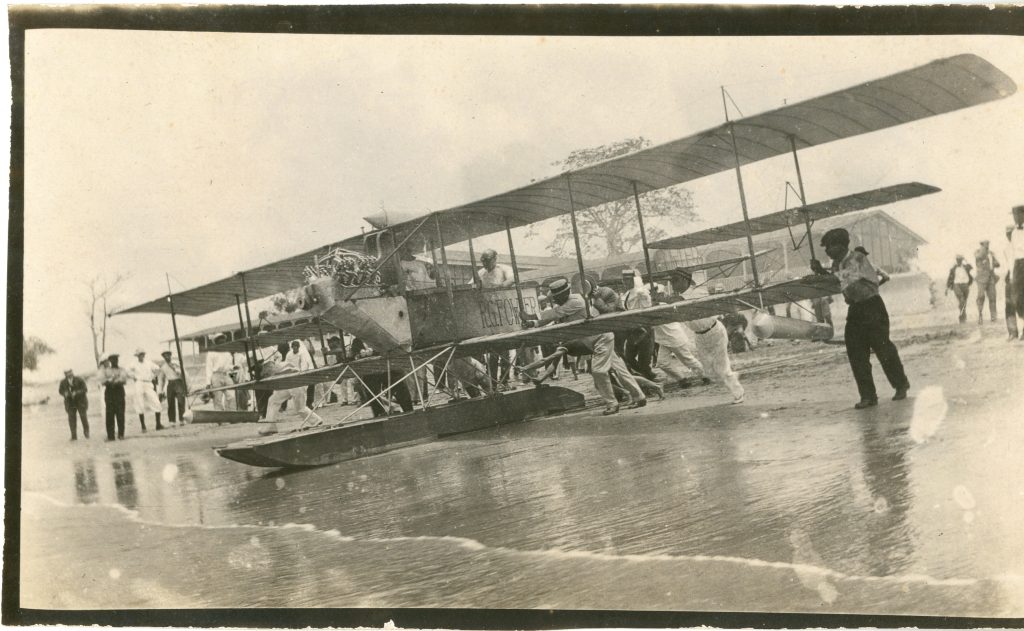
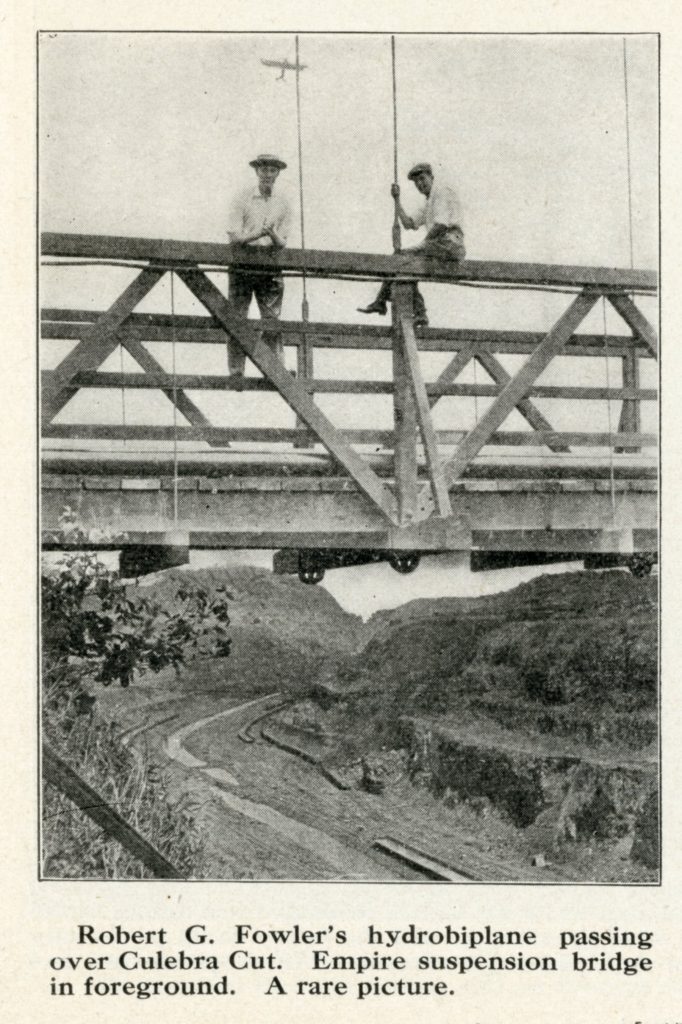
A group of men push Robert Fowler’s hydroplane into the water. From the Photo Album of Albert Christopher Garlington. II.2022.5.1. Fowler and Duhem made their historic trip on April 27th, 1913. While flying over Culebra Cut they were captured in the background of a photograph.
As they approached the end of their hour and 45 minute long flight, right over Cristobal, they ran out of gas and the engine stopped. Fowler was successful in guiding the plane to a landing spot in shallow water.
The image on the right is taken from America’s Triumph at Panama by Ralph Emmett Avery, 1913. Come check out the book in our Latin American and Caribbean Collection Library, https://ufl-flvc.primo.exlibrisgroup.com/permalink/01FALSC_UFL/6ad6fc/alma990227615780306597
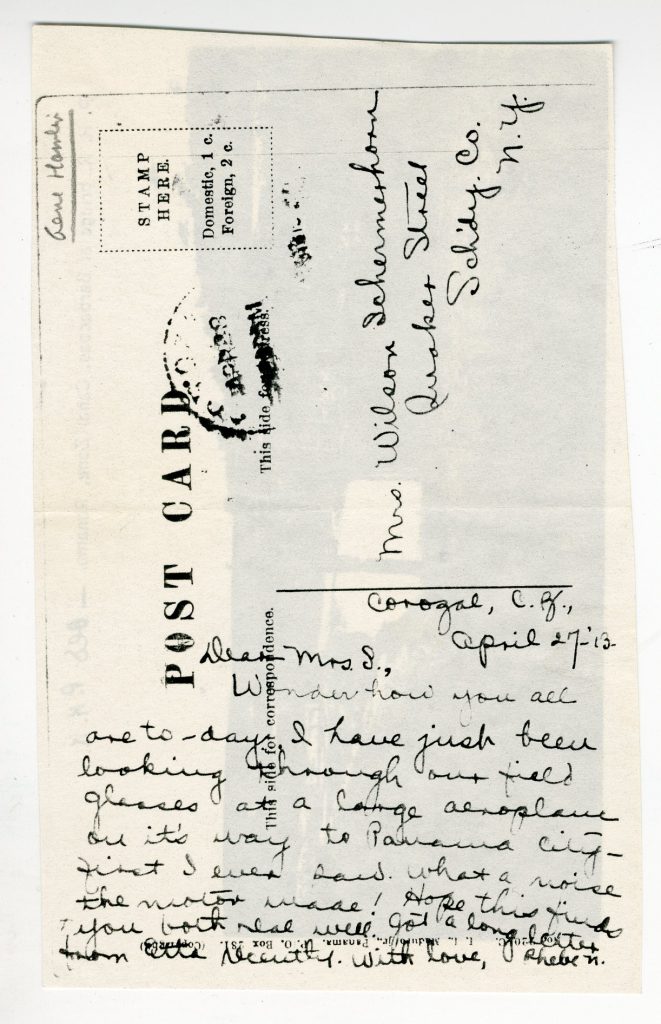
The note on the back of this postcard from the Robert J. Karrer papers mentions watching and hearing Fowler’s plane flying over Panama. This was the first “aeroplane” the sender had ever seen. II.2021.36.49. 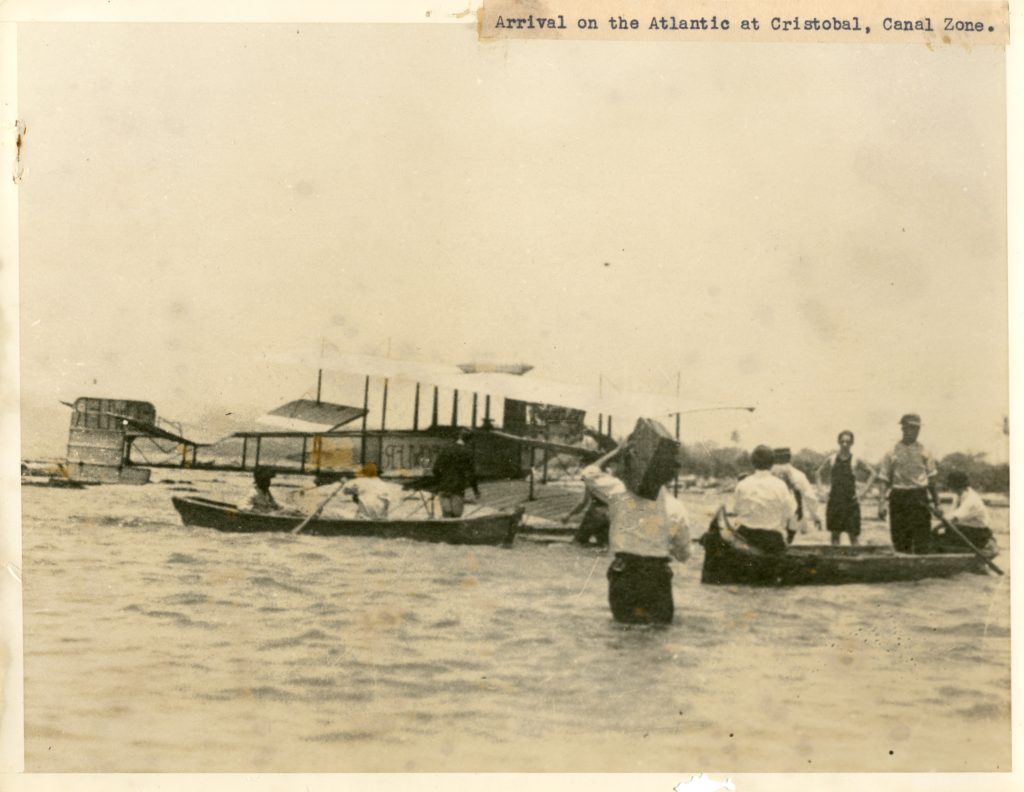
Fowler’s plane in Limon Bay near Colon. Duhem, the cinematographer, is in the foreground with his camera box on his shoulder. II.2024.164.1. Gift of Mickey Fitzgerald. Below is some of the footage that Duhem shot from the plane. You can watch them fly over Canal Zone towns and the construction site of the Canal. At minute 10:23 you can see the moment they run out of gas and the propeller stops in the film’s frame!
Near the end locals come out to greet them and help pull the plane on shore. The young ones have fun waving at the camera, just like they do today.
Panama by Air (Reel 4), Ray Duhem, 1914, Internet Archive Despite the harrowing achievement, the real drama was yet to come.
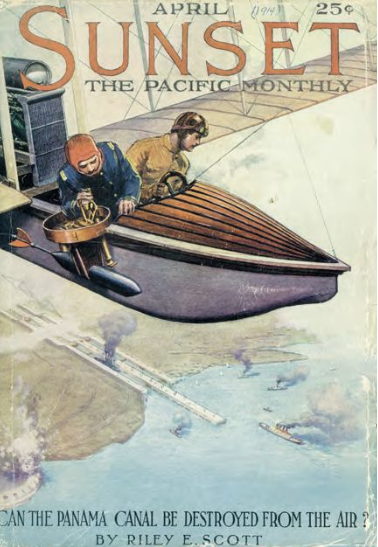
Charles Kellogg Field was the editor of Sunset The Pacific Monthly in April 1914 when the article about Fowler and Duhem’s flight was published. He and other aviation enthusiasts had concerns that Congress did not fully appreciate the importance and potential danger of airplanes. The author of the article, Riley E. Scott, was a West Point graduate and bombing expert who realized that their flight exposed a weakness in the Canal’s defenses. The cover caused quite a stir.
The image on the left is the cover of Sunset The Pacific Monthly, April 1914 issue. II.2019.999.249.
Three months after publication, at the request of the War Department, Fowler, Duhem, Scott, and Field were arrested and charged with spying by violating a statute that prohibited sharing military information. While filming the Canal’s construction Duhem had also filmed military installations. Scott included a still image of the future site for the 16-inch gun on Naos Island off the coast of Panama City in the article with a dramatic caption.
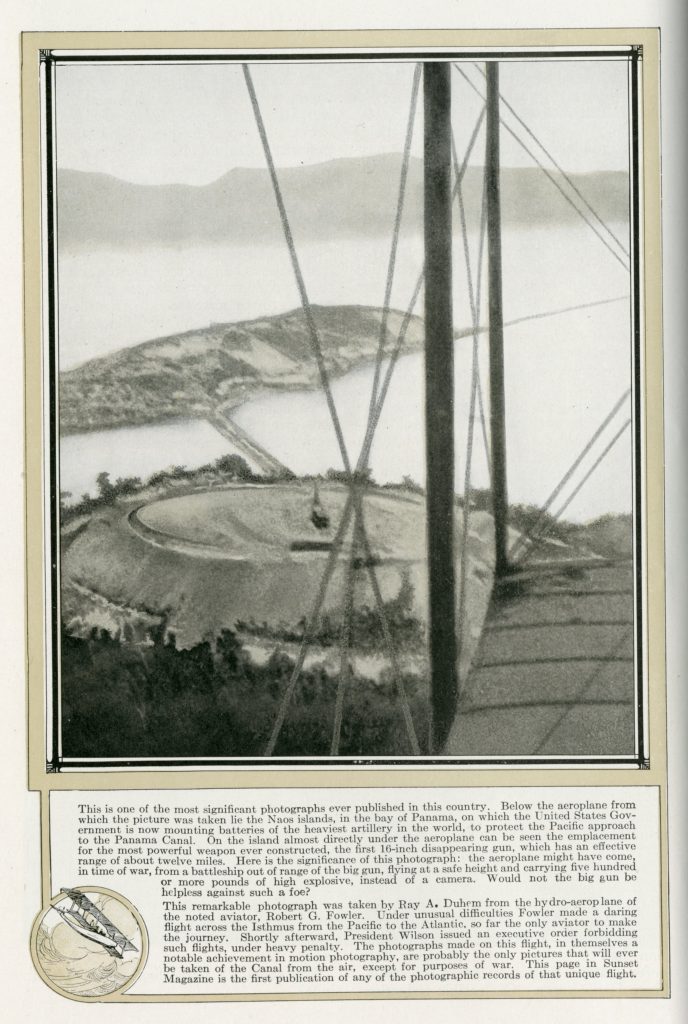
A page from Riley E. Scott’s article “Can the Panama Canal be Destroyed From the Air?”. Published in Sunset The Pacific Monthly, April 1914. II.2019.999.249. The men appeared in court and explained that they had been granted permission prior to the flight by both the War Department in Washington and by Colonel George C. Goethals, Chief Engineer of the Panama Canal construction. The case was dropped a year later.
The image on the right is taken from The Life and Times of Robert G. Fowler by Maria Schell Burden.

Fowler’s plane is on display at the Smithsonian National Air and Space Museum, Steven F. Udvar-Hazy Center in Chantilly, VA. (minus the wooden pontoons damaged during the crash landing)

The Fowler-Gage Biplane flown over the Isthmus of Panama in 1913. Gift of Robert Fowler. https://airandspace.si.edu/collection-objects/fowler-gage-biplane/nasm_A19510004000
Two other efforts had been made to fly over Panama by different parties: O.G. Simmons, Al Welsh, and James H. Hare from Collier’s Weekly and Jesse Seligman. Neither group attempted the crossing. The Collier’s group cited lack of viable landing sites as a critical part of their decision. Severe air crosscurrents and wind were also dangerous elements. Fowler experienced the significant winds first hand on his flight. In one event an air current flipped the plane around so that it was flying in the opposite direction, and in another an air pocket over Culebra sent the plane plunging 300 feet straight down.
These images are taken from an article James H. Hare wrote in the Aero Club of America Bulletin called, “Why We Did Not Fly Across the Panama Isthmus.”
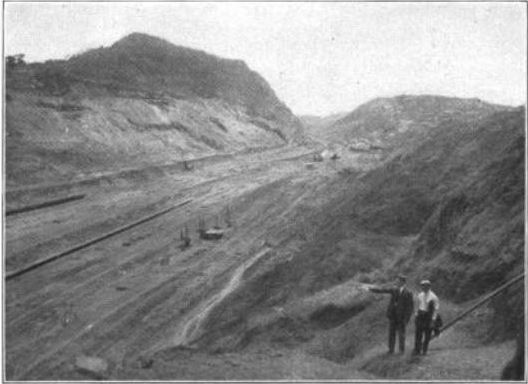
Simmons and Welsh at the Culebra Cut 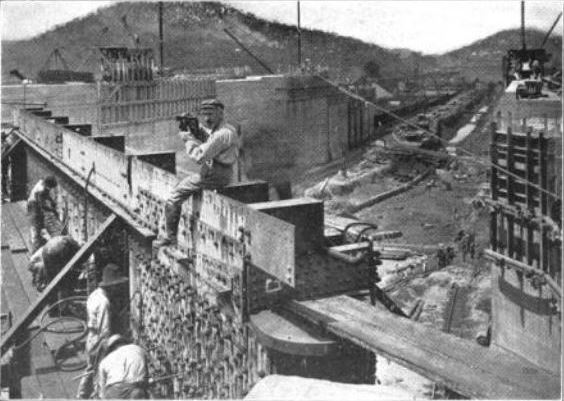
James H. Hare Looking for a Landing Place -
Manhattan in Panama
Do you know anyone that is connected both to the Panama Canal and the Manhattan Project?
There are likely more but here are highlights from the lives of three individuals who were associated with both: Hartley Rowe, Colonel Elmer Ellsworth Kirkpatrick, and Katherine “Kitty” Oppenheimer.
Hartley Rowe
Hartley Rowe was an industrial engineer who worked on the construction of the Panama Canal from 1904-1908. He joined the Isthmian Canal Commission in November 1904 and transferred back and forth between the Panama Railroad and the Canal Commission as an Electrician. He managed a power plant in La Boca and was a resident engineer until 1919 when he returned to the United States after almost 15 years of continued service at the Canal. His work in 1912 included managing air compressor plants which were critical to powering the steam shovels digging the Canal.
Rowe belonged to the Society of the Chagres and is mentioned in their yearbooks, serving as a Vice President 1915-1916. https://ufdc.ufl.edu/aa00013083/00001 He was also an active member of the Panama Canal Society and appears often in their publication the Canal Record.

Seating Chart for the Society of the Chagres Banquet, February 21, 1913. 2011.021.013. Gift of Linda Adelsberger. The name Ben Jenkins is noted on the seating chart and he happened to be sitting right across the table from Hartley Rowe. Do you know who Ben Jenkins was? His travels through the Canal during his work for the United Fruit Company are well documented in the Panama American newspaper.


Panama American, June 6, 1926. Were any of your family members there?
Rowe joined the Manhattan Project in Los Alamos in 1944 and worked on the team transitioning the implosion program from weapons research to production.

General Advisory Committee of the Atomic Energy Commission in Santa Fe, NM, April 3, 1947. Left to Right: James B. Conant, J. Robert Oppenheimer, Brigadier General James McCormack, Hartley Rowe, John H. Manley, Isidor Isaac Rabi, and Roger S. Warner. Image from the Bulletin of the Atomic Scientists. Public Domain. Colonel Elmer E. Kirkpatrick
Elmer E. Kirkpatrick was an officer in the United States Army Quartermasters Corps and the Army Corps of Engineers. After graduating from West Point in 1925 his fourth, and first overseas, post was the Panama Canal. He arrived in August of 1939 and supervised war preparations at Fort Davis, Fort Randolph, France Field, and other anti-aircraft artillery positions around Gatun Lake.

The 1940 Census lists his family as living on the main road in Fort Randolph. 
In 1944, he started his work with the Manhattan Project. Initially he spent considerable time at Los Alamos and other locations. He assisted in inspecting bomb prototypes and observing training of the 509th Composite Group, the United States Army Air Force unit tasked with the deployment of nuclear weapons. He was also sent to the Pacific Island of Tinian where he was responsible for the development of facilities that would be used in the movements of the atomic bombs dropped on Hiroshima and Nagasaki.
After extensive service in the Construction Division of the Pacific he moved to Jacksonville, Florida and was involved in building the initial facilities at Cape Canaveral.
Another interesting connection is his service as an assistant professor in the College of Architecture at the University of Florida. He was hired in June 1959 and taught in the Department of Building Construction.

University Record, Undergraduate Catalog 1962-1963, University of Florida. Held in the University Archives, a neighbor collection to PCMC in the Special & Area Studies Collections Library. https://ufdc.ufl.edu/uf00075594/00077 Katherine “Kitty” Oppenheimer
Katherine “Kitty” Oppenheimer was the wife of J. Robert Oppenheimer. While living in Los Alamos during the Manhattan Project she worked for the Health Group conducting blood tests designed to evaluate the dangers of radiation, she led social engagements to provide distractions from the stressful environment, and raised her two young children. Throughout her life she served as an important confidant to her husband who became an internationally known figure for his work on the atomic bomb.
Sadly, unlike the former two, Katherine’s association with the Panama Canal came at the end of her life. In 1972, she was planning to sail from the U.S. to Japan by way of the Canal but fell ill early in the voyage. She died of a pulmonary embolism at Gorgas Hospital in the Canal Zone. The record of her death is among the Gorgas Hospital Mortuary Registers housed today in the National Archives of the United States.
During their time at the Institute of Advanced Study, Robert Oppenheimer had a greenhouse built for Kitty who was a trained botanist. She raised orchids there and often received rare varieties as gifts from her husband.
Many people mention the beautiful orchids in Panama in anecdotes and oral history interviews. I can’t help but think that Kitty would have very much enjoyed seeing them.

Taken from an article about orchids in Panama, published in the May 1970 Panama Canal Review. Stay tuned for a related blog post about Appendix 6.

Final Draft of Appendix 6, Isthmian Canal Studies 1947, 2014.133.1 -
Panoramic Panama

E.O. Goldbeck, Gatun Locks, 1930s, 2000.92 Some amazing treasures recently came back from the University of Florida Library’s Digital Support Services. Although they are all photographs, some items took two people to carry because of their incredible size – they are 6 feet long! (Thanks to Michele in our Grand Reading Room for being the second pair of hands)


Many of the photographs are images taken by E.O (Eugene Omar) Goldbeck, a commercial photographer who specialized in panoramic photography. He is know for using a Cirkut, a rotating panoramic camera, and for his images of military bases and personnel. In addition to Goldbeck’s name, look for his company “National Photo and News Service”.
Watch the Cirkut in action on YouTube. The spool of film that would have been inside the camera was about 10 inches tall and the unrolled film was 7 feet long. Goldbeck first visited the Panama Canal in 1914, and credited that trip with his introduction to the full potential of the panoramic format. Afterwards, he traveled to Panama every few years and stayed there for about three months each time. He took photographs of the U.S. military personnel and a few scenic views of the Canal and surrounding cities.
His panoramic photos are well known and easily recognizable for their often complex arrangements of people into formations. To capture these expansive photos he often had to climb tall towers, including the 505 foot tall Navy wireless tower in Panama.

E.O. Goldbeck, 33rd U.S. Infantry, Ft. Clayton, Panama Canal Zone, May 9, 1939. Click on this link to view a larger photo in our digital collection, https://ufdc.ufl.edu/uf00098453/00001 
E.O. Goldbeck, Troops of Ft. Amador, Panama Canal Zone, 1933. Click on this link to view a larger photo in our digital collection, https://ufdc.ufl.edu/uf00098450/00001 
E.O. Goldbeck, Ft. Sherman, Panama Canal Zone, 1930. Click on this link to view a larger photo in our digital collection, https://ufdc.ufl.edu/uf00098456/00001 
E.O. Goldbeck, Albrook Field, Panama Canal Zone, 1933. Click on this link to view a larger photo in our digital collection, https://ufdc.ufl.edu/uf00098449/00001 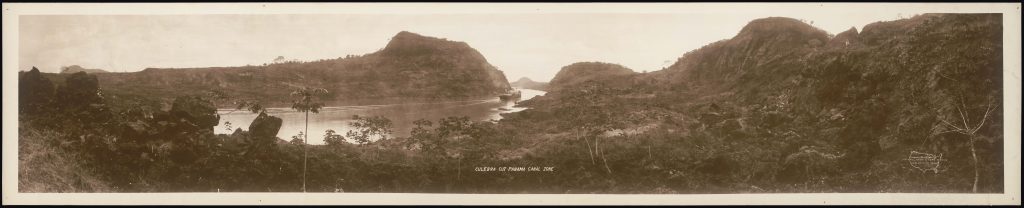
E.O. Goldbeck, Culebra Cut, Panama Canal Zone. Click on this link to view a larger photo in our digital collection, https://ufdc.ufl.edu/pcmi002610/00001 During the 1914 trip Goldbeck stayed at the Army-Navy YMCA in Cristobal and purchased cigarettes there to use as trade currency on an excursion to the San Blas Islands. He exchanged 60 cigarettes for 60 parakeets which he released in the courtyard of the YMCA when he returned. He said that when he came back years later, there were still parakeets living in the courtyard’s palm trees.

Real Photo Postcard, Army & Navy YMCA, Cristobal C.Z., II.2021.36.106 On another trip to Panama in 1930, Goldbeck photographed the first airmail flight from the Canal Zone to Washington D.C. and New York City – famously flown by Charles Lindbergh. Goldbeck shot video footage of the postmaster giving Lindbergh the mail and took still photos of the airplane taking off. The plane then came back and picked up the film, transporting it as part of the mail delivery. That same evening, the footage Goldbeck created was featured as part of the news broadcast about the flight.
We are fortunate to have these beautiful and important Goldbeck photographs in the collection. Thank you to our Conservation and Preservation Department and Digital Support Services for helping us preserve them!
Have you seen Goldbecks’s photographs before? Was your family member stationed in the Canal Zone in the early 20th century and possibly featured in one of the images?
The book The Panoramic Photography of Eugene O. Goldbeck by Clyde W. Burleson and E. Jessica Hickman is a wonderful place to learn more about his adventures and photographic process. You can also hear an interesting story about Goldbeck and his photographs on an episode of Antiques Roadshow. https://www.pbs.org/video/appraisal-e-o-goldbeck-panoramic-photographs-vofq3d/
-
Canal Zone Cemeteries
We were reminded of the important place that the cemeteries hold in the history of Panama and the Canal Zone by the annual clean-up of the Panamanian cemeteries, supported by CGM Cemetery Preservation Foundation (https://www.cgmcemeteryfoundation.org/) and traditionally held on November 2nd. The PCMC holds several photographs of Canal Zone cemeteries, taken throughout the twentieth century. Help us enhance the collection by describing your memories about the cemeteries or by filling in missing information about the photographs below.

Corozal Cemetery, American side, 1993. 
Corozal Cemetery, Panamanian side, 1993. 
Mt. Hope Cemetery, date unknown. 
“View looking North from top of Ancon Hill, showing Axis of Canal – September 29, 1912.” Photo by Ernest Hallen showing an old cemetery on the right, possibly the Ancon Cemetery from the French era, which was moved in order to build the Administration Building. 
Photo from the Corozal, Gatun, Mt. Hope Cemetery Preservation Foundation (CGM)’s annual cemetery clean-up day, 2020. The CGM is a non-profit organization dedicated to maintaining, restoring, and preserving the gravesites of people of Panamanian and West Indian descent in the former Canal Zone. -
Sports in the Zone
The PCMC holds a large number of photographs of sports played in the Canal Zone. What sports did you play in the Zone? What was unique about sports in the Canal Zone? Which sports were the most popular or most competitive?
As always, please comment if you have any additional information about the photographs below.

A basketball game between a Canal Zone Team and possibly a Central American Team, circa 1920s. 
Latin American Schools tennis players, year unknown. 
Balboa High School swim team, year unknown. -
La Boca Normal Training School
In a recent oral history interview conducted by Pan Caribbean Sankofa, Inc. in collaboration with the PCMC, an interview participant recalled her experiences attending La Boca Normal Training School after high school to train as a teacher. She would become a second-grade teacher and, later, a school crossing guard in the community.
What do you remember about La Boca Normal Training School or other schools in La Boca?
La Boca Normal Training School yearbook, The Thinker, 1944, pgs. 79-82


-
Hitting the Open Road
While this collection extensively covers the Panama Railroad, we also have a number of photographs of cars and buses. What do you remember about this form of transportation in the Canal Zone and Panama? Did you own your own car? Did you ride chivas or other public buses? What do you remember about the Pan-American Highway or other roads in the Canal Zone or Panama?
Below are photographs of automobiles from the collection – do you recognize anyone in these photos?
 Two boys posing on an automobile outside of Cristobal High School, 1935.

Men outside a chiva at a farmer’s market, 1939.
 A car on Gaillard Highway near Miraflores, undated.
-
Steelies
In her memoir, Canal Zone Daughter, Judy Haisten describes her childhood memories of exploiting movie theater seats for their “steelies”:
“Broken seats were common because of the ‘steelies’ – steel ball-bearings that would come out of the seat mechanism if you knew how to get one. The steelie was a hot commodity. We played marbles every day at school and nothing, I mean nothing, beat having a steelie in a marble collection.
…The best way to get a steelie was from a movie-theater seat. First you had to find an unbroken seat. Next, you had to bounce hard in the seat, over and over, just right until the seat broke and the ball-bearing fell out. Then you had to move fast to catch that tiny steel ball before it rolled down the theater floor.
With a wooden floor, everyone else in the theater also heard the steelie rolling and tried to grab it. No one would waste an opportunity to get a precious steelie. The little ball rolling down the floor was free game – until it was in someone’s hands.”
Haisten’s memories are from Gamboa Movie Theater – did you retrieve steelies from other movie theaters as well? Besides movie theater seats, how would you get steelies? Why were they so significant in playing marbles? What memories do you have about finding or playing with steelies?


Movie program sheet, Balboa and Coco Solo Theaters, February 1978