
Panoramic Panama

Some amazing treasures recently came back from the University of Florida Library’s Digital Support Services. Although they are all photographs, some items took two people to carry because of their incredible size – they are 6 feet long! (Thanks to Michele in our Grand Reading Room for being the second pair of hands)


Many of the photographs are images taken by E.O (Eugene Omar) Goldbeck, a commercial photographer who specialized in panoramic photography. He is know for using a Cirkut, a rotating panoramic camera, and for his images of military bases and personnel. In addition to Goldbeck’s name, look for his company “National Photo and News Service”.
Goldbeck first visited the Panama Canal in 1914, and credited that trip with his introduction to the full potential of the panoramic format. Afterwards, he traveled to Panama every few years and stayed there for about three months each time. He took photographs of the U.S. military personnel and a few scenic views of the Canal and surrounding cities.
His panoramic photos are well known and easily recognizable for their often complex arrangements of people into formations. To capture these expansive photos he often had to climb tall towers, including the 505 foot tall Navy wireless tower in Panama.




During the 1914 trip Goldbeck stayed at the Army-Navy YMCA in Cristobal and purchased cigarettes there to use as trade currency on an excursion to the San Blas Islands. He exchanged 60 cigarettes for 60 parakeets which he released in the courtyard of the YMCA when he returned. He said that when he came back years later, there were still parakeets living in the courtyard’s palm trees.

On another trip to Panama in 1930, Goldbeck photographed the first airmail flight from the Canal Zone to Washington D.C. and New York City – famously flown by Charles Lindbergh. Goldbeck shot video footage of the postmaster giving Lindbergh the mail and took still photos of the airplane taking off. The plane then came back and picked up the film, transporting it as part of the mail delivery. That same evening, the footage Goldbeck created was featured as part of the news broadcast about the flight.


We are fortunate to have these beautiful and important Goldbeck photographs in the collection. Thank you to our Conservation and Preservation Department and Digital Support Services for helping us preserve them!
Have you seen Goldbecks’s photographs before? Was your family member stationed in the Canal Zone in the early 20th century and possibly featured in one of the images?
The book The Panoramic Photography of Eugene O. Goldbeck by Clyde W. Burleson and E. Jessica Hickman is a wonderful place to learn more about his adventures and photographic process. You can also hear an interesting story about Goldbeck and his photographs on an episode of Antiques Roadshow. https://www.pbs.org/video/appraisal-e-o-goldbeck-panoramic-photographs-vofq3d/


4 Comments
Robert Dryja
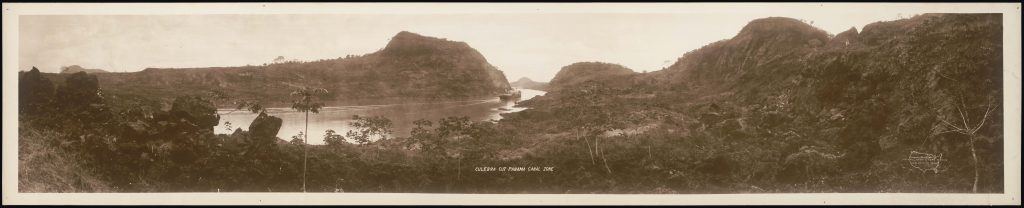
The photograph of Culebra Cut is such a contrast to photographs of the locks. Culebra Cut reflected the natural world of tropical jungle while the locks reflected monumental engineering. A person could see and appreciate both at the same time in the early 20th century while transiting the canal from ocean to ocean. The Panama Canal was composed of both.
Gilbert Small
Wonderful history pictures and commentaries about our beloved Panama Canal Zone and the general development of Panama.
Carl N. Berg of Cocoli, CZ
I believe some of these panoramic black and white photos are displayed at tabletop level in Niko’s Cafe
in Balboa. Nicko’s is built on the site of the former Balboa Bowling Alley, between the commissary and the
high school gymnasium.
–Carl N. Berg in Tempe, Arizona; former resident of Cocoli.
–See you at the 2023 PC Society Reunion in Orlando
Patricia Shedden Ivie
I lived in the Canal Zone from 1044 to 1953. I lived in Cristobal and Margarita with my grandparents, Robert W. White and Josephine Maher White. It was a great place to grow up.