-
Can you identify these street views?
Hello, PCMC members! Below are two images of unknown street scenes in the Canal Zone. Can you tell us where they are from, along with any other information about these places? If you can guess the general period they belong to, that would be helpful as well!

Image 1 
Image 2 -
Canal Zone Memories: Hotel Washington
Take a look at this picturesque photo taken in 1948 of Hotel Washington in Colón, Republic of Panama.

Do you have any memories associated with this hotel? Did you ever go there for events? Did you ever have friends or relatives who stayed there? Did you or someone you knew work there?
Make sure to join us for the 2018 Panama Canal Society Reunion in Orlando from June 27 – July 1, 2018, where there will be an exhibit about popular culture in the Panama Canal Zone on display. See more information and register here: https://www.pancanalsociety.org/reunion.html. We hope to see you there!
-
From the Stacks: Tourists in the Canal Zone
Here’s a photo we found from 1962/1963 of tourists at the Observation Platform at the locks.

How did you interact with tourists in the Canal Zone? Would you ever visit the observation platform or other tourist sites for school or with your family?
Make sure to join us for the 2018 Panama Canal Society Reunion in Orlando from June 27 – July 1, 2018, where there will be an exhibit about popular culture in the Panama Canal Zone on display. See more information and register here: https://www.pancanalsociety.org/reunion.html. We hope to see you there!
-
Call for Travel to Collections Proposals
Travel grants up to $2,500 are available to undertake research between August 1, 2018 and June 30, 2019 with UF’s Special and Area Studies Collections. Proposals are due Friday, June 1, 2018 with award notifications expected the week of July 1, 2018.
Judging criteria includes prioritization for interdisciplinary research and/or use of more than one collection, and proposals that support a feasible and tangible publication (e.g., an article, dissertation or book chapter). Awardees must travel 100 miles or farther to be eligible.
This year, in addition to the general travel grants, specific travel funds have been earmarked for proposals relating to the following areas:
- Constitutional studies and/or the legal profession in Florida
- The American era of the Panama Canal, the Panama Canal Zone and Panama Canal Museum materials (http://cms.uflib.ufl.edu/pcmc/index.aspx)
- Melvin J. Fregly (http://www.library.ufl.edu/spec/archome/fregly.htm) Please direct submissions to Florence M. Turcotte (turcotte@ufl.edu).
These must include:
- Title and description of proposed project (approx. 500 words), identifying relevant materials for consultation
- Budget estimate for travel, lodging and other expenses including:
– Transportation costs to and from Gainesville
– Housing costs for a maximum of two weeks - Statement affirming applicant’s commitment to submit a report at the end of the residency, including permission to use the report for promotions
- CV or résumé
- Name, postal address, telephone number, and a valid email address
Awardees must use our collections onsite and submit a report (approx. 500 words) describing the research visit by the end of their residency (June 30, 2019). Distribution of award occurs after submission of report and payment paperwork. Dates of research should be coordinated with appropriate curators.
QUESTIONS? If you have questions about the suitability of your proposal, or need information on any aspect of the program, please contact Flo Turcotte by phone (352-273-2767) or email (turcotte@ufl.edu).
-
Molas in Full Color
UF School of Art and Art History examined Panamanian molas from the PCMC collection first-hand to understand their complex appliqué techniques. Their class took place in the Judaica Suite in the Smathers Library.


Read here the full story here: https://arts.ufl.edu/in-the-loop/news/molas-in-full-color/
-
From the Stacks: Cayuco Race
The PCMC team came across these photographs from a cayuco race that occurred in 1999. Cayuco are boats that are traditionally used by native people in Panama, and are crafted from a large tree trunk.
Do you remember watching or participating in one of these races? Can you recognize any of the competitors in these photographs?

Look at the interesting figurehead on this cayuco! 
Two teams neck-to-neck! 
If you look carefully, you can see the words “We’re almost there” inscribed in the inside of the cayuco. 
OOPS! In 1954, Wesley Townsend, an employee of the Panama Canal Company, decided to take a group of Boy Explorer Scouts to visit an indigenous community on the Chagres River. During their visit, the boys learned about native culture and how to paddle a cayuco, which was a major method of transportation of the region. In time, the competition between them intensified and they decided to have a formal race, leading to the Ocean-to-Ocean Cayuco Race, a tradition which has now lasted for more than half a century.
To read the story behind one cayuco, Due Process, visit the Panama Canal Museum’s website here: http://cms.uflib.ufl.edu/pcm/readstories/Hobey_Richey.aspx.
Make sure to join us for the 2018 Panama Canal Society Reunion in Orlando from June 27 – July 1, 2018, where there will be an exhibit about popular culture in the Panama Canal Zone on display. See more information and register here: https://www.pancanalsociety.org/reunion.html. We hope to see you there!
-
From the Stacks: Panama Canal Women’s Welfare Group
We recently stumbled upon this photo of women who seem to belong to a “Panama Canal Women’s Welfare Group.” Any help identifying the women pictured would be much appreciated.

Do you remember the Panama Canal Women’s Welfare Group being very active in the Canal Zone? What kinds of excursions did these women go on? What was their mission or purpose? Did you know anyone in this group? What other organizations or clubs were prevalent in the Zone?
Thank you to all who contribute! Don’t forget to join us for the 2018 Panama Canal Society Reunion in Orlando from June 27 – July 1, 2018, there will be an exhibit about popular culture in the Panama Canal Zone on display.
-
Carnaval in the Canal Zone
Recently, we came across a collection of photos from Balboa in February 1958 as Carnaval (also spelled Carnival) celebrations were underway. Carnaval is still one of the most anticipated holidays in Panama and other parts of Central and South America. The festival lasts for about four days before Ash Wednesday, allowing attendees to indulge in foods and activities that are forbidden during the Lenten season.

Here, you can see the “Carnaval Queen” in costume. It is customary to determine a “King” and “Queen” of Carnaval, which is rooted in the beginnings of Carnaval in colonial Panama, when participants would satirize and mock political figures. 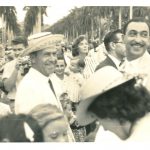

In these photos, Governor William E. Potter interacts with Balboa citizens.
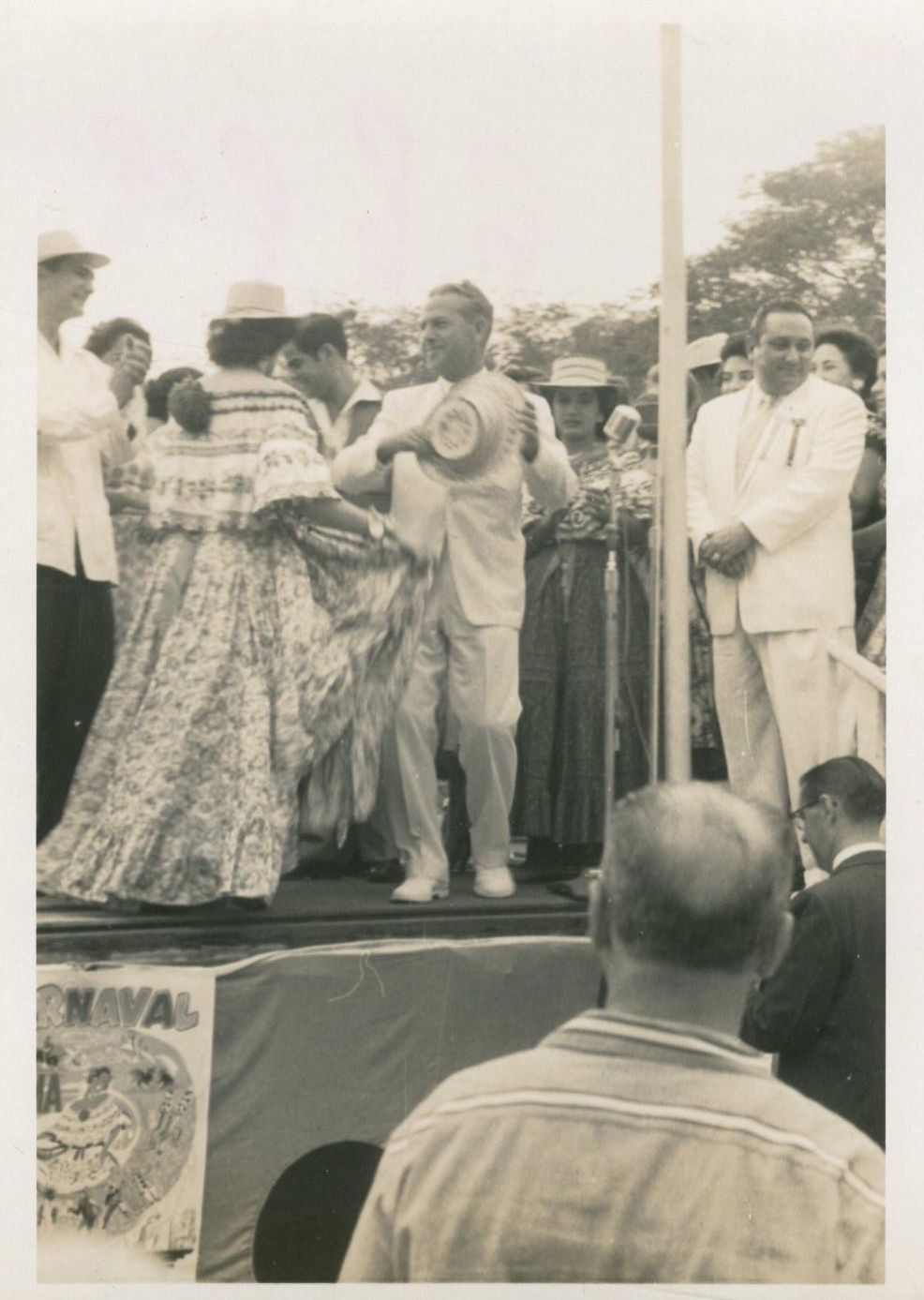
Governor Potter and the Carnaval Queen on stage. 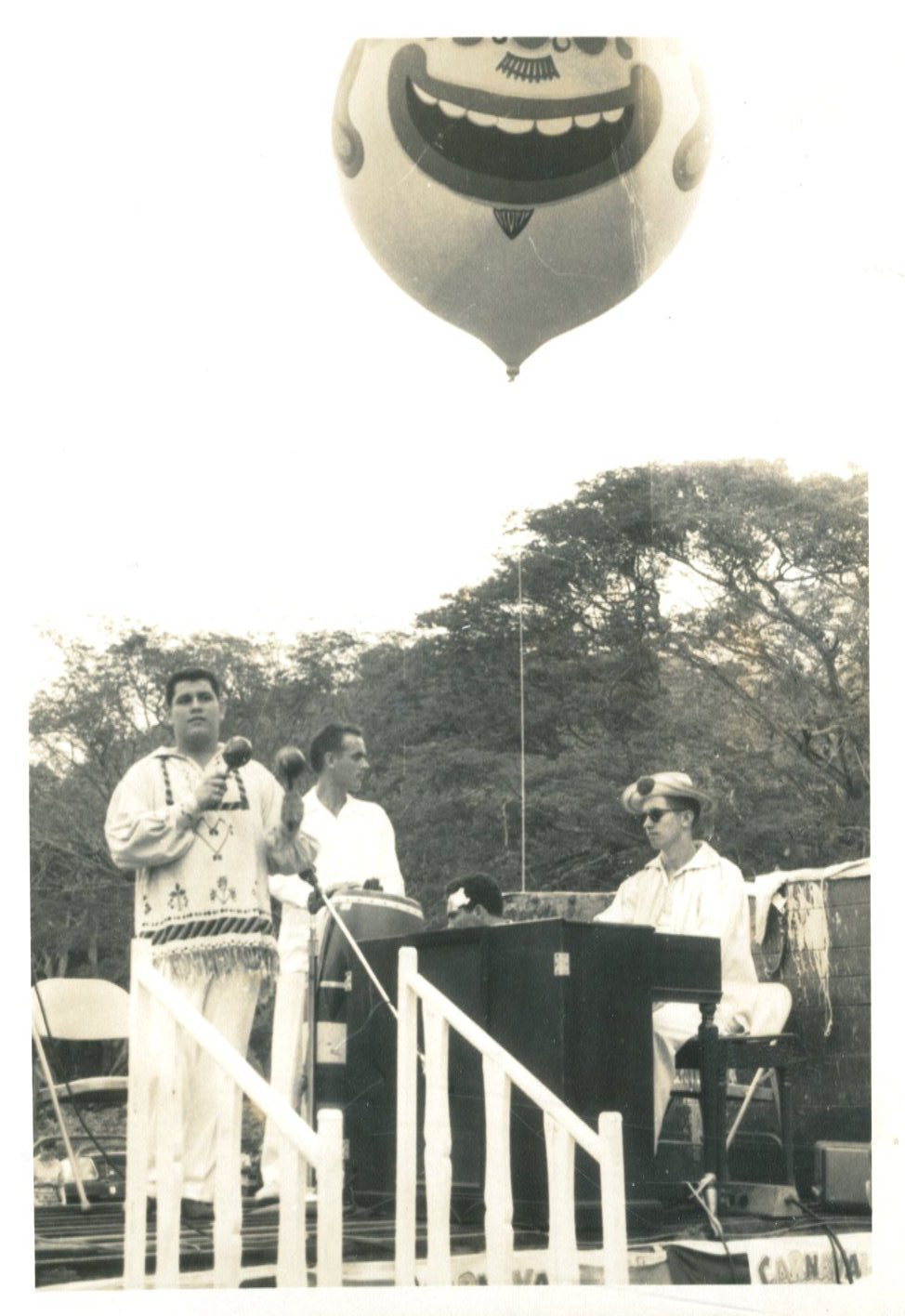
Pictured: “Chipi” Azcarraga, the son of world renowned Lucho Azcarraga, on maracas; Vic Herr, BHS band director is playing the conga; Edgar Ameglio (BHS ’58) has a bandage on his head; Don Randel (BHS ’58) is playing the organ. From Don Randel, regarding the photo above: “Photo is of a rehearsal for the Carnival Tuesday parade in Panama City, in which we played on a float, which required a generator to produce 60 cycle 110 volt current for the organ. We played strictly Panamanian music–tamboritos, etc.”

A giant figurine of a woman is paraded, followed by marchers wearing large masks. At the 2018 Panama Canal Society Reunion in Orlando from June 27 – July 1, 2018, there will be an exhibit about popular culture in the Panama Canal Zone on display. We hope to see you there!
Did you ever participate in Carnaval celebrations? What was unique about celebrating Carnaval in the Canal Zone?


