-
Stuff about Sturgis

The Sturgis docked in Gatun Lake. U.S. Army Photo courtesy of Office of History, HQ, U.S. Army Corps of Engineers. Oral history interviews are a great place to learn about parts of Panama Canal history that you might not have known about or have forgotten. At this year’s Panama Canal Society reunion in Orlando, we had the pleasure of meeting and talking to Carol Hellums.
She and her husband Bill had done an interview with the Panama Canal Museum in 2011 and it opens with a great story about how they met in 1968 on an airplane headed to Panama. Bill was moving down to serve as part of the crew on the Sturgis, and Carol was visiting her parents.
Carol taught us about the MH-1A pressurized water nuclear reactor, aka the Sturgis, the first floating nuclear power station. It was built by the Army Reactors Branch of the Army Corps of Engineers as a way to generate power in remote, inaccessible, or difficult locations – the “MH” stands for mobile, high power. The Sturgis was a converted Liberty Ship, a special class of cargo ship that was built during World War II. Because the vessel would be stationary for the majority of its life it was re-designed to be a towed craft, and it was taken to its home near the Gatun Spillway in August 1968.

Sturgis in Gatun Lake. Image from the U.S. Army Corps of Engineers exhibit Army Nuclear Power Program – MH-1A Sturgis. In the early months of 1968, the Canal experienced a water shortage that affected both the operations of the Canal and the electricity supplied to the Canal Zone which was provided by the hydroelectric power station at Gatun Dam. By subsidizing the power station, the water that would have been used could instead be reserved for transiting ships.
The Sturgis generated electricity for the Canal Zone from 1968-1975, along with a second barge, the diesel-fueled Andrew J. Weber added in November 1968. It is estimated that they helped reserve over one trillion gallons of water for use in Canal operations.
Bill worked on the Sturgis monitoring the environment, taking water and sediment samples under the boat, and gathering biomass further afield in the jungles for radiological analysis. He and Carol joke that he basically got to fish in the Canal Zone for a living. Listen to a clip from their oral history below:
Transcript In the clip Bill mentions that The Big Picture, a news series produced by the U.S. Army, came down to Panama and filmed him. It took a while, but after watching a lot of episodes I finally found the one that features the Sturgis! View the episode below. The section about the Sturgis begins at 17:17:
Eventually two turbines were added to the Canal system and the Sturgis became obsolete. This story reminds us that the water shortage the Canal is experiencing today is not a new problem and that numerous efforts have been made to mitigate the issue over time. Creative solutions will undoubtedly continue be a part of the Canal’s future as it faces increasing environmental challenges.
In their interview, Bill also told an incredible story about a storm the Sturgis weathered during it’s trip back to Ft. Belvoir, Virginia to begin the deactivation of the reactor. Listen to a clip from the story:
Transcript Click through the slideshow below by pressing the arrows at the left and right sides of the image:

MH-1A Control Room with Operator, 1965-1977 . United States Armed Forces Nuclear Energy Association. https://usace.contentdm.oclc.org/digital/collection/p15141coll5/id/4115/rec/16 
Shoe covers from the MH-1A Sturgis. Office of History, HQ, U.S. Army Corps of Engineers. https://usace.contentdm.oclc.org/digital/collection/p15141coll5/id/4131/rec/12 
Cutaway model of the MH-1A Sturgis. Office of History, HQ, U.S. Army Corps of Engineers. https://usace.contentdm.oclc.org/digital/collection/p15141coll5/id/4137/rec/2 
Reactor containment vessel of the MH-1A reactor. Office of History, HQ, U.S. Army Corps of Engineers. https://usace.contentdm.oclc.org/digital/collection/p15141coll5/id/4138/rec/9
After the extensive process of deactivation, the ship was “mothballed” as part of the James River Reserve Fleet. Its final decontamination began in 2014 and by 2019 it had been scrapped.
To learn more about the origin, life, and decommissioning of the Sturgis view this U.S. Army Corps of Engineers exhibit: https://www.usace.army.mil/About/History/Exhibits/Nuclear-Power-Program/Sturgis/
To listen to Bill and Carol’s full interview visit out digital collection: An Interview with William and Carol Hellums
Do you remember seeing the Sturgis? Do you have any stories about the ship’s time at the Canal?
This post is part of our fall focus on the important work of the Panama Canal Museum and on the oral history program they began and which continues today. This year is the 25th anniversary of the founding of the Panama Canal Museum in 1998. The museum operated for 14 years in Seminole, Florida, before closing in July 2012 and transferring its collection to UF. The successes achieved by the museum paved the way for the PCMC to develop as a preeminent research collection for the study of the American era of the Canal. For more information on the history of the Museum, please visit go.ufl.edu/pcm
Between now and the end of December, we are celebrating their 25th Anniversary and hope to honor their hard work as well as that of our Friends of the PCMC group by adding $13,000 to the $12,000 that was raised by this year’s Silent Auction for a total of $25,000 – $25,000 for 25 amazing years!
If you would like help us reach the goal please donate here: https://pcmc.uflib.ufl.edu/oralhistory/. All funds will go to support the PCMC oral history program.
-
Twenty-Five

Envelope created to celebrate the 25th Anniversary of the Panama Canal, 1914-1939. Two Canal Zone stamps also created to celebrate the 25th Anniversary, Scott 126 and 127. Gift of Dr. Carl A. and Martha B. Peterson. II.2018.89.1.
Happy 25th Anniversary to the Panama Canal Museum

This year is the 25th anniversary of the founding of the Panama Canal Museum in 1998. The museum successfully operated for 14 years in Seminole, Florida, before closing in July 2012 and transferring its collection to UF. The successes achieved by the museum over those 14 years paved the way for the PCMC to develop as a preeminent research collection for the study of the American era of the Canal. For more information on the history of the Museum, please visit go.ufl.edu/pcm
Twenty-five years ago a group of individuals got together with the common goal of preserving the history of the American Era of the Panama Canal. Early on a committee was established to acquire the items needed for this “Repository of Memories”: artifacts, papers, photographs, scrapbooks, diaries, letters, yearbooks, programs, commissary memorabilia, reports, operations manuals, books, signs…you name it. Those treasures became the foundation of the Panama Canal Museum and were used to create permanent exhibits about the Spanish, French, and American Eras of the Canal, the Tivoli, and the Panama Railroad as well as 17 rotating and traveling exhibits. Under their stewardship the collection grew to over 13,000 objects.
Enjoy this slideshow highlighting PCM’s history. Press the arrows at the right and left to move through the images.

The school bell from Cristobal joining the Panama Canal Museum’s collection 
Panama Canal Museum Review, October 2001 
Panama Canal Museum Review, November 2001 
Panama Canal Museum Review, Fall/Winter 2008 
Panama Canal Museum Review, May 2005 
Panama Canal Museum Staff and Volunteers in Panamanian style dress. 
Panama Canal Museum Review, Spring/Summer 2006 
Chris Skeie and Ed Beasley with a Canal Zone Boy Scouts Flag 
Panama Canal Museum Review, October 2003 
Panama Canal Museum Review, Spring/Summer 2008 
Panama Canal Museum Review, Fall/Winter 2011
In addition to building and running the museum, they earned federal grants, had a gift shop, created educational curriculum, designed ornaments, made a board game, hosted potluck lunches (including a lunch with “Teddy Roosevelt” in 2008), ran a silent auction and created exhibits to display at the Panama Canal Society Reunion, and published three books: Opening the Gates to Canal Cuisine: Preserving the American Era in 2005, Write of Passage: Stories of the American Era of the Panama Canal in 2008, and Panama Canal Townsites in 2012. This list goes on – their work and dedication was impressive.
They even got a phone call from the popular game show “Who Wants to be a Millionaire?” with a request to answer some questions about the Panama Canal for the program! Does anyone know if they ever asked a contestant the question?
The video below offers a small glimpse into their efforts.
Although the Museum’s collection officially became part of the University of Florida in 2012, the founders and friends of the original museum have continued to steward, support, and build the collection. They are an essential part of the success of the Panama Canal Museum Collection at UF.

Panama Canal Museum Review, Spring/Summer 2011 Since the collection’s arrival at UF, it has grown to over 25,000 objects, more than 13,000 pages/items have been digitized, and our Friends have helped raise over $1.1 million to support it. In 2017, we opened the Albert H. Nahmad Panama Canal Gallery where the Panama Canal Museum’s legacy lives on through annual rotating exhibitions.
The Silent Auction that the Museum started hosting at the Panama Canal Society Reunion in 2003 has also continued and is now run by the Friends of the Panama Canal Museum Collection. The current auction committee includes some familiar faces from the Panama Canal Museum’s vendor tables, “The Walkerettes”.

The Walker sisters Mickey, Jeanne, and Carol and their aunt Emily Bliss volunteer, running the Panama Canal Museum’s vendor tables at the Panama Canal Society reunion in 2011. Read the Panama Canal Museum Review’s wonderful write up about these ladies and their families multi-generational history at the Canal on page six of the Fall/Winter 2011 issue. Between now and the end of December, we are hoping to honor their hard work by adding $13,000 to the $12,000 that the auction raised at the reunion this year for a total of $25,000 – $25,000 for 25 amazing years!
If you would like help us reach the goal please donate here: https://pcmc.uflib.ufl.edu/oralhistory/. All funds will go to support the PCMC oral history program.
Another happy anniversary to the Panama Canal Museum and a huge thank you for everything you have done to collect and preserve this history!
Back in 2003 Leo Krziza made a similar challenge – he offered to donate $25,000 to the museum if other donations could be raised to match it. The response exceeded his expectations with gifts from others totaling $44,000. Leo presented his check, written in memory of his sister Esther, to Joe Wood at the Panama Canal Society Reunion.

-
Manhattan in Panama
Do you know anyone that is connected both to the Panama Canal and the Manhattan Project?
There are likely more but here are highlights from the lives of three individuals who were associated with both: Hartley Rowe, Colonel Elmer Ellsworth Kirkpatrick, and Katherine “Kitty” Oppenheimer.
Hartley Rowe
Hartley Rowe was an industrial engineer who worked on the construction of the Panama Canal from 1904-1908. He joined the Isthmian Canal Commission in November 1904 and transferred back and forth between the Panama Railroad and the Canal Commission as an Electrician. He managed a power plant in La Boca and was a resident engineer until 1919 when he returned to the United States after almost 15 years of continued service at the Canal. His work in 1912 included managing air compressor plants which were critical to powering the steam shovels digging the Canal.
Rowe belonged to the Society of the Chagres and is mentioned in their yearbooks, serving as a Vice President 1915-1916. https://ufdc.ufl.edu/aa00013083/00001 He was also an active member of the Panama Canal Society and appears often in their publication the Canal Record.

Seating Chart for the Society of the Chagres Banquet, February 21, 1913. 2011.021.013. Gift of Linda Adelsberger. The name Ben Jenkins is noted on the seating chart and he happened to be sitting right across the table from Hartley Rowe. Do you know who Ben Jenkins was? His travels through the Canal during his work for the United Fruit Company are well documented in the Panama American newspaper.


Panama American, June 6, 1926. Were any of your family members there?
Rowe joined the Manhattan Project in Los Alamos in 1944 and worked on the team transitioning the implosion program from weapons research to production.

General Advisory Committee of the Atomic Energy Commission in Santa Fe, NM, April 3, 1947. Left to Right: James B. Conant, J. Robert Oppenheimer, Brigadier General James McCormack, Hartley Rowe, John H. Manley, Isidor Isaac Rabi, and Roger S. Warner. Image from the Bulletin of the Atomic Scientists. Public Domain. Colonel Elmer E. Kirkpatrick
Elmer E. Kirkpatrick was an officer in the United States Army Quartermasters Corps and the Army Corps of Engineers. After graduating from West Point in 1925 his fourth, and first overseas, post was the Panama Canal. He arrived in August of 1939 and supervised war preparations at Fort Davis, Fort Randolph, France Field, and other anti-aircraft artillery positions around Gatun Lake.

The 1940 Census lists his family as living on the main road in Fort Randolph. 
In 1944, he started his work with the Manhattan Project. Initially he spent considerable time at Los Alamos and other locations. He assisted in inspecting bomb prototypes and observing training of the 509th Composite Group, the United States Army Air Force unit tasked with the deployment of nuclear weapons. He was also sent to the Pacific Island of Tinian where he was responsible for the development of facilities that would be used in the movements of the atomic bombs dropped on Hiroshima and Nagasaki.
After extensive service in the Construction Division of the Pacific he moved to Jacksonville, Florida and was involved in building the initial facilities at Cape Canaveral.
Another interesting connection is his service as an assistant professor in the College of Architecture at the University of Florida. He was hired in June 1959 and taught in the Department of Building Construction.

University Record, Undergraduate Catalog 1962-1963, University of Florida. Held in the University Archives, a neighbor collection to PCMC in the Special & Area Studies Collections Library. https://ufdc.ufl.edu/uf00075594/00077 Katherine “Kitty” Oppenheimer
Katherine “Kitty” Oppenheimer was the wife of J. Robert Oppenheimer. While living in Los Alamos during the Manhattan Project she worked for the Health Group conducting blood tests designed to evaluate the dangers of radiation, she led social engagements to provide distractions from the stressful environment, and raised her two young children. Throughout her life she served as an important confidant to her husband who became an internationally known figure for his work on the atomic bomb.
Sadly, unlike the former two, Katherine’s association with the Panama Canal came at the end of her life. In 1972, she was planning to sail from the U.S. to Japan by way of the Canal but fell ill early in the voyage. She died of a pulmonary embolism at Gorgas Hospital in the Canal Zone. The record of her death is among the Gorgas Hospital Mortuary Registers housed today in the National Archives of the United States.
During their time at the Institute of Advanced Study, Robert Oppenheimer had a greenhouse built for Kitty who was a trained botanist. She raised orchids there and often received rare varieties as gifts from her husband.
Many people mention the beautiful orchids in Panama in anecdotes and oral history interviews. I can’t help but think that Kitty would have very much enjoyed seeing them.

Taken from an article about orchids in Panama, published in the May 1970 Panama Canal Review. Stay tuned for a related blog post about Appendix 6.

Final Draft of Appendix 6, Isthmian Canal Studies 1947, 2014.133.1 -
Panoramic Panama

E.O. Goldbeck, Gatun Locks, 1930s, 2000.92 Some amazing treasures recently came back from the University of Florida Library’s Digital Support Services. Although they are all photographs, some items took two people to carry because of their incredible size – they are 6 feet long! (Thanks to Michele in our Grand Reading Room for being the second pair of hands)


Many of the photographs are images taken by E.O (Eugene Omar) Goldbeck, a commercial photographer who specialized in panoramic photography. He is know for using a Cirkut, a rotating panoramic camera, and for his images of military bases and personnel. In addition to Goldbeck’s name, look for his company “National Photo and News Service”.
Watch the Cirkut in action on YouTube. The spool of film that would have been inside the camera was about 10 inches tall and the unrolled film was 7 feet long. Goldbeck first visited the Panama Canal in 1914, and credited that trip with his introduction to the full potential of the panoramic format. Afterwards, he traveled to Panama every few years and stayed there for about three months each time. He took photographs of the U.S. military personnel and a few scenic views of the Canal and surrounding cities.
His panoramic photos are well known and easily recognizable for their often complex arrangements of people into formations. To capture these expansive photos he often had to climb tall towers, including the 505 foot tall Navy wireless tower in Panama.

E.O. Goldbeck, 33rd U.S. Infantry, Ft. Clayton, Panama Canal Zone, May 9, 1939. Click on this link to view a larger photo in our digital collection, https://ufdc.ufl.edu/uf00098453/00001 
E.O. Goldbeck, Troops of Ft. Amador, Panama Canal Zone, 1933. Click on this link to view a larger photo in our digital collection, https://ufdc.ufl.edu/uf00098450/00001 
E.O. Goldbeck, Ft. Sherman, Panama Canal Zone, 1930. Click on this link to view a larger photo in our digital collection, https://ufdc.ufl.edu/uf00098456/00001 
E.O. Goldbeck, Albrook Field, Panama Canal Zone, 1933. Click on this link to view a larger photo in our digital collection, https://ufdc.ufl.edu/uf00098449/00001 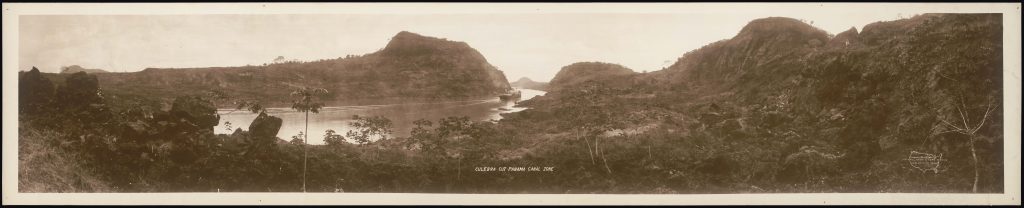
E.O. Goldbeck, Culebra Cut, Panama Canal Zone. Click on this link to view a larger photo in our digital collection, https://ufdc.ufl.edu/pcmi002610/00001 During the 1914 trip Goldbeck stayed at the Army-Navy YMCA in Cristobal and purchased cigarettes there to use as trade currency on an excursion to the San Blas Islands. He exchanged 60 cigarettes for 60 parakeets which he released in the courtyard of the YMCA when he returned. He said that when he came back years later, there were still parakeets living in the courtyard’s palm trees.

Real Photo Postcard, Army & Navy YMCA, Cristobal C.Z., II.2021.36.106 On another trip to Panama in 1930, Goldbeck photographed the first airmail flight from the Canal Zone to Washington D.C. and New York City – famously flown by Charles Lindbergh. Goldbeck shot video footage of the postmaster giving Lindbergh the mail and took still photos of the airplane taking off. The plane then came back and picked up the film, transporting it as part of the mail delivery. That same evening, the footage Goldbeck created was featured as part of the news broadcast about the flight.
We are fortunate to have these beautiful and important Goldbeck photographs in the collection. Thank you to our Conservation and Preservation Department and Digital Support Services for helping us preserve them!
Have you seen Goldbecks’s photographs before? Was your family member stationed in the Canal Zone in the early 20th century and possibly featured in one of the images?
The book The Panoramic Photography of Eugene O. Goldbeck by Clyde W. Burleson and E. Jessica Hickman is a wonderful place to learn more about his adventures and photographic process. You can also hear an interesting story about Goldbeck and his photographs on an episode of Antiques Roadshow. https://www.pbs.org/video/appraisal-e-o-goldbeck-panoramic-photographs-vofq3d/
-
Happy New Year! and the 10 for 10 review

Fireworks from Sosa Hill, c1960, 2007.072.001.002 We hope everyone had a wonderful holiday season. We are back in the office and catching up before the spring semester gets in full swing.
As promised, we wanted to share an update with you about the 10 for 10 campaign we completed at the end of last year. The goal was to raise $10,000 in 10 weeks to honor the 10 year anniversary of the Panama Canal Museum Collection coming to the University of Florida. The funds will be used to support the Oral History Program.
We are thrilled to say that with Albert and Jane Nahmad, Kathy Egolf, Carol Meyer MD, and Joe and Bev Wood leading the charge, we were able to raise $19,401, almost doubling our goal. Thank you to everyone that participated. This tremendous show of support will help us continue conducting oral history interviews and capturing the incredible history and priceless memories of those that lived and worked at the Panama Canal.
A special thank you to Albert and Jane Nahmad, who donated $15,000 for the Oral History Program! The Nahmads previously had generously provided the funding to establish the Panama Canal Gallery, which is dedicated to Albert’s classmates in the Balboa High School Class of 1958 (https://pcmc.uflib.ufl.edu/exhibits/gallery/).
Thank you for following the 10 weeks with us. Visit our Oral History Program page to keep listening to the amazing stories, https://ufdc.ufl.edu/collections/ohpcm.
-
10 for 10 – week 10
Thank you for celebrating with us!
This is the final week, of our 10 FOR 10 campaign to celebrate the 10th anniversary of the Panama Canal Museum Collection’s (PCMC) arrival at the University of Florida. We will post an update on the success of the campaign in January so that you can share in the excitement.
We hope you have enjoyed the past ten weeks of oral history clips – I had such a wonderful but difficult time selecting them. There are many treasures in these interviews and it was hard to only pick ten. We hope that you will explore the interviews more on your own here. In additional to being a joy to conduct and to listen too, these interviews help document the past as well as to enrich our classes, research, and annual exhibits in the Albert H. Nahmad Panama Canal Gallery. Please get in touch with us if you are interested in doing an oral history, ehbemis@ufl.edu.
Now, on to the finale…
Since it is the last week I let myself pick two clips – one is Jeanne Sperry and the other is Bob Zumbado. They both talk about Christmas traditions and “chicanery” as Bob puts it.

“Christmas doesn’t end for the children of the Canal Zone until the last tree goes up in flames.” Panama Canal Review, February 1955, https://ufdc.ufl.edu/uf00097366/00133 Interview with Jeanne Sperry, 2021, https://ufdc.ufl.edu/aa00087673/00001 Interview with Bob Zumbado, 2011, https://ufdc.ufl.edu/aa00013369/00001 The goal is to raise $10,000 during the ten weeks to support the PCMC oral history program. If you are interested in donating, please visit https://pcmc.uflib.ufl.edu/oralhistory/ or contact John Nemmers, jnemmers@ufl.edu, (352) 273-2766. View our Celebrating Ten Years Booklet. Contact Betsy Bemis, ehbemis@ufl.edu, if you are interested in doing an oral history interview.

-
10 for 10 – week 9
This is week nine of our 10 FOR 10 campaign to celebrate the 10th anniversary of the Panama Canal Museum Collection’s (PCMC) arrival at the University of Florida!
Once a week for ten weeks we will post an oral history clip to the blog. We hope you will enjoy them and that at least one or two of the stories inspire some memories
This week we selected a clip from Cirilo Alexander – he discusses being a young man in the Canal Zone during World War II and listening to news about the war on the radio.

Search Light Drill, U.S. Fleet, Panama Bay, WWII, II.2022.5.1 Interview with Cirilo Alexander, 2020, http://ufdc.ufl.edu/AA00081785/00001 The goal is to raise $10,000 during the ten weeks to support the PCMC oral history program. If you are interested in donating, please visit https://pcmc.uflib.ufl.edu/oralhistory/ or contact John Nemmers, jnemmers@ufl.edu, (352) 273-2766. View our Celebrating Ten Years Booklet. Contact Betsy Bemis, ehbemis@ufl.edu, if you are interested in doing an oral history interview.
-
10 for 10 – week 8
This is week eight of our 10 FOR 10 campaign to celebrate the 10th anniversary of the Panama Canal Museum Collection’s (PCMC) arrival at the University of Florida!
Once a week for ten weeks we will post an oral history clip to the blog. We hope you will enjoy them and that at least one or two of the stories inspire some memories.
This week we selected a clip of Bill McLaughlin – he talks about his favorite beach and the construction era town of Gorgona

Moving buildings in sections. Partitions loaded onto flat cars ready to be moved. Gorgona, C.Z. 1913, 2014.160.17 Interview with Bill McLaughlin, 2020, http://ufdc.ufl.edu/AA00081345/00001 The goal is to raise $10,000 during the ten weeks to support the PCMC oral history program. If you are interested in donating, please visit https://pcmc.uflib.ufl.edu/oralhistory/ or contact John Nemmers, jnemmers@ufl.edu, (352) 273-2766. View our Celebrating Ten Years Booklet. Contact Betsy Bemis, ehbemis@ufl.edu, if you are interested in doing an oral history interview.
-
10 for 10 – week 7
Happy Thanksgiving Week!
This is week seven of our 10 FOR 10 campaign to celebrate the 10th anniversary of the Panama Canal Museum Collection’s (PCMC) arrival at the University of Florida!
Once a week for ten weeks we will post an oral history clip to the blog. We hope you will enjoy them and that at least one or two of the stories inspire some memories.
This week we selected a clip from the Bremer family. In addition to Thanksgiving, this week is certain to be full of football for many people so we picked a clip about football games in the Canal Zone.
Click this link if you are interested in reading Thanksgiving recipes from the Panama Canal Review, November 1969, http://ufdc.ufl.edu/UF00097366/00045

Thanksgiving, Panama, 1909, II.2022.80.3, Gift of Barbara Daniels 
Back of the photograph of Thanksgiving in Panama in 1909, II.2022.80.3. It reads: “Thanksgiving ’09 Panama. The preacher. only half the table shows. There were eleven in all.” The name at the bottom is difficult to read. Possibly “The Stewarts”. What do you think?
Interview with the Bremer Family, 2010, http://ufdc.ufl.edu/AA00013365/00001 The goal is to raise $10,000 during the ten weeks to support the PCMC oral history program. If you are interested in donating, please visit https://pcmc.uflib.ufl.edu/oralhistory/ or contact John Nemmers, jnemmers@ufl.edu, (352) 273-2766. View our Celebrating Ten Years Booklet. Contact Betsy Bemis, ehbemis@ufl.edu, if you are interested in doing an oral history interview.
-
10 for 10 – week 6
This is week six of our 10 FOR 10 campaign to celebrate the 10th anniversary of the Panama Canal Museum Collection’s (PCMC) arrival at the University of Florida!
Once a week for ten weeks we will post an oral history clip to the blog. We hope you will enjoy them and that at least one or two of the stories inspire some memories.
This week we selected a clip from Ricardo Cox – he tells a story about riding his bike and how once it ended up in the Canal.

Interview with Ricardo Cox, 2020, http://ufdc.ufl.edu/AA00081797/00001 The goal is to raise $10,000 during the ten weeks to support the PCMC oral history program. If you are interested in donating, please visit https://pcmc.uflib.ufl.edu/oralhistory/ or contact John Nemmers, jnemmers@ufl.edu, (352) 273-2766. View our Celebrating Ten Years Booklet. Contact Betsy Bemis, ehbemis@ufl.edu, if you are interested in doing an oral history interview.


