-
Sidney Young
This post is part of a pilot student project created for the University of Florida class, Raising History from the Grave: Primary Historical Research in Literary Analysis and Public Humanities taught by Dr. Leah Rosenberg. The students focused on members of the Black Caribbean diaspora who worked on the Panama Canal or in the Canal Zone, the U.S. territory that surrounded the Panama Canal for much of the 20th century. These employees were originally classified as Silver employees because they were paid in silver currency as opposed to the Gold employees who were American citizens paid in gold currency. The term is still used today by both the community and scholars. The students worked with Pan Caribbean Sankofa, a community organization dedicated to preserving the history of Caribbean people in Panama, who identified community leaders as subjects for the project. Students consulted a wide array of archival materials in the Panama Canal Museum Collection and other institutions and learned how to use these resources to highlight individual accomplishments and connect lives to their larger communities through the digital humanities. For other posts, see Raising History from the Grave.

Sidney Young working at his desk at the Panama Tribune https://digitalcollections.nypl.org/items/a7d0e925-f8c4-eff6-e040-e00a18060357 Childhood and Education
Sidney Adolphus Young was born in December 1898 in Kingston, Jamaica, to Thaddeus Augustus Young (a cabinet maker) and Sarah Elizabeth Young (a farmer’s daughter). He and his parents moved to Panama in 1906, but his parents sent Sidney back to Jamaica for education. He attended West Branch Elementary School from 1908 to 1911, pursuing private studies in Classics and Social Studies (“Sidney Young” 1-2).
West Branch Elementary was “if not the foremost, one of the foremost schools in the Island” (“Mr. A.L. Walcott” 6) in Jamaica. While Sidney was in attendance, West Branch was under the leadership of A.L. Walcott and had “a first class position” as well as the “largest [attendance] in the island” (“An Honoured Son of the Soil” 8). The school held concerts, competitions, and celebrations, both for the cultural enrichment of the pupils and the benefit of the larger community (“West Branch School” 11, “West Branch, Kingston” 9). The fact that Sidney went to school here speaks to the socio-economic status of his family and explains why he was sent to Jamaica for schooling.
While the school Sidney attended was quite exceptional, the elementary educational system in Jamaica was less than ideal. The pupil-teacher system, where teachers would apprentice students, led to a lackluster standard of education. These apprentices, often around 13 years of age, would observe teachers and eventually teach younger students in the hopes of becoming elementary school teachers one day. This system neither provided adequate training nor produced effective teachers. Teachers were authoritative, and the curriculum was mainly comprised of rote memorization of the 3 R’s: reading, writing, and ‘rithmetic (Jeffrey 202-3). Additionally, the schooling system was fraught with racial and class divisions. Lower-class black children were taught less material than middle-class children (the social group to which Sidney Young’s family belonged).
For the lower class, elementary schooling was more a method of social control than a way of instruction. Their education was intended to occupy them and discourage them from criminal activity (228). The education of upper-class children was designed to infuse them with loyalty to England and “intellectual, cultural, and technological orientation to the mother country” (200). Middle-class children like Sidney were caught in the middle. He would have been treated better than his black peers and thus be instilled with a sense of superiority. He would also have been suffused with loyalty to England and all that entailed, but he and his family were still far from the upper class in regard to power and wealth.
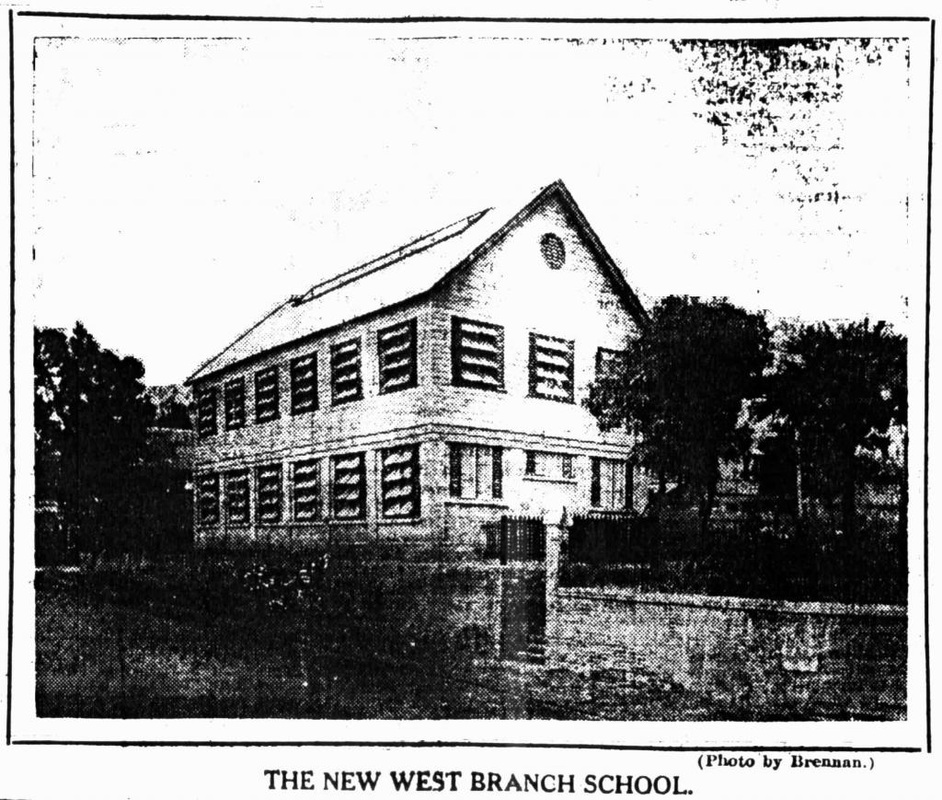
Photograph of West Branch Elementary School (Photo by James William Charles Brennan, circa 1890-1900 https://archivesearch.lib.cam.ac.uk/agents/people/3722) Career Before Journalism
In his teens, Sidney Young returned to Panama. He worked in the canal zone as a messenger, his first and only job in the canal zone. In 1916, he apprenticed at a printing business as a printer’s devil. He also worked for both a mercantile company and a bakery (Putnam, Sidney Young 2). He was also heavily involved in civic life in the West Indian community. He was for instance, a Boy Scout. Throughout his life, he remained a staunch supporter of scouting in Panama. He became a scout leader, and later on, he even made a space for the regular publication of scout-related articles in the Panama Tribune’s weekly “Scout Corner” when he founded his own newspaper (Putnam, Sidney Young 2, To Study the Fragments 624).
In 1924, Sidney Young led a group of 17 scouts to the Scouts Imperial Jamboree at the Wembley British Empire Exhibition. A newsreel by Topical Budget entitled “Greatest Jamboree, Wembley”, depicts the celebration. On his trip, Young was part of a parade of 640 scouts who were greeted by and congratulated by King George V for their appearance and discipline. In his speech, he communicated that being a scout makes a boy a better citizen of the empire and that the children would learn more in one week at the exhibition than one year back home. The Chief Scout, Sir Robert Baden Powell, spoke after him. He encouraged the boys to learn as much as possible about England, taking home the good parts and keeping the bad parts to themselves (“British King Addresses Over Seas Boy Scouts” 1, 8). The entire purpose of the British Empire Exhibition was to reinforce colonial racial hierarchies. Through the education of youth, they hoped to strengthen trade ties and build connections within the empire, enhancing Britain’s hold over their colonies (Ryu 55).
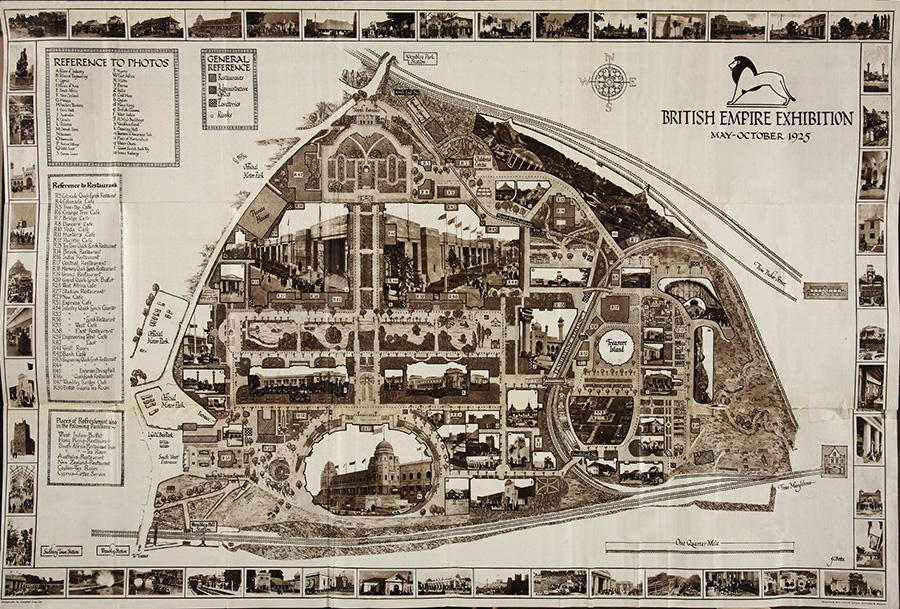
Plan of the British Empire Exhibition, 1925. https://blog.nationalarchives.gov.uk/20speople-a-vast-window-display-the-british-empire-exhibition-of-1924-5/ 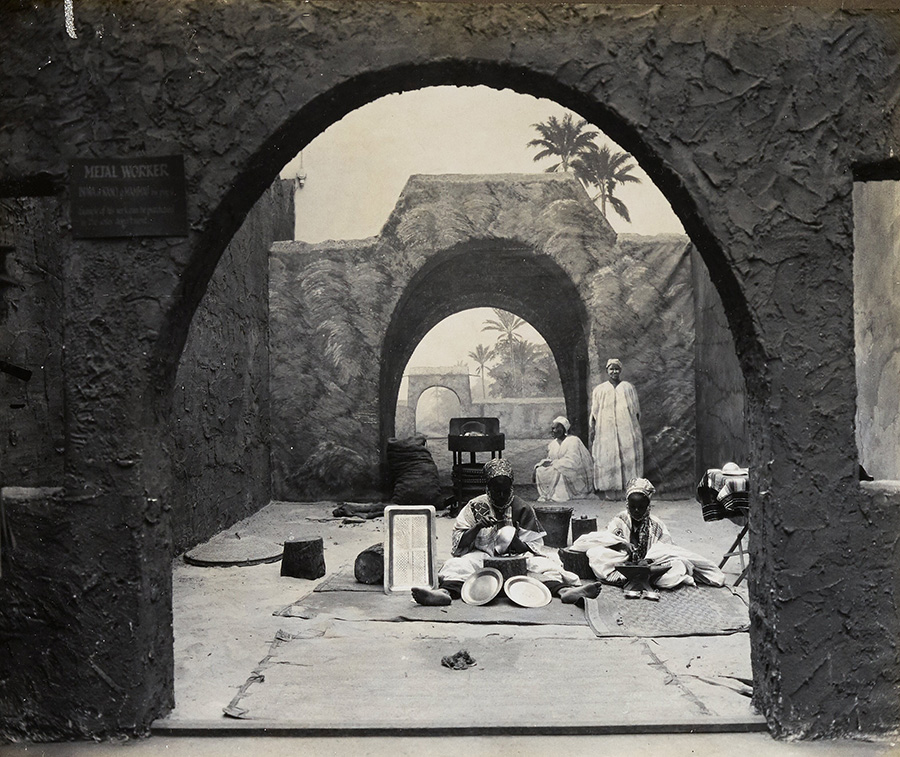
People participating in the metalwork display at the Nigerian Pavilion, 1925. https://blog.nationalarchives.gov.uk/20speople-a-vast-window-display-the-british-empire-exhibition-of-1924-5/ Journalism Career
According to Lara Putnam, Young’s journalism career began in 1924 with Central American News, where he worked as a proofreader and an assistant manager. In 1925, he switched to being a reporter in the Panama Star & Herald where he remained until 1926. He also got married to Mita Spencer in 1926. They had a son, David Antonio Young, as well as an adoptive daughter, Claudia Wilson. After working at the Panama Star & Herald, he became the cable editor of the Panama American and the chief editor of the “West Indian Page.” Young was the person who suggested the Panama American should have a “West Indian Page” and insisted they create one for the newspaper. Young was also involved in the management of the Panama Times’ “West Indian Page,” of which he was the editor from 1926 to 1927 (Sidney Young 2, 3).
During his time at the Panama American, Young published Isthmian Echoes in 1927. The book was a compilation of articles from the “West Indian Page” of the Panama American. This means that Sidney Young personally edited and picked these articles himself. He also added articles from his column “Sid Says,” where he expressed his opinions about the West Indian communities in Panama and their treatment to all his readers.
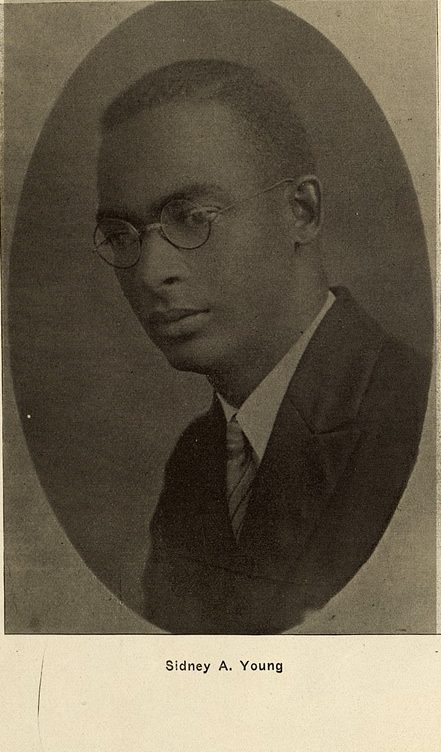
Portrait of Sidney Young found in Isthmian Echoes https://ufdc.ufl.edu/aa00014955/00001/images SID SAYS
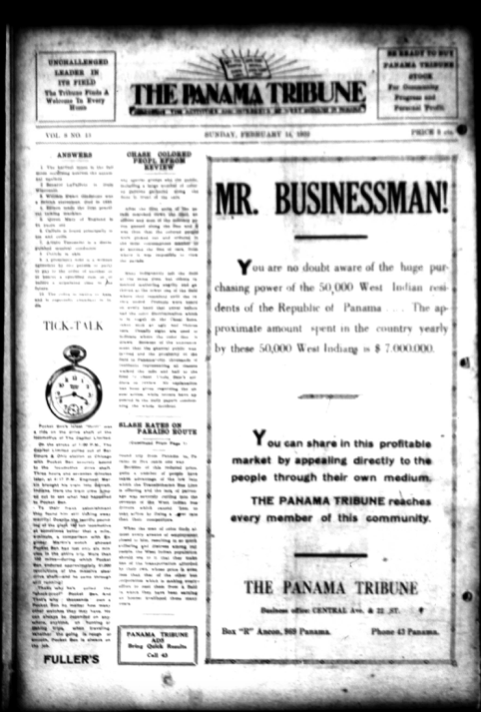
In this particular section, we are able to find many of Young’s political views. After seeing “El Ch*mbo es un engañadizo y todo el mundo lo engaña.” written on a building (Translation: “The West Indian is a fool and all the world fools him.”), Young wrote “Engañadizo” in response. In this editorial, he agrees that West Indians are foolish, but he redefines the phrase to prove a point about economic solidarity in the West Indian community. Young states that West Indians spend all of their money on useless trinkets and raffles from people outside of their community rather than spending it on people in their community. He claims that people, “Nordics, Jews, Chinese and Hindus,” are infiltrating their spaces and may even begin taking businesses from them (224). Young calls for West Indians to spend their money more wisely and to go out of their way to support West Indian businesses rather than disparaging them. He later includes in his newspaper, The Panama Tribune, “BE READY TO BUY PANAMA TRIBUNE STOCK For Community Progress and Personal Profit” which emphasizes his belief that the community should literally be investing in West Indian Businesses to support them. In this way, West Indians would support only the people that support them and cycle money throughout their community
“On the other hand let any ambitious West Indian, willing to start from the bottom up, display a like enterprise and he would be spurned by his own people with the remark that ‘Him want to get rich quick.’”
– Isthmian Echoes, 224Young has another editorial named “Pastures New,” which expresses his worry about what will happen to the West Indian community if their most talented youth all leave. This was following the writer Winslow Gaskin’s departure. He claims talented and skillful young people abandoning their hometowns leave their communities stagnant. Young, nonetheless, wishes Gaskin the best and says he knows he will be a valued writer in New York. This displays Young’s focus on creating progress for his people. Young wants to help his people progress politically, socially, and culturally.
“I do not know what will happen to our community, friends and countrymen, if all out talented youngmen leave the old homestead for pastures new and greener fields”
– Isthmian Echoes, 232, 233In “The Federation of West Indians,” Young writes about a possible federation created to unite the islands in the West Indies. He supports the idea and believes that this unification will be a step towards progress. This assertion demonstrates his belief that people across the British West Indies should come together and fight for their rights and move towards progress as a unit rather than divided. He expressed his disappointment in West Indians on the Isthmus who continue to be jealous and insult one another and acknowledged that these prejudices would make it difficult to create a federation, but held strongly that it would be the path to a better future for British West Indians. From this editorial, we know that Young disapproved of island rivalries and believed in a cohesive front against the oppressive powers.
“Federation would bring about a uniform system of government, education, customs, tariffs, closer commercial interchange and social intercourse, which without the slightest shadow of a doubt would redound to the prosperity and progress of the islands”
– Isthmian Echoes, 291His editorials give you a very clear look into what Young thought about his community and how he envisioned progress would look like. Overall, they focus on the betterment of the people and cooperation with one another that he called for. He called for West Indians to uplift each other rather than feeling like they were competing.
Panama Tribune
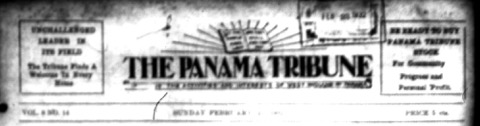
In 1928, Sidney Young founded the Panama Tribune, a West Indian Newspaper, as a response to racist Panamanian policies being passed at the time and to receiving unequal pay in comparison to his white counterparts while working at the Panama American (Corinealdi 32). He wanted this newspaper to empower the black community in Panama. However, the reach of the Panama Tribune was much greater than just Panama. The paper managed to make its way to the US, Jamaica, Guatemala, Honduras, Costa Rica, and Peru (Corinealdi 35). It also became the “longest-running Black Newsweekly in Central America” (Corinealdi 1).
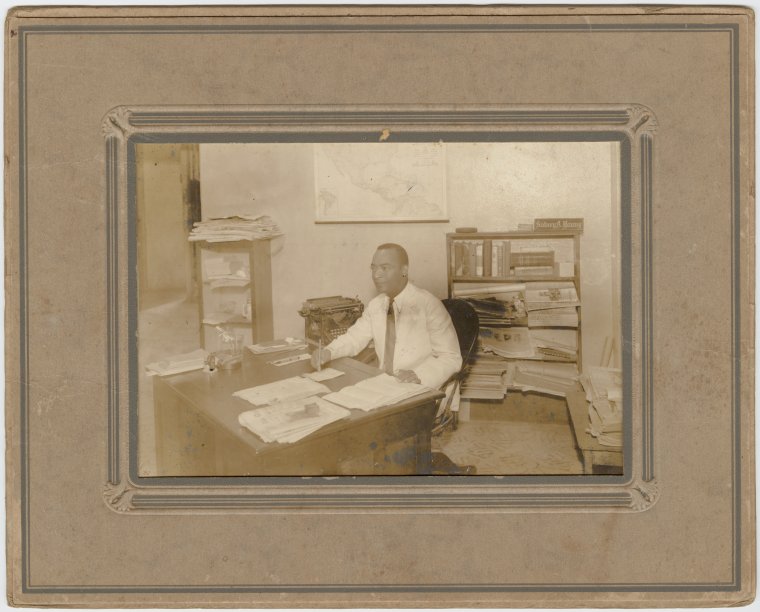
Sidney Young working at his desk at the Panama Tribune https://digitalcollections.nypl.org/items/a7d0e925-f8c4-eff6-e040-e00a18060357 This paper was also unique in that it was staffed by immigrants from the Caribbean and their descendants (Corinealdi, 31). The newspaper was made by Caribbean immigrants and for Caribbean immigrants. This allowed the paper to cover the news from Panama and black diasporas worldwide that West Indians in Panama wanted to hear about (Corinealdi, 30). Only one page devoted to West Indian affairs like the Panama American was insufficient due to the lack of space and could not cover both local and international news. Through these papers, the African diaspora could connect and keep up with each other. Communities within Panama also had the opportunity to be spotlighted in the paper (Corinealdi, 37). More minor news regarding local occurrences pertaining to the West Indian community was added, which further let these communities connect with one another. Readers could also send letters and be published regardless of whether they agreed with the paper or where they were from. If they could send it to Panama, there was a chance it would get published. Young spread news, educated and helped those who read his paper connect with one another. This created a sense of community between everyone and helped empower people across the diaspora.
Panama Tribune Exhibit
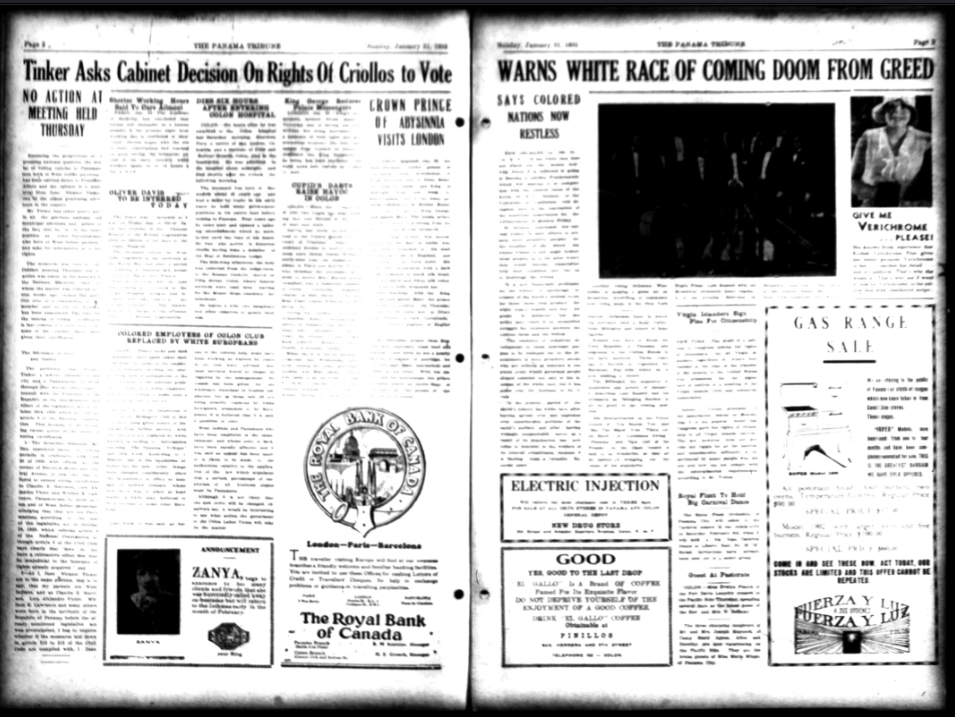
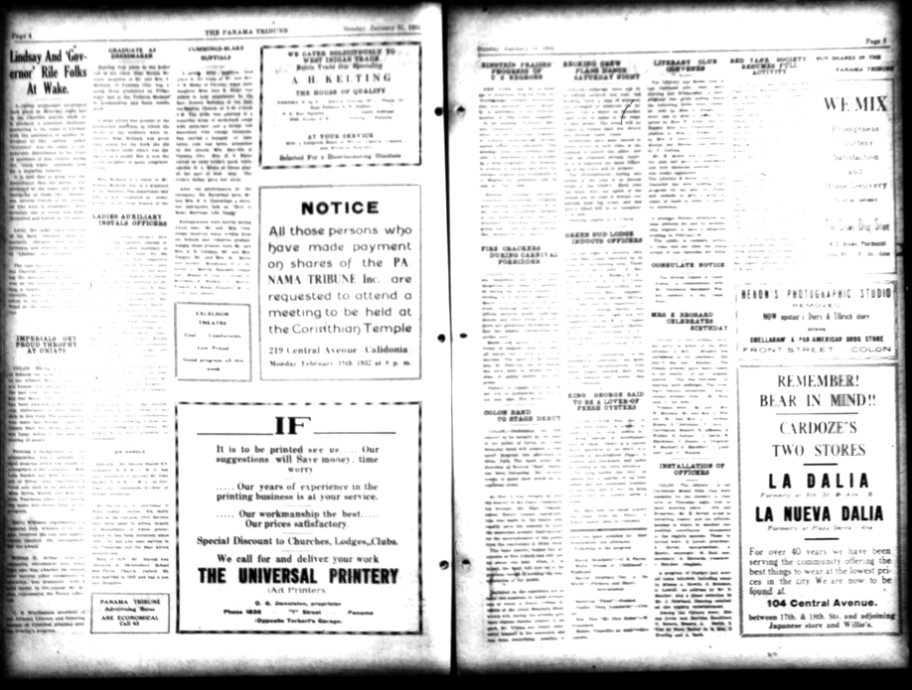
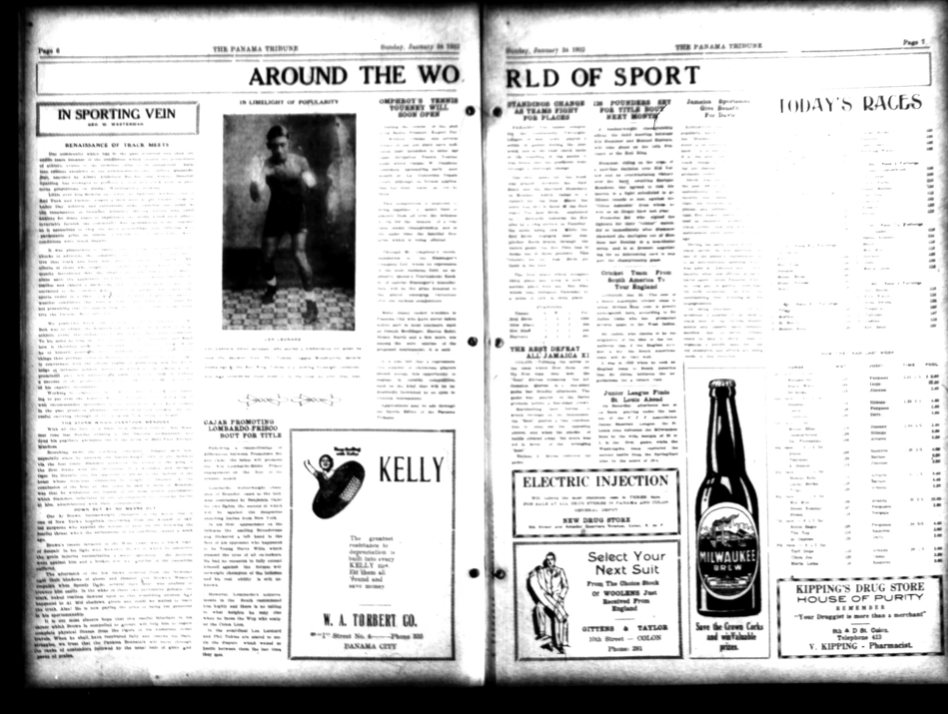
(All images of the Panama Tribune were taken from the Library of Congress)
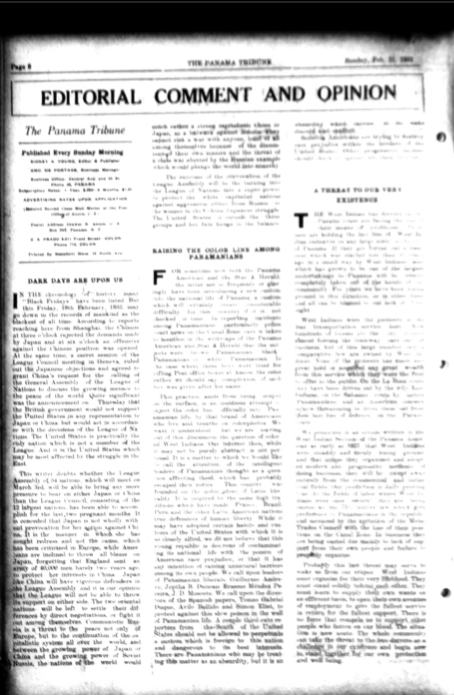
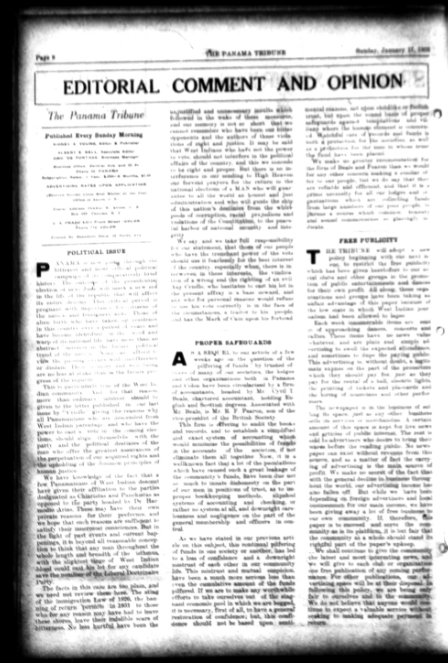
Pages one through five are typically general stories that could focus on a range of topics, for example, Panamanian significant issues, international news, and noteworthy events within the African diaspora. These stories have no specific trend, unlike those in other sections. Some examples of headlines include “Tinker Asks Cabinet Decision On Rights Of Criollos To Vote,” “Crown Prince Of Abysinnia Visits London,” and “Lindsay and ‘Governor’ Rile Folks At Wake”
Pages six through seven are called “Around the World of Sports.” Some sports mentioned were baseball, track, boxing, tennis, horse races, and cricket. The newspaper will also sometimes choose to highlight an athlete in a mini section called “In Limelight of Popularity.” If you look below the word Around, you will see an image of one of these athletes. They also include a section called “Today’s Races.” Races here refer to horse races. They include the horse name, weight, jockey, time, and pool for the race that week and the prior week.
Page eight is called “Editorial Comment and Opinion.” This largely echoes his column Sid Says since this would be where he added his political and social views. Some titles from this include “Dark Days Are Upon Us” and “Free Publicity.”
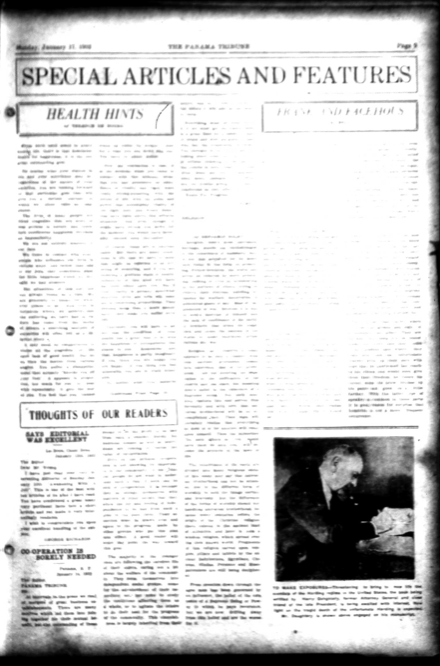
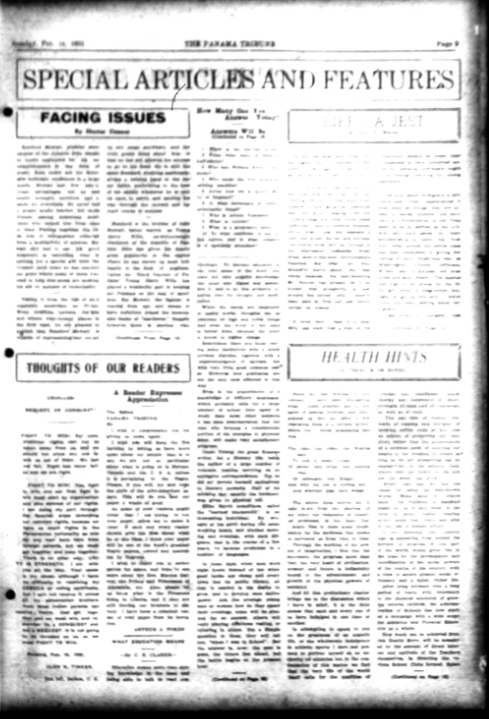
The next page is “Special Articles and Features.” This page has a few rolling topics. They seemingly always have “Health Hints” and “Thoughts of Readers.” In the latter, they publish letters sent to them by readers. Their letters could stretch out as far as New York or be from Panama. This demonstrates the paper’s reach at the time of printing. An example of one of the sections that came and went would be “Our Weekly English Lessons.”
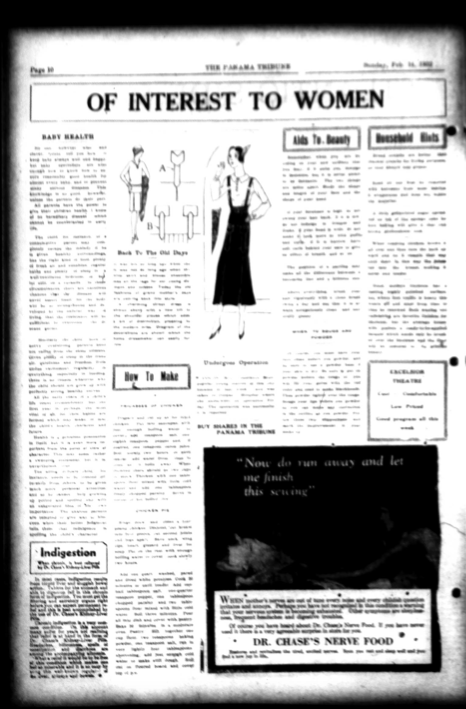
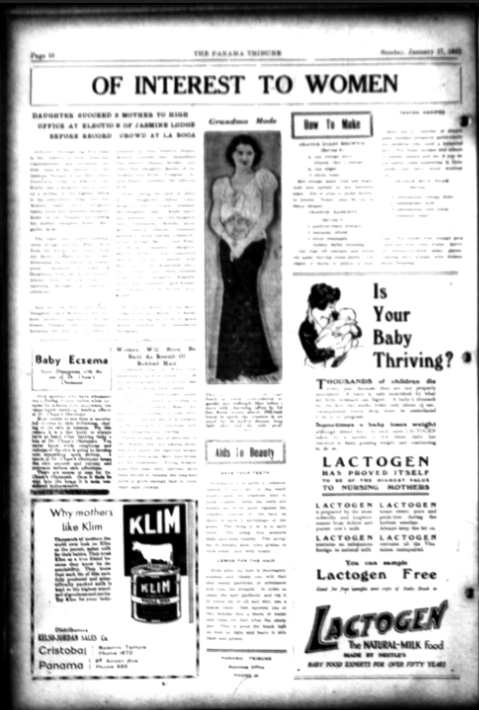
Page 10 is referred to as “Of Interest to Women.” Some articles found in this section were “Aids to Beauty,” “How to Make” (recipes), “Household Hints,” etc. This page largely concerns parenting, beauty, housekeeping, and style. While this seems stereotypical, we see this newspaper highlight the accomplishments of Black women around the world, for example, the potential Olympic entrance of a “colored” girl (Tribune, 10).
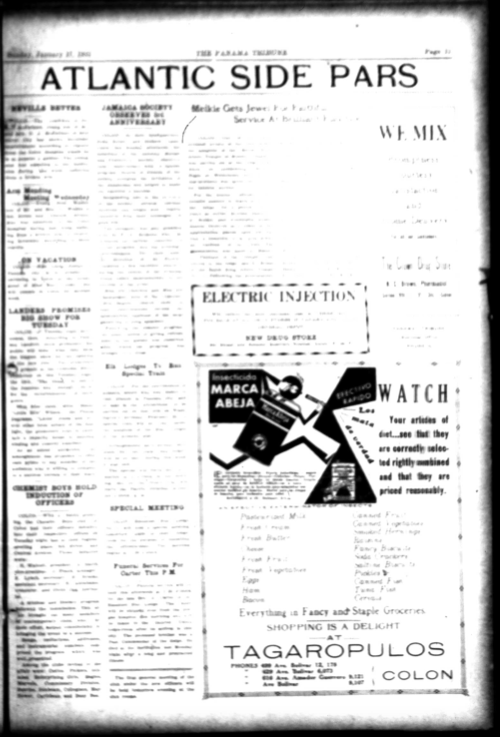
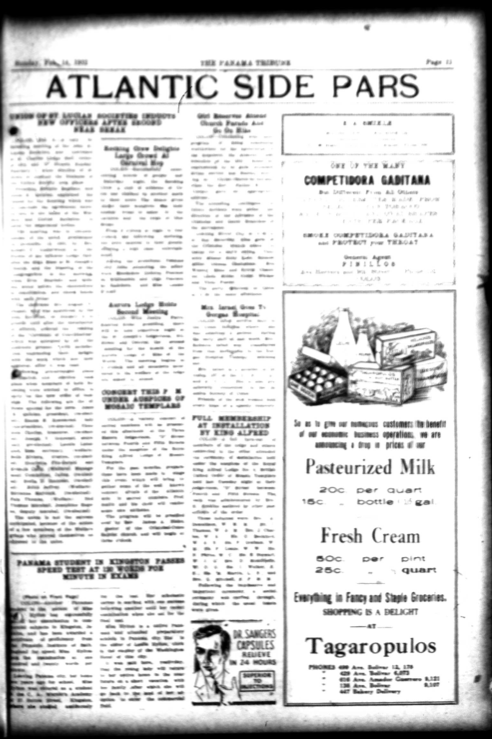
Page 11 is called “Atlantic Side Pars” and appears to be about what is happening around Colón. This would make sense since Colón has Panama’s largest African descendent population (Corinealdi).
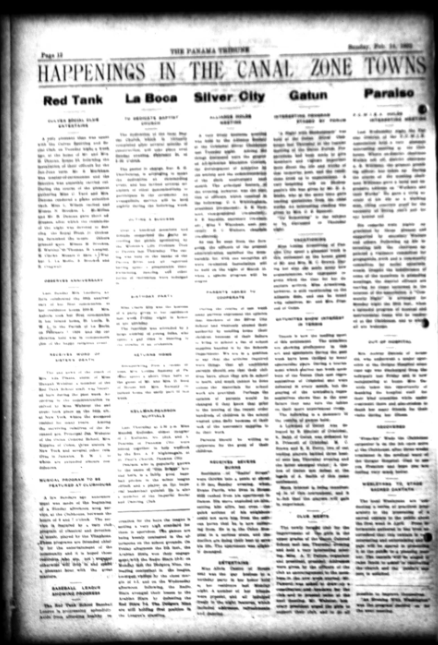
The 12th page contains the “Happenings in the Canal Zone Towns.” The subsections here are referred to by the name of the towns they are talking about. They talk about meetings, news, balls, etc., in Gatun, La Boca, Silver City, Paraiso, and Red Tank villages.
Page 13, with no heading at the top, usually contains a continuation of “Health Hints” and “Thoughts of Readers.”
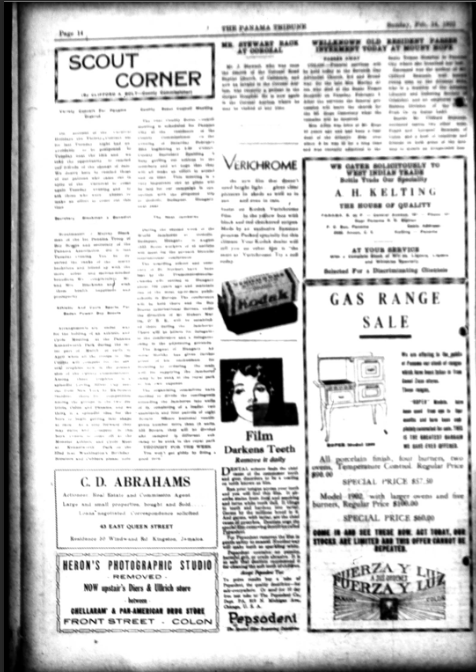
Page 14 was called “Scout Corner.” This seems to be general club meetings and community affairs, not all having to do with Boy Scouts.
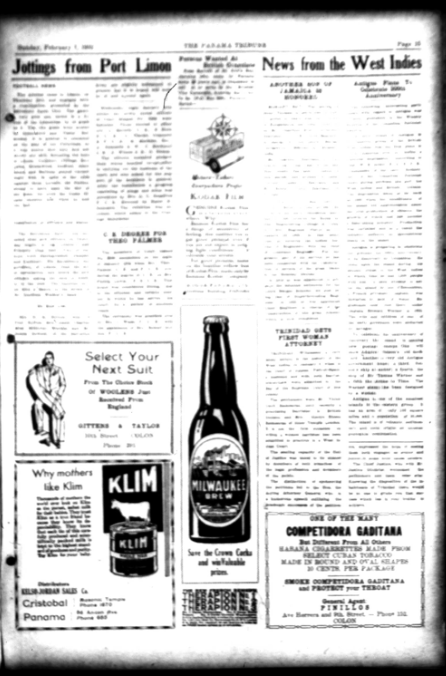
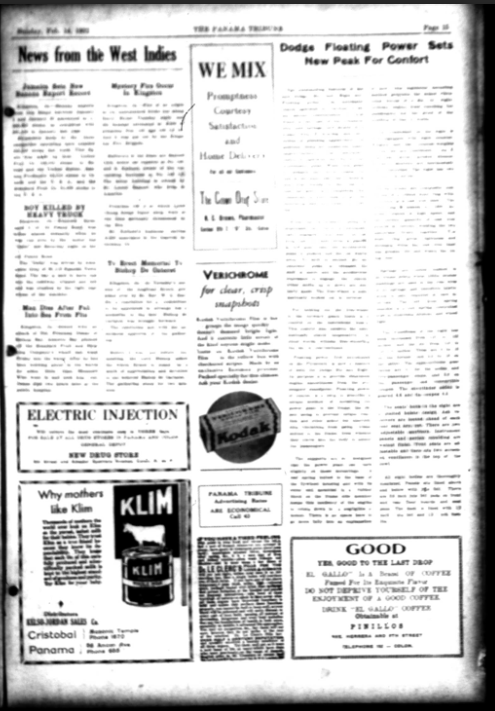
“News From the West Indies” appeared on page 15. This makes sense since the majority of the Panama Tribune’s readers are typically from the West Indies and likely have family there. The “News From the West Indies” section can include death notices and reports of local occurrences in West Indian islands. Page 15 also sometimes includes “Jottings from Port Limon,” which similarly documents local occurrences within the West Indian community in Costa Rica, where Port Limon is.
The final page contains continuations from the first page.
Timeline

Legacy
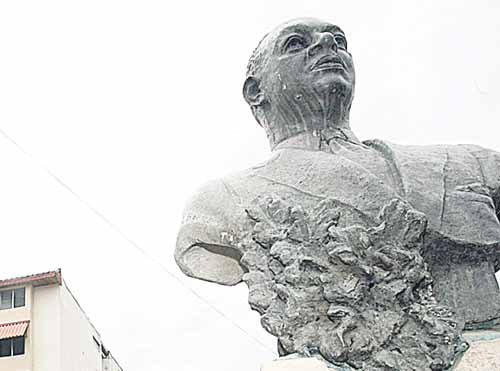
bust of Sidney Young in Rio Abajo https://www.panamaamerica.com.pa/nacion/recuperaran-parque-sidney-young-370261 After a long career devoted to West Indian journalism, Sidney Young died in Panama City in 1959 at the age of 61, leaving behind a rich legacy. His reach was incredible, and it is no wonder why he is still talked about to this day. He described himself and those working with him as people who would “ bring light” to help their communities move towards “progress” (Corinealdi, 29). He did this through fostering a strong community with his newspaper.
Sidney Young has had an incredibly large impact in Panama with a park named after him with a bronze bust in Rio Abajo. The park and bust signify his lasting impact in the black diaspora in Panama. The dedication he showed to his community throughout his life lives on through the beneficial impact this park has had on the citizens in Rio Abajo.
There is also a community center in his name called el “Centro De Desarrollo Comunitario Sidney Young.” This center can be rented out for parties, hosts cultural festivals, and even has free classes for children and adults. A mural was recently painted on the side in 2022 where young kids helped a painter to create a beautiful quetzal.
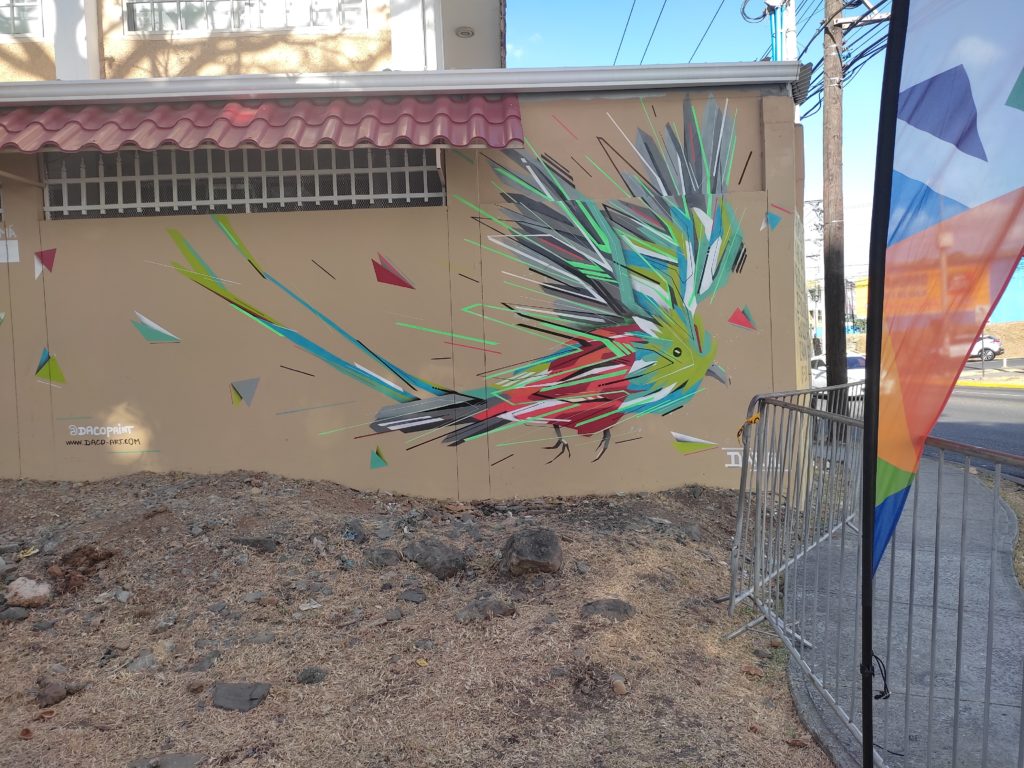
Mural on the side of el Centro De Desarrollo Comunitario Sidney Young cultura.mupa.gob.pa/mural-street-art-con-daco-paint/ It is very apt for this center to be attached to his name since his feelings around the importance of community rang loudly in his writing. His articles around West Indians in Panama called for a tight knit community that worked for the interests of everyone and the Panama Tribune played a large role in pulling together and informing the West Indian community. This plays a larger part in the empowerment of black people all over the world since the Tribune made it to black diasporas around the world. The sharing of information across the world allowed communities to feel more connected to one another. He brought light to communities that were largely ignored by white audiences and pushed for them to help themselves.
Works Cited
“An Honoured Son of the Soil.” Jamaica Gleaner, 6 Apr. 1897, p. 8.
“British King Addresses Over Seas Boy Scouts.” The Workman, Vol. 13 No. 2, 23 Aug. 2024, pp. 1–8. DLOC.
Brennan, James William Charles. “The New West Branch School.” Jamaica History, https://jamaica-history.weebly.com/west-branch.html. 11 April 2024.
Corinealdi, Kaysha. Panama in Black: Afro-Caribbean World Making in the Twentieth Century. Duke University Press, 2022, https://doi.org/10.1515/9781478023128.
Howells, Katherine. “‘A Vast Window Display’: The British Empire Exhibition of 1924-5.” The National Archives, 23 Feb. 2022, https://blog.nationalarchives.gov.uk/20speople-a-vast-window-display-the-british-empire-exhibition-of-1924-5/.
Jeffrey, Duncan. EDUCATION ECONOMY AND CLASS IN COLONIAL JAMAICA 1700-1944. 1980. McMaster University, https://macsphere.mcmaster.ca/bitstream/11375/7659/1/fulltext.pdf. macsphere.
Kingston. Marriage Records 1892 • FamilySearch. familySearch, 22 Dec. 1892, https://www.familysearch.org/ark:/61903/3:1:33S7-95JB-9SLW?view=index&personArk=%2Fark%3A%2F61903%2F1%3A1%3AKP1W-MXT&action=view.
Martin, Henry. ‘One, Two, Three, Four, Colon Man a Come.’ 28 Sept. 2014, https://jamaica-gleaner.com/article/focus/20140928/%E2%80%98one-two-three-four-colon-man-come%E2%80%99.
Mgpp .::. The Marcus Garvey and UNIA Papers Project, UCLA. UCLA Africa Studies Center. https://www.international.ucla.edu/asc/mgpp/sample07. Accessed 1 Mar. 2024.
Mojica, Yaritza. “Recuperarán Parque Sidney Young.” Panama America, 16 Jan. 2008, https://www.panamaamerica.com.pa/nacion/recuperaran-parque-sidney-young-370261.
“Mr. AL Walcott: A Character Sketch.” Jamaica Gleaner, 17 Oct. 1901, p. 6.
“Mural Street Art Con Daco Paint.” Cultura, Municipio de Panamá, cultura.mupa.gob.pa/mural-street-art-con-daco-paint/. Accessed 2024.
The Panama Tribune, vol. 8, no. 9, 17 Jan. 1932, p. 1-16. Library of Congress
The Panama Tribune, vol. 8, no. 10, 24 Jan. 1932, p. 1-16. Library of Congress
The Panama Tribune, vol. 8, no. 11, 31 Jan. 1932, p. 1-16. Library of Congress
The Panama Tribune, vol. 8, no. 12, 7 Feb. 1932, p. 1-16. Library of Congress
The Panama Tribune, vol. 8, no. 13, 14 Feb. 1932, p. 1-16. Library of Congress
The Panama Tribune, vol. 8, no. 14, 21 Feb. 1932, p. 1-16. Library of Congress
Port Royal. Birth Registers 1899 • FamilySearch. familySearch, Jan. 1899, https://www.familysearch.org/ark:/61903/3:1:9Q97-YS89-MTXM?view=index&personArk=%2Fark%3A%2F61903%2F1%3A1%3AXNM9-NX9&action=view.
Putnam, Lara. “To Study the Fragments/Whole: Microhistory and the Atlantic World.” Journal of Social History, vol. 39, no. 3, 2006, pp. 615–30.
Putnam, Lara (2014) Sidney Young, the Panama Tribune, and the Geography of Black Belonging. In: American Historical Association Annual Meeting, January 2014 – January 2014, Washington DC. (Unpublished)
Ryu, JIyi. Visualising and Experiencing the British Imperial World: The British Empire Exhibition at Wembley (1924/25). 2018. The University of York, https://etheses.whiterose.ac.uk/21902/.
Schomburg Center for Research in Black Culture, Photographs and Prints Division, The New York Public Library. “Sidney Young, publisher, Panama Tribune” The New York Public Library Digital Collections. 1930. https://digitalcollections.nypl.org/items/a7d0e925-f8c4-eff6-e040-e00a18060357
“Sidney Young, Publisher, Panama Tribune.” NYPL Digital Collections, created 1930, https://digitalcollections.nypl.org/items/a7d0e925-f8c4-eff6-e040-e00a18060357.
Sidney Young Travel Documents (April 4th, 1946). https://www.ancestry.com/discoveryui-content/view/2530446:8842?tid=&pid=&queryId=e1474f80-8e32-4daf-95f0-6f3b90822de2&_phsrc=zzI1&_phstart=successSource. Accessed 26 Feb. 2024.
“West Branch, Kingston.” Jamaica Gleaner, May 29, 1908, p. 9.
“West Branch School.” Kingston Gleaner, 8 Nov. 1906, p. 11.
Young, Sidney. Isthmian Echoes: UFDC. printed by Benedetti hnos., 1927, https://ufdc.ufl.edu/aa00014955/00001/images.
—. “The Panama American, West Indian Section.” Panama American, 915th ed., 21 Apr. 1928, p. 6. dLOC.
You May Also Like

George Stratford Seymour Cockburn
-
Joseph French
This post is part of a pilot student project created for the University of Florida class, Raising History from the Grave: Primary Historical Research in Literary Analysis and Public Humanities taught by Dr. Leah Rosenberg. The students focused on members of the Black Caribbean diaspora who worked on the Panama Canal or in the Canal Zone, the U.S. territory that surrounded the Panama Canal for much of the 20th century. These employees were originally classified as Silver employees because they were paid in silver currency as opposed to the Gold employees who were American citizens paid in gold currency. The term is still used today by both the community and scholars. The students worked with Pan Caribbean Sankofa, a community organization dedicated to preserving the history of Caribbean people in Panama, who identified community leaders as subjects for the project. Students consulted a wide array of archival materials in the Panama Canal Museum Collection and other institutions and learned how to use these resources to highlight individual accomplishments and connect lives to their larger communities through the digital humanities. For other posts, see Raising History from the Grave.
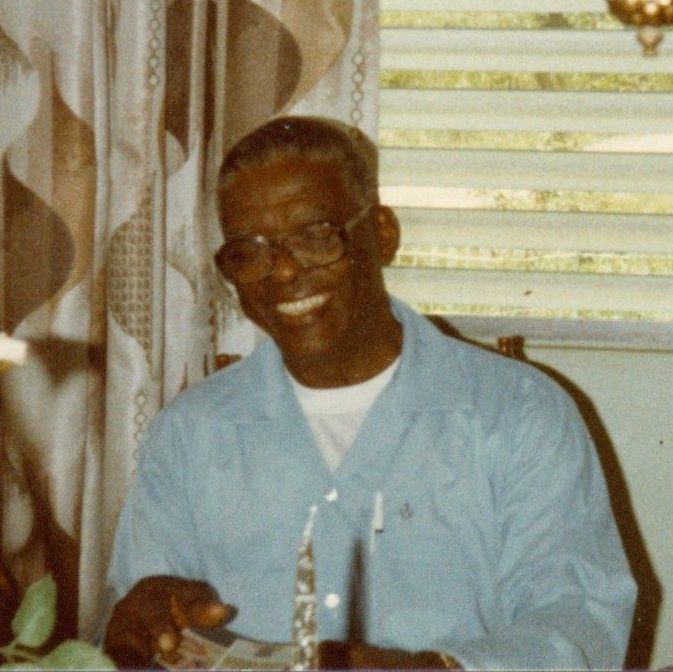
Photo from the Gamboa ‘Silver Town’ Reunion website. https://gamboa.domains.uflib.ufl.edu/gallery-item/mr-french/ 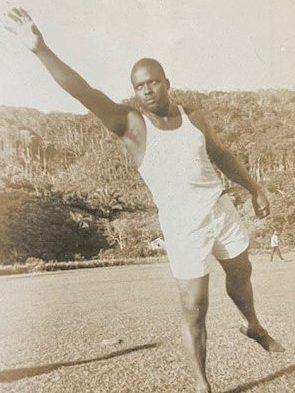
Mr. French practicing his shotput. Gift of the French Family. II.2024.25.19 Why We Remember
Joseph French spent most of his career in the Panama Canal Zone townsite known as Gamboa or Santa Cruz. The community uses both names to reference their beloved hometown as well as a few other nicknames, ‘Gambo’ and ‘Gyambo’. As the city grew larger, a tight-knit and loyal community blossomed. In 1936, the relocation of the Panama Canal’s dredging division from Paraiso to Gamboa was an important moment in the expansion and development of the town. A larger population meant robust infrastructure, schools, community centers; and of course, leaders. Joseph French embodied a leader in every aspect of his character. His many years of teaching, coaching, and uplifting the community of Gamboa have left an unrivaled legacy. His integrity, compassion, and work ethic live on in those he touched, and serve as an inspiration for those familiar with his character.
Interview with Innis, Rex. Conducted by Gamboa Reunion Group. 2014.
An oral interview with Innis Rex references a “Mr. French,” as one of Gamboa’s leaders; he is likely referring to Joseph French.
An oral interview with Innis Rex references a “Mr. French,” as one of Gamboa’s leaders; he is likely referring to Joseph French. Both the interviewer and Mr. Innis explain that living in Gamboa was like being part of one big family where everyone looked after each other. The interviewer interjects to say, “that in a sense we were all children to almost everybody, all the big people. I mean, we had our direct parents, we might have had our biological parents, but we had a sense of caring and parenthood throughout the community.” This statement again reinforces the idea that Gamboa was an incredibly tight knit community and that Mr. French was one of its prominent leaders.
If you’re interested in listening to the entire oral history or reading the transcript, please click here.
Interview with Cornelius Gilling. Conducted by Gamboa Reunion Group. 2014.
Click here to read more from an interview with Cornelius Gilling, a Gamboa Resident. Mr. Gilling provides details about what the environment of Gamboa was like.
When asked about what it was like to move to Gamboa from Paraiso, Gilling replied “we were right in the middle of the jungle”. The interviewer replied “Middle of the jungle?” to which Gilling said “But, it was made out like a city. Remember? We didn’t have to worry about anything. We had the [inaudible]. We got the clubhouse, we got the ship, we got the school.” The interviewer said “So it was a good place to live?” and Gilling said “Exactly. Everything was perfect.” This shows how important schools and the social aspect of living in Gamboa were, and both of these things are areas that Mr. French had an impact on as a teacher and a coach.
If you’re interested in listening to the oral history or reading the transcript, please click here.
Firefighting
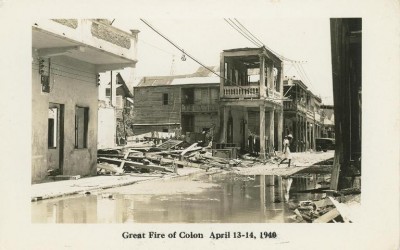
We know that Joseph French started his time as a firefighter in the city of Colon in 1935. As he didn’t switch careers until 1941, it is likely that he was present for the great fire of Colon in 1940. 10,000-12,000 people lost their homes in this devastating fire. The New York Times described the firefighters as a “small army.” Was Mr. French among them?
Scenes from Colon, Panama After Fire. Panama Canal Museum Collection. Gift of Joy Maale, 2000.011.001.003
Interview with Homer Welch. Conducted by Gamboa Reunion Group. 2014.
In an interview with Mr. Homer Welch, Mr. Welch speaks about the difficulties in finding work outside of employment related to the Panama Canal, and how it was very difficult to get a job as a fireman. This helps us understand some of the struggles that Mr. French may have gone through in his career as a firefighter. Through this story, it is clear that leaders such as Mr. French helped children across Panama towns achieve better lives.
If you’re interested in listening to the entire oral history or reading the transcript, please click here.
Interview with Cedric Gittens. Conducted by Pan Caribbean Sankofa. 26 August 2020.
Click here to read about this interview with Cedric Gittens. Mr. Gittens talks about how he had worked in Silver City as a store man (someone who took cargo from box cars as they arrived at storage and then broke them down into units before shipping them to commissaries). He later became a firefighter, and he details the physical work that went into the job as well as the racial hierarchy that existed within the Fire Department at that time.
We know that Mr. French worked as a firefighter for at least a while (although the length of his firefighting career remains unknown to us), so this interview is helpful in furthering our understanding of what Mr. French’s experience was probably like during his time serving the Fire Department and what struggles he likely faced while working there. Moreover, Mr. Gittens’ explanation of what it was like living in Silver City provides us broader insight into the community atmosphere.
If you’re interested in listening to the entire oral history or reading the transcript, please click here.
Interview with Theophilus Peterkin. Conducted by Gamboa Reunion Group. 2014.
Click here to read about this interview with Mr. Theophilus Peterkin. It gives us a glimpse into what it was like becoming a firefighter in Gamboa and, in a similar manner to Mr. Gittens, describes a racial hierarchy that existed within the Fire Department.
“I always thought, if you can get a job, take a job. I was lucky enough that I got a job at the Fire Department and that was like a success story.” Talking about what the job was like, he said “They’re gonna make it tough for you. The white man is not going to be happy about you taking jobs from the white man. That’s the white chief telling all this. He says, they’re going to call you n*, they’re going to call you son of a bitch, they’re going to call you asshole, call you all this stuff. He says that is allowed by our standards. The standard is to belittle the black man. If you can put up with that, take the job. We took it, we put up with all that stuff. And the white people were a little taken aback because they figured black people, what they hell did they know, you know? But then when there were fires, we performed better than the white man himself. And the thing about a white man is that when they go to fire, they walk away from it. And then the quartermaster, what they used to call the quartermaster. How would you call it now, in America? Clean up crew. They were sent a crew to clean up. The white fireman put out a fire and they’re done. But with us, when we put out a fire, we were the clean-up. [Inaudible]. And we did a better job than the guys with the quartermaster. White people began to appreciate us, and they started putting in a good word for us.”
Teaching and Coaching

Mr. French, 1949. Gift of the French Family. II.2024.25.25 
Gift of the French Family. II.2024.25.28.2 
Gift of the French Family. II.2024.25.28.1 
Mr. French with the archery team. Gift of the French Family. II.2024.25.21 
Mr. French with the girl’s basketball team. Gift of the French Family. II.2024.25.23 
Mr. French with the soccer team. Gift of the French Family. II.2024.25.20.1 
Mr. French (center). Gift of the French Family. II.2024.25.20.3
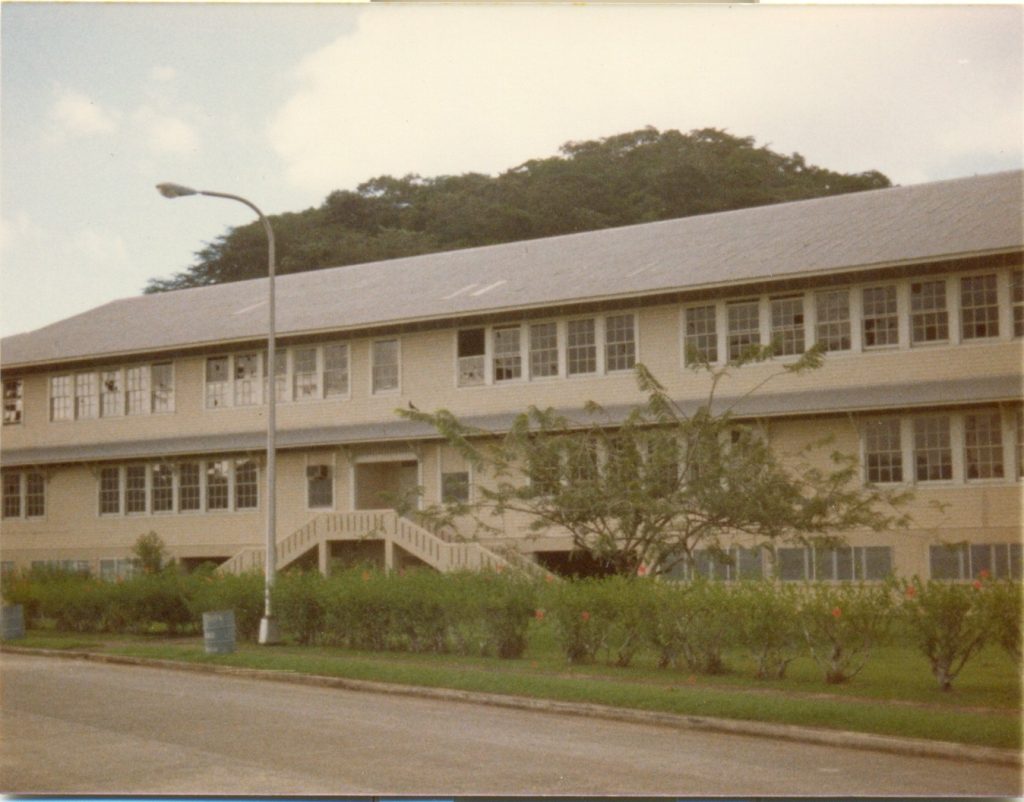
In 1941, French began to serve his community in a new way: he became an instructor of physical education in the Canal Zone Schools. Mr. French was, at this point, a renowned athlete in his own right. He represented Panama for Track in the Central American and Caribbean Games in 1938 and 1946. French was a gym instructor at Santa Cruz K-12, but he coached many sports teams in his free time.
Santa Cruz Elementary School, circa 1975. Photo courtesy of Gamboa ‘Silver Town’ Reunion website.
As a coach, French discovered a new outlet of community outreach: sports. Thus, French’s day-to-day life changed when he became an instructor and coach, but he remained focused on improving his community.
French directed several organized sports leagues in the early 1950s and encouraged many successful careers in sports. French coached many young athletes who would eventually travel to the United States to play Major League Baseball. His significance as a coach is resounding; he created a sports infrastructure that encouraged many youths to become stars. According to the Baseball Almanac, 10% of Panamanian-born MLB players were from the ‘Silver Town’ of Gamboa. The Baseball Almanac is the official baseball history website, and it can be accessed here.
Interview with Earl Holder. Conducted by Gamboa Reunion Group. 2014.
Click here to read more about this oral history with Earl Holder, who played for the Detroit Tigers. He tells of his experience as part of the first class of the Gamboa schools. When asked about the games that he played as a kid, he said that he always loved baseball.
“When I came up in my—during teenage years, I played everything. Basketball, baseball,
track and field, softball. The only thing that I never did participate in was soccer. Because I really didn’t
know that soccer was a game that has these techniques. I thought you just kick the ball and run down
and kick the bill. I didn’t understand that game – kick the ball, running behind, and kicking, and so on.
Baseball was my love. That was my love, baseball. Baseball, see? Because I remember – my team from
the major league, the Detroit Tigers – I remember when I retired, it brought tears to my eyes when they
presented me a large eight-by-ten photo with the then-manager of the Detroit Tigers, Sparky Anderson.
They told him about me, I’m an ardent Detroit fan, and he sent me a big autographed photograph and
wished me well on my retirement, so on and so on, some time ago. And so, but I remember at my
retirement, when they handed me the keys, I couldn’t help it, I just broke into tears.”This interview emphasizes the influence that baseball had on the community of Gamboa, and thus how important Mr. French’s impact was on the community.
If you’re interested in listening to the entire oral history or reading the transcript, please click here.
Interview with Theophilus Peterkin. Conducted by Gamboa Reunion Group. 2014.
Click here to read more from an oral history with Mr. Theophilus Peterkin. Mr. Peterkin doesn’t reference Mr. French directly, but he does talk about how important baseball was to the community.
Mr. Peterkin named many memorable players, demonstrating how decades later sports continues to be an important part of his memory of Gamboa.
“Gamboa was a unique, a very unique community. In the sense that everybody—people like a family. One family, it was just one family. Like I said, you fight today and tomorrow you’re shaking hands. You’re hugging and kissing and sitting and drinking beer, and eating an ice cream. Gamboa was so unique. All the Canal Zone holidays, the picnics were held in Gamboa. Every one. Because Gamboa had everything in one place.”
This interview is paramount in our understanding of how important baseball was to those living in the community and thus how Mr. French impacted the community of Gamboa, and more specifically, the sports community. Mr. French’s success in teaching young athletes who went on to become professionals is reflective of his incredibly impressive coaching abilities. Mr. Peterkin was also a fireman, which allows us to have a better idea of what Mr. French’s time as a firefighter might have been like.
If you’re interested in listening to the entire oral history or reading the transcript, please click here.
Rod Carew
To Rodney Carew, Mr. French was so much more than a coach; he was a guardian. Long before his successful Major League Baseball career, Mr. Carew was a victim of domestic violence. In his memoir One Tough Out Mr. Carew describes his relationship with Mr. French. He was an uncle, a coach, and a father figure whom Carew could actually trust.
Mr. French confronted Carew’s father, Eric, about the boy’s injuries. He wasn’t able to stop the beatings, but he was able to provide the fathering that he knew this boy deserved.

“Mr. French made sure I was at school every day and that I was doing my homework. If my tattered clothes failed to cover the scars on my back or legs, he found a shirt or pants to help me maintain some dignity. On days when boys went shirtless in gym, Mr. French allowed me to keep my shirt on to hide my welts. This only traded one issue for another; now I was the only boy wearing a shirt. Still, I gladly drew looks for that rather than endure the shame and embarrassment that would come from revealing my bruises. There would be more mentoring by Mr. French, but these were the sad circumstances that brought us closer.” – Rod Carew
Image: Rod Carew made 18 All Star teams in a 19-year career. Louis Requena/MLB Photos/Getty Images.
As Mr. Carew got older, French played an instrumental role in making the most of his athletic talent.
“A decathlon champion in his youth, he [Mr. French] knew the traits of a good athlete. He found them in the scared, scarred son of his wife’s sister, the boy he was already keeping an eye on. In what became the first boost for my career, he signed me up for Little League.
My parents couldn’t afford the fee, so Mr. French made a deal with me: I would have to work it off. As the gym teacher at Gamboa High School, he also was in charge of maintaining the field. I had to help him by removing rocks, painting fences, and such. The better I played, the more he let me treat my chores with the intensity of Tom Sawyer and the fence he was supposed to be painting.
Right away, I drew attention for hitting more frequently and more forcefully than anyone else, my age or older. Parents from other teams accused me of being older than 12. Mr. French taught me to treat this as a compliment.” – Rod Carew
Image: Associated Press


“Once I was clearly the best player in Gamboa, Mr. French took me to other parks around the Canal Zone to see how I stacked up against other kids my age and older. Then we sought action throughout the interior of Panama.
The only time Eric came to a Little League game, I had three hits, two of them home runs. He showed no reaction to any of those. But after I made an error in the field, he was in the dugout waiting for me when the half-inning ended. He put his meaty hand around my throat and tried lifting me. Mr. French saw and screamed, “Take your hands off that boy!” He let go and I gagged, gasping for air.”- Rod Carew
Image: Time Magazine, July 18, 1977.
Carew’s story demonstrates the multi-faceted nature of Mr. French’s impact on the community. He wasn’t just a great coach, but a fierce protector and an empowering presence.
One of his former students who played on the women’s basketball team, ‘Gyambo Girls’ recalls Mr. French Fondly. Photo from the Gamboa ‘Silver Town’ Reunion website.

“He went beyond the ‘authority’ of the Canal Zone ‘Silver/Local Rate’ governance to secure physical training equipment (usually ‘hand me downs’ from ‘Gold/U.S. rated’ schools) for Gyambo kids. And he was more often than not successful in negotiating with Panamanian private enterprises to sponsor local teams that competed in sports events throughout the Republic’s terminal cities and surrounding towns. It was a badge of honor to qualify to make his teams. Making meant that you met his criteria for personal character, discipline and sportsperson skills. Many of us will remember that he bought an old truck, remodeled it with back seat benches to carry local teams wherever he could ‘negotiate’ a friendly competition with locals and bring us safely back home. He widened our horizons beyond the limited plane of ‘Gyambo’s isolation.”
Community Work
Interview with Sylvia Perryman. Conducted by Gamboa Reunion Group. 2014.
Click here to read more from an interview, Ms. Sylvia Perryman as she details her memories of the Gamboa community.
Ms. Perryman talks about how everyone acted as family to each other and looked after others’ children, recounting specific anecdotes about conflict resolution, housing, and difficulties of having family working in the Canal Zone.
“I like Gamboa. It was—to me it was like a home…A home with a home. Because the neighbors look out for you and your kids. They don’t think that their kid’s better than that and, I mean, used to go fighting with them, but still they love each other.”
Ms. Perryman’s stories about the Gamboa community provides broad insight into what Mr. French’s impact may have been like and how this impact lives on in his legacy.
If you’re interested in listening to the entire oral history or reading the transcript, please click here.
Throughout his years teaching and coaching the children of Gamboa, Mr. French also volunteered his time to social organizations that bettered the communities he lived in. In 1966, he served as the President of the Santa Cruz Social Welfare Council. A Panama Canal Spillway article describes a leadership workshop French organized for volunteers to advocate for and help them become more active members of their communities. There was also a Language Tutoring workshop in 1971 that Mr. French helped develop. Mr. French organized this workshop in partnership with the Gamboa Baptist Church, and it was open to all students. This workshop aimed to help children obtain the individual attention they needed to increase their reading, writing, and oral skills in both Spanish and English. All profits made from this workshop were reinvested in the schools.
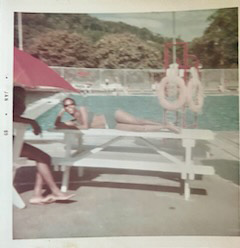
These are just two instances of the many recorded organizations Joseph French was personally involved with. French had a commitment to fostering strong and supportive civic organizations. French advocated to build the first gymnasiums and swimming pools for the residents of Gamboa to enjoy. These small acts portray just how active and involved he truly was within his community.
The image on the left was shared by Vilma Nesfield. She is seen at the swimming pool where Mr. French taught kids to swim. And fondly remembered that “he was always there to rescue us…if we were in trouble. Good old days!”
Interview with Arthur Wade. Conducted by Gamboa Reunion Group. 2014.
Click here to read more from In an interview with Mr. Arthur Wade. Mr. Wade talks about the tight-knit community in Gamboa and how it was really the people that made the place. There was a profound sense of pride and respect for others that radiated through the community that Mr. French was such an influential leader of. Wade asserts that the values community members learned in Gamboa have traveled with them as they have moved to the United States and elsewhere.
“I would say we had one of the best close communities there. People encouraged you, man. People – they took advantage of the opportunity that we were – we had a proud community, let’s face it. Our parents and our forefathers were hard working, and they were – The kids, we grew up with a lot of respect for our family. I would think, to me, the heritage and respect and work ethic and, I would tend to think, encouragement. I would think Panama – Gamboa – was a town of family, decency, and caring, and people were close-knit. I would think that is one of the things we can say. We weren’t neglected.”
In many of the comments on Mr. French’s photos and community maps posted by the Gamboa Reunion Group, it is said in some way or another that for parents in Gamboa, it took this entire village to raise their children. Stories like that of Mr. Wade amplifies our understanding of the culture, dynamic, and community values of Gamboa.
If you’re interested in listening to the entire oral history or reading the transcript, please click here.
Joseph French Honored for his Community Work

Gift of the French Family. II.2024.25.32 
Gift of the French Family. II.2024.25.32 
Gift of the French Family. II.2024.25.32 
Gift of the French Family. II.2024.25.32 
Gift of the French Family. II.2024.25.32 
Gift of the French Family. II.2024.25.32 
Gift of the French Family. II.2024.25.32 
Gift of the French Family. II.2024.25.32
Joseph French received the Meritorious Son award on August 18th, 1977. He is shown in the picture above receiving the award from Panama City Mayor Diomedes Concepcion. Joseph French won the award for his efforts in molding baseball stars such as Rod Carew and Rennie Stennet. City Council awarded him a scroll during his ceremony.
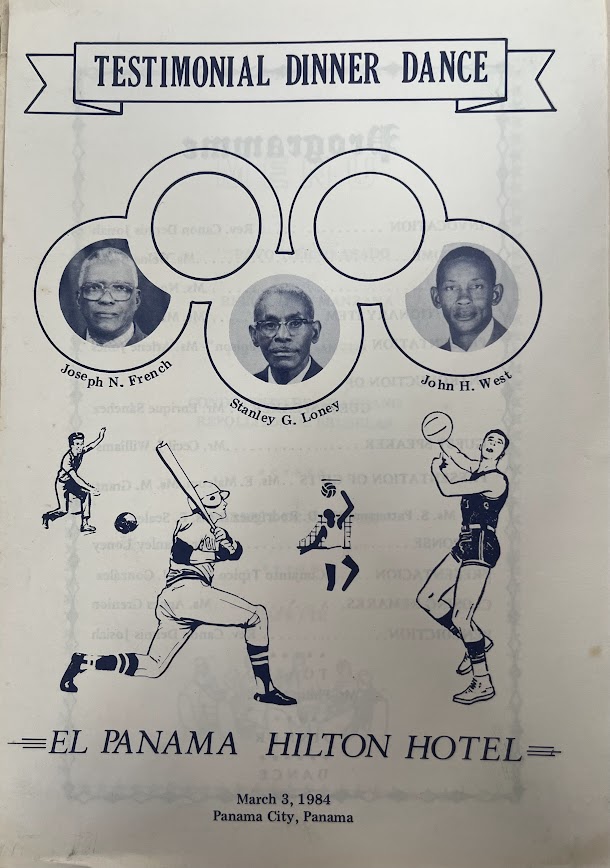
On March 3rd, 1984, Joseph French was honored at a Testimonial Dinner Dance at the Panama Hilton Hotel along with two others, Stanley Loney and John West. El Republica published an article in their newspaper advertising this event to the public. Joseph French and the other two community leaders were “being honored in recognition of their contribution to the growth and development of youngsters in the various Canal Zone communities for a combined total of over 100 years.” This dinner was put on by the young people these leaders impacted. They wanted to show their appreciation for all the work and effort these men put into their lives.
Program. Gift of the French Family. II.2024.25.34

Gamboa/Santa Cruz bleachers. Gift of the French Family. II.2024.25.6.3 On a local level, the Gamboa Schools honored him with their own field day when he retired. On May 25th, 1984, the school held a field day to honor Mr. French. They played softball, basketball, bridge, quadrille dancing, and many other activities to Corregimiento de Ancon in Paraiso. This event gathered proceeds from refreshment sales to donate to Centro Medico de Paraiso and the Pedro Miguel-Paraiso Nursery in Mr. French’s name.
Inteview with Leatha and Louis Sprauve. Conducted by Gamboa reunion Group. 2014.
Click here to read more from an interview with Leatha and Louis Sprauve. Mrs. Sprauve said “Gamboa was unique. Everybody look out for each other’s child. You couldn’t get away with nothing in Gamboa.”
Later in this interview, Mrs. Sprauve directly speaks about Mr. French and the impact that he had on the community, particularly youth sports. She says, “I would say [who] helped keep us off the streets was Mr. French with his involvement…of every sport. Every sport come in and teams were formed to keep us busy, like it or not, you know. That gym was never closed… He worked it eight hours and he stayed there. He formed four teams – Front Square, Church Square, Dust Bowl, and Parallel, volleyball teams. And we had the volleyball team going and get the trophy—we got the trophy for [inaudible], you know, you get
something like that.” Mr. Sprauve says Mr. French “dedicated his whole life.”This statement reinforces the fact that Mr. French offered community guidance to the youth. He steered them in directions that followed their talents and dreams.
Without men like Joseph French, children like Leatha and Louis Sprauve may have had a different path in their lives. Testimonials like hers continue to show the influence that French had over the children in Gamboa and the Canal Zones to receive such high praise and admiration from his community.
If you’re interested in listening to the entire oral history or reading the transcript, please click here.
An Enduring Legacy
The process of researching Joseph French was itself inspiring. As we acknowledge the legacy that French created, we are inspired by his unshakable commitment to his community. Extending respect, compassion, and attention towards others is important, and few figures are more emblematic of that than Joseph French.
Thank you to Mr. French’s family for sharing materials about his life with the class so that we could learn about the tremendous impact he had on the community.
You May Also Like
George Stratford Seymour Cockburn
-
Lessons with Lucho
Lucho Azcarraga’s name comes up in conversations and oral history interviews more than almost anyone else. So many people have fond memories of hearing him play at the Amador Officer’s Club or dancing the night away to his music at the El Panama. He is a true icon of Canal Zone and Panamanian life.


Album covers of Lucho Azcrraga records, Alegres Pascuas en Panama and Navidades en Panama: Christmas in Panama, 2005.85.1.10 and 2005.85.1.10, Gifts of Judy Benoit
Lucho got his start playing piano for silent movies at three theaters in Panama and the Canal Zone- the El Dorado from 1-3pm, Amador from 3-5pm, and the Cecilia from 5-7pm for a total of three dollars a day. When talking pictures came along he improvised and started playing the organ in the 10-minute break between shows. He slowly moved from the theaters to the “gardens”, particularly at El Rancho, where he provided entertainment both at lunch time and during the evening hours. The rest is history!
Although Lucho is known for his small combo or “conjunto”, did you know he started with an 8-piece orchestra?

Image from the back of El Panama Fiesta album cover
This final post of the “Twenty-Five” series celebrating the 25th anniversary of the Panama Canal Museum and their continued support after the collection came to the University of Florida, was also inspired by Don Randel’s oral history interview and a story he told about taking lessons from Lucho. (See the previous post that includes clips from Don’s interview about his family’s business in Panama City and sports.)
Listen to Don’s wonderful story about taking lessons from Lucho in the clip below. You can also visit the digital collection to hear his full interview.
Use the left and right arrows to view the two photos of El Panama Hilton.

Carnival Float, February 1958, 2016.64.1, Chipi Azcarraga on maracas, Vic Herr playing congas, Edgar Ameglio behind the organ, Don Randel playing the organ. This photo is of a rehearsal for the carnival Tuesday parade in Panama City. Don also mentions some of the other people in the music and theater worlds of Panama that he remembers or that had an impact on his life and career. Use the arrows at the left and right to move through the slideshow of people that Don mentions. Do you have memories of them as well?

Victor Herr (and Don Randel on the bottom left), Zonian, Balboa High School Yearbook, 1957 
Don Musselman, Zonian, Balboa High School Yearbook, 1957 
Emile Beaumont (Don’s piano teacher), Panama American, September 1944 
Judge Guthrie Crowe, Panama Canal Review, September 1952 
Dolores Leacock (Pianist), Panama American, April 13, 1956 
Jose Quintero and Vivien Leigh (Scarlett in Gone with the Wind), Panama This Month, January 1962
Amador didn’t have all the fun.

Fort Kobbe Officers’ Wives’ Club Scrapbook, 1957-1958, 2011.999.236 
Fort Kobbe Officers’ Wives’ Club Scrapbook, 1957-1958, 2011.999.236
Frank Baldwin also told a unique story about Lucho in his “Memoirs of Panama and the Canal Zone.”
“My father married Lea Azcarraga, who was one of Lucho Azcarraga’s older sisters. She was born in
David, province of Chiriqui. She was one of the first women in Panama to drive a car, smoked and
played golf. She was one of the first Panamanians to learn to speak English, too. She lived in Panama
City by Simon Bolivar Plaza where Teatro National is, and worked for the Red Cross before marrying.
One year my brother and I went to the US with my father and mother. Lucho came with us, but my
father left him in New York while we went to Canada where he had arranged for Lucho to take
classes from Lew White at the Roxy Theater, which was very famous. In those days, they didn’t have
talking movies, so they had organs and pianos playing in the different theaters. Lew White was so
impressed with Lucho that he called a fellow named Jesse Crawford from the Paramount Theater to
listen to him. When we returned, my father tried to pay but they wouldn’t take the money because
they wanted Lucho to stay to play in one of the theatres. But Lucho was only 17, and wanted to
go home. Lucho had played music like the Tango, Danzón and all the Latin music for these famous
organists, and they were fascinated because they had not heard it that way before. Lucho was five
years older than I was. When I was 15 years old I played in Lucho’s orchestra. In those days it wasn’t
an orchestra, it was a “combo”, and I played the clarinet at the old Union Club. My father would
drop me off, and then Lucho would take me home later.” – Frank A. BaldwinLea Azcarraga sounds pretty interesting. We would love to know more about her too.

Postcard of the Union Club, Panama City, Gift of Brad Wilde, II.2021.36.106
Frank Townsend and Sydney Townsend Corbett highlight Lucho and others in their write-up The Music Makers 2022 – Lucho, Papito, Leroy, Mario, Tito, and Frank. They talk about the joy of dancing to music in Panama and the thrill of once again experiencing live Panamanian music at the Panama Canal Society Reunions each year. Read their story in the digital collection by clicking here or download a PDF below.
Lucho was born in 1912, two years before the Canal was even finished!

Lucho and Frank Townsend, 1992. From The Music Makers, II.2023.52.2
Did you know that in addition to the organ Lucho played the accordion? If you listened to the clip of Don Randel’s interview you do.
Share a comment about your favorite Lucho moment and enjoy this gallery of some of his album covers.


This post is part of our fall focus on the important work of the Panama Canal Museum and on the oral history program they began and which continues today. This year is the 25th anniversary of the founding of the Panama Canal Museum in 1998. The museum operated for 14 years in Seminole, Florida, before closing in July 2012 and transferring its collection to UF. The successes achieved by the museum paved the way for the PCMC to develop as a preeminent research collection for the study of the American era of the Canal. For more information on the history of the Museum, please visit go.ufl.edu/pcm
Between now and the end of December, we are celebrating this 25th Anniversary and hope to honor their hard work as well as that of our Friends of the PCMC group by adding $13,000 to the $12,000 that was raised by this year’s Silent Auction for a total of $25,000 – $25,000 for 25 amazing years!
If you would like help us reach the goal please donate here: https://pcmc.uflib.ufl.edu/oralhistory/. All funds will go to support the PCMC oral history program.
-
Insurance on the Isthmus

Balboa High School, Parakeet, October 9, 1954 How was coverage at one of the world’s biggest construction sites?
Earlier this year we had the pleasure of doing an oral history interview with Don Randel, Balboa High School Class of 1958. He told us about his family’s connection to the Panama Canal and a unique element of the construction days – insurance.
Don’s aunt and uncle, Sally and Henry Seymour, arrived on the Isthmus during the construction of the Canal. Sailing records indicate they went back and forth from Panama a few times before finally settling down and opening their insurance business, Seymour Agency, around 1913. Don remembers that it started off providing workers insurance for Canal employees.

Sailing record from the S.S. Havana. Leaving Colon on November 11, 1905 and arriving in New York on November 17, 1905. We enlarged the names of Henry and Sally so you could see them. 
While we were working on this blog post we got a donation of a large group of old envelopes associated with the Panama Canal. We couldn’t believe that one of them was from Henry Seymour! And it was addressed to Hartley Rowe, the engineer we featured in the Manhattan in Panama blog post a few months ago. What timing! According to their Certificate of Registration, Henry and Sally lived in Camp Otis in 1914, before they later moved into more glamorous quarters (hint…it is a well known hotel on the Pacific side).

Certificate of Registration of American Citizen, Henry and Sally Seymour, July 1, 1913 
Photo Postcard of Camp Otis Looking North, Gift of Brad Wilde, II.2021.36.47 Henry Seymour passed away in 1927, but Sally kept the business going, running it out of the Tivoli Hotel until the 1940s when she decided to retire and asked Don’s father to take over the business.
Use the arrows on the left and right to click through the slideshow of U.S. Census records that include Henry and Sally Seymour living at the Tivoli.
Sally could often be seen on evenings in the dining room of the Tivoli with her beloved cocker spaniel Chica.
Listen to Don talk about his aunt and uncle and the insurance agency.
Use the left and right arrows to flip through the slideshow below to see a few Tivoli Hotel items and photos. According to the menu, Sally probably paid 50 cents for her scotch on the rocks (listen to the clip if you don’t know what this means).
The Panama American includes a notice of Sally’s farewell party in March 1946 as she prepared to permanently return to the United States. Sadly, only a few days later, the same paper shared the news of her unfortunate passing in New Orleans, part way through the voyage.
Follow the coverage of Sally’s departure and funeral service through this gallery of clips from the Panama American newspaper. (Issues: March 2, 8, 14, 20, 24, 1946)


Most of the early 20th century issues of the Panama American were digitized through funding generously provided by a family of long-time supporters of the Panama Canal Museum and the PCMC here at UF. This newspaper is one of the most utilized items in the PCMC collection and has been viewed over 13 million times.
Don’s father ran the Seymour Agency for many years and Don spoke of fond memories visiting the agency office which his father had moved into Panama City. Under his father’s ownership the agency sponsored baseball, bowling, and cricket teams.
In his interview Don talked about some of those sports teams and his own Little League team, the Firemen. We have a wonderful photo of the 1952 team that includes Don among the ranks.
Listen to a clip about sports from Don’s interview.

1952 Little League Firemen Team. A handwritten caption on the back of the photo lists the names of some coaches and players. Back Row Coaches: Huddleston, ? ; Middle Row Players: Richard Morris, ?, Ted Webb, Fred Dube, John Chase, ?, Mo Shoch, Don Randel; Front Row: ?, ?, Jim Price, ?, ?, Frank Townsend, ?, ?, ?. Gift of Frank Townsend. II.2019.39.5 Can you help us identify anyone else?
Stay tuned to hear more from Don’s interview in our next post. It might make you want to break out your old records and dance...
This post is part of our fall focus on the important work of the Panama Canal Museum and on the oral history program they began and which continues today. This year is the 25th anniversary of the founding of the Panama Canal Museum in 1998. The museum operated for 14 years in Seminole, Florida, before closing in July 2012 and transferring its collection to UF. The successes achieved by the museum paved the way for the PCMC to develop as a preeminent research collection for the study of the American era of the Canal. For more information on the history of the Museum, please visit go.ufl.edu/pcm
Between now and the end of December, we are celebrating their 25th Anniversary and hope to honor their hard work as well as that of our Friends of the PCMC group by adding $13,000 to the $12,000 that was raised by this year’s Silent Auction for a total of $25,000 – $25,000 for 25 amazing years!
If you would like help us reach the goal please donate here: https://pcmc.uflib.ufl.edu/oralhistory/. All funds will go to support the PCMC oral history program.
-
Audio Clips (and more) about Amador
Congratulations to our friends at the Biomuseo who debuted their exhibit Amador: Ayer y Hoy earlier this year. The exhibit consists of 48 panels displayed throughout the Amador Causeway and explores its history from creation during the construction of the Canal and service as a military installation through its use today as a public place for everyone to enjoy.
When the team from the Biomuseo was working on the exhibit in 2022 they came to the University of Florida for a week to conduct research. Many photographs from the PCMC collection can be seen on the panels in Panama! Their visit coincided with our annual luncheon so they were also able to meet members of the Panama Canal Society and the Friends of the Panama Canal Museum Collection and they later interviewed many about their memories of Amador and the causeway. Numerous quotes from those interviews are featured throughout the exhibit. We are working with the Biomuseo on the long term preservation of the full interviews.

Image provided by the Biomuseo The exhibit explores many different facets of the history of the causeway: history, fishing, music, art, and biodiversity to name a few.

Image provided by the Biomuseo The land that was occupied by Fort Amador and the causeway that was once part of Fort Grant were created with material excavated during the construction of the Panama Canal. The area of Fort Amador was known as the “Balboa Dump” and was originally covered by water. The causeway served as a breakwater for the Pacific entrance of the Canal, and also connected the Canal Zone to the “fortified islands” of Naos, Culebra, Perico, and Flamenco which housed important defense installations. The railroad that had been used to build the breakwater was originally left in place to move ammunition and other military equipment.

These early photos show some of the different phases of construction Click on an image to enlarge it.


Amador, the causeway, and particularly the Officer’s Club were a big part of life for many. The Amador Officer’s Club housed high school dances, many enjoyed fishing off the causeway, and swimming at the beach club.
Enjoy the following clips from our oral history collection.
Interview with Malena, Didi, and Fred Bremer, https://ufdc.ufl.edu/aa00013365/00001 
Panama Canal Review, October 1952 Interview with Jose Vanga, https://ufdc.ufl.edu/aa00040427/00001 
Postcard of Fort Amador, II.2021.36.106 
The Tropic Times, June 15, 1990 
During a recent trip to Panama we had the pleasure of spending a wonderful morning with our Biomuseo friends who showed us around the causeway, the old Officers Club which is now their work space, and gave us a great drive-by tour of some iconic buildings in the former Canal Zone.
Visit the virtual exhibit to hear some of the clips (https://biomuseo.org/amador/) and next time you are in Panama, stop by the causeway, enjoy the beautiful view, and explore the exhibit which was funded by the public diplomacy grant program of the United States Embassy in Panama.
Panel number 31 is pretty fun…
The fabulous team at the Biomuseo is putting the finishing touches on the next exhibit which will go up in Ciudad del Saber, which occupies the land that was formerly Ft. Clayton.
What are your favorite memories of the causeway?

Panama Canal Review, October 1979
This post is part of our fall focus on the important work of the Panama Canal Museum and on the oral history program they began and which continues today. This year is the 25th anniversary of the founding of the Panama Canal Museum in 1998. The museum operated for 14 years in Seminole, Florida, before closing in July 2012 and transferring its collection to UF. The successes achieved by the museum paved the way for the PCMC to develop as a preeminent research collection for the study of the American era of the Canal. For more information on the history of the Museum, please visit go.ufl.edu/pcm
Between now and the end of December, we are celebrating their 25th Anniversary and hope to honor their hard work as well as that of our Friends of the PCMC group by adding $13,000 to the $12,000 that was raised by this year’s Silent Auction for a total of $25,000 – $25,000 for 25 amazing years!
If you would like help us reach the goal please donate here: https://pcmc.uflib.ufl.edu/oralhistory/. All funds will go to support the PCMC oral history program.
-
Stuff about Sturgis

The Sturgis docked in Gatun Lake. U.S. Army Photo courtesy of Office of History, HQ, U.S. Army Corps of Engineers. Oral history interviews are a great place to learn about parts of Panama Canal history that you might not have known about or have forgotten. At this year’s Panama Canal Society reunion in Orlando, we had the pleasure of meeting and talking to Carol Hellums.
She and her husband Bill had done an interview with the Panama Canal Museum in 2011 and it opens with a great story about how they met in 1968 on an airplane headed to Panama. Bill was moving down to serve as part of the crew on the Sturgis, and Carol was visiting her parents.
Carol taught us about the MH-1A pressurized water nuclear reactor, aka the Sturgis, the first floating nuclear power station. It was built by the Army Reactors Branch of the Army Corps of Engineers as a way to generate power in remote, inaccessible, or difficult locations – the “MH” stands for mobile, high power. The Sturgis was a converted Liberty Ship, a special class of cargo ship that was built during World War II. Because the vessel would be stationary for the majority of its life it was re-designed to be a towed craft, and it was taken to its home near the Gatun Spillway in August 1968.

Sturgis in Gatun Lake. Image from the U.S. Army Corps of Engineers exhibit Army Nuclear Power Program – MH-1A Sturgis. In the early months of 1968, the Canal experienced a water shortage that affected both the operations of the Canal and the electricity supplied to the Canal Zone which was provided by the hydroelectric power station at Gatun Dam. By subsidizing the power station, the water that would have been used could instead be reserved for transiting ships.
The Sturgis generated electricity for the Canal Zone from 1968-1975, along with a second barge, the diesel-fueled Andrew J. Weber added in November 1968. It is estimated that they helped reserve over one trillion gallons of water for use in Canal operations.
Bill worked on the Sturgis monitoring the environment, taking water and sediment samples under the boat, and gathering biomass further afield in the jungles for radiological analysis. He and Carol joke that he basically got to fish in the Canal Zone for a living. Listen to a clip from their oral history below:
Transcript In the clip Bill mentions that The Big Picture, a news series produced by the U.S. Army, came down to Panama and filmed him. It took a while, but after watching a lot of episodes I finally found the one that features the Sturgis! View the episode below. The section about the Sturgis begins at 17:17:
Eventually two turbines were added to the Canal system and the Sturgis became obsolete. This story reminds us that the water shortage the Canal is experiencing today is not a new problem and that numerous efforts have been made to mitigate the issue over time. Creative solutions will undoubtedly continue be a part of the Canal’s future as it faces increasing environmental challenges.
In their interview, Bill also told an incredible story about a storm the Sturgis weathered during it’s trip back to Ft. Belvoir, Virginia to begin the deactivation of the reactor. Listen to a clip from the story:
Transcript Click through the slideshow below by pressing the arrows at the left and right sides of the image:

MH-1A Control Room with Operator, 1965-1977 . United States Armed Forces Nuclear Energy Association. https://usace.contentdm.oclc.org/digital/collection/p15141coll5/id/4115/rec/16 
Shoe covers from the MH-1A Sturgis. Office of History, HQ, U.S. Army Corps of Engineers. https://usace.contentdm.oclc.org/digital/collection/p15141coll5/id/4131/rec/12 
Cutaway model of the MH-1A Sturgis. Office of History, HQ, U.S. Army Corps of Engineers. https://usace.contentdm.oclc.org/digital/collection/p15141coll5/id/4137/rec/2 
Reactor containment vessel of the MH-1A reactor. Office of History, HQ, U.S. Army Corps of Engineers. https://usace.contentdm.oclc.org/digital/collection/p15141coll5/id/4138/rec/9
After the extensive process of deactivation, the ship was “mothballed” as part of the James River Reserve Fleet. Its final decontamination began in 2014 and by 2019 it had been scrapped.
To learn more about the origin, life, and decommissioning of the Sturgis view this U.S. Army Corps of Engineers exhibit: https://www.usace.army.mil/About/History/Exhibits/Nuclear-Power-Program/Sturgis/
To listen to Bill and Carol’s full interview visit out digital collection: An Interview with William and Carol Hellums
Do you remember seeing the Sturgis? Do you have any stories about the ship’s time at the Canal?
This post is part of our fall focus on the important work of the Panama Canal Museum and on the oral history program they began and which continues today. This year is the 25th anniversary of the founding of the Panama Canal Museum in 1998. The museum operated for 14 years in Seminole, Florida, before closing in July 2012 and transferring its collection to UF. The successes achieved by the museum paved the way for the PCMC to develop as a preeminent research collection for the study of the American era of the Canal. For more information on the history of the Museum, please visit go.ufl.edu/pcm
Between now and the end of December, we are celebrating their 25th Anniversary and hope to honor their hard work as well as that of our Friends of the PCMC group by adding $13,000 to the $12,000 that was raised by this year’s Silent Auction for a total of $25,000 – $25,000 for 25 amazing years!
If you would like help us reach the goal please donate here: https://pcmc.uflib.ufl.edu/oralhistory/. All funds will go to support the PCMC oral history program.
-
Twenty-Five

Envelope created to celebrate the 25th Anniversary of the Panama Canal, 1914-1939. Two Canal Zone stamps also created to celebrate the 25th Anniversary, Scott 126 and 127. Gift of Dr. Carl A. and Martha B. Peterson. II.2018.89.1.
Happy 25th Anniversary to the Panama Canal Museum

This year is the 25th anniversary of the founding of the Panama Canal Museum in 1998. The museum successfully operated for 14 years in Seminole, Florida, before closing in July 2012 and transferring its collection to UF. The successes achieved by the museum over those 14 years paved the way for the PCMC to develop as a preeminent research collection for the study of the American era of the Canal. For more information on the history of the Museum, please visit go.ufl.edu/pcm
Twenty-five years ago a group of individuals got together with the common goal of preserving the history of the American Era of the Panama Canal. Early on a committee was established to acquire the items needed for this “Repository of Memories”: artifacts, papers, photographs, scrapbooks, diaries, letters, yearbooks, programs, commissary memorabilia, reports, operations manuals, books, signs…you name it. Those treasures became the foundation of the Panama Canal Museum and were used to create permanent exhibits about the Spanish, French, and American Eras of the Canal, the Tivoli, and the Panama Railroad as well as 17 rotating and traveling exhibits. Under their stewardship the collection grew to over 13,000 objects.
Enjoy this slideshow highlighting PCM’s history. Press the arrows at the right and left to move through the images.

The school bell from Cristobal joining the Panama Canal Museum’s collection 
Panama Canal Museum Review, October 2001 
Panama Canal Museum Review, November 2001 
Panama Canal Museum Review, Fall/Winter 2008 
Panama Canal Museum Review, May 2005 
Panama Canal Museum Staff and Volunteers in Panamanian style dress. 
Panama Canal Museum Review, Spring/Summer 2006 
Chris Skeie and Ed Beasley with a Canal Zone Boy Scouts Flag 
Panama Canal Museum Review, October 2003 
Panama Canal Museum Review, Spring/Summer 2008 
Panama Canal Museum Review, Fall/Winter 2011
In addition to building and running the museum, they earned federal grants, had a gift shop, created educational curriculum, designed ornaments, made a board game, hosted potluck lunches (including a lunch with “Teddy Roosevelt” in 2008), ran a silent auction and created exhibits to display at the Panama Canal Society Reunion, and published three books: Opening the Gates to Canal Cuisine: Preserving the American Era in 2005, Write of Passage: Stories of the American Era of the Panama Canal in 2008, and Panama Canal Townsites in 2012. This list goes on – their work and dedication was impressive.
They even got a phone call from the popular game show “Who Wants to be a Millionaire?” with a request to answer some questions about the Panama Canal for the program! Does anyone know if they ever asked a contestant the question?
The video below offers a small glimpse into their efforts.
Although the Museum’s collection officially became part of the University of Florida in 2012, the founders and friends of the original museum have continued to steward, support, and build the collection. They are an essential part of the success of the Panama Canal Museum Collection at UF.

Panama Canal Museum Review, Spring/Summer 2011 Since the collection’s arrival at UF, it has grown to over 25,000 objects, more than 13,000 pages/items have been digitized, and our Friends have helped raise over $1.1 million to support it. In 2017, we opened the Albert H. Nahmad Panama Canal Gallery where the Panama Canal Museum’s legacy lives on through annual rotating exhibitions.
The Silent Auction that the Museum started hosting at the Panama Canal Society Reunion in 2003 has also continued and is now run by the Friends of the Panama Canal Museum Collection. The current auction committee includes some familiar faces from the Panama Canal Museum’s vendor tables, “The Walkerettes”.

The Walker sisters Mickey, Jeanne, and Carol and their aunt Emily Bliss volunteer, running the Panama Canal Museum’s vendor tables at the Panama Canal Society reunion in 2011. Read the Panama Canal Museum Review’s wonderful write up about these ladies and their families multi-generational history at the Canal on page six of the Fall/Winter 2011 issue. Between now and the end of December, we are hoping to honor their hard work by adding $13,000 to the $12,000 that the auction raised at the reunion this year for a total of $25,000 – $25,000 for 25 amazing years!
If you would like help us reach the goal please donate here: https://pcmc.uflib.ufl.edu/oralhistory/. All funds will go to support the PCMC oral history program.
Another happy anniversary to the Panama Canal Museum and a huge thank you for everything you have done to collect and preserve this history!
Back in 2003 Leo Krziza made a similar challenge – he offered to donate $25,000 to the museum if other donations could be raised to match it. The response exceeded his expectations with gifts from others totaling $44,000. Leo presented his check, written in memory of his sister Esther, to Joe Wood at the Panama Canal Society Reunion.

-
Manhattan in Panama
Do you know anyone that is connected both to the Panama Canal and the Manhattan Project?
There are likely more but here are highlights from the lives of three individuals who were associated with both: Hartley Rowe, Colonel Elmer Ellsworth Kirkpatrick, and Katherine “Kitty” Oppenheimer.
Hartley Rowe
Hartley Rowe was an industrial engineer who worked on the construction of the Panama Canal from 1904-1908. He joined the Isthmian Canal Commission in November 1904 and transferred back and forth between the Panama Railroad and the Canal Commission as an Electrician. He managed a power plant in La Boca and was a resident engineer until 1919 when he returned to the United States after almost 15 years of continued service at the Canal. His work in 1912 included managing air compressor plants which were critical to powering the steam shovels digging the Canal.
Rowe belonged to the Society of the Chagres and is mentioned in their yearbooks, serving as a Vice President 1915-1916. https://ufdc.ufl.edu/aa00013083/00001 He was also an active member of the Panama Canal Society and appears often in their publication the Canal Record.

Seating Chart for the Society of the Chagres Banquet, February 21, 1913. 2011.021.013. Gift of Linda Adelsberger. The name Ben Jenkins is noted on the seating chart and he happened to be sitting right across the table from Hartley Rowe. Do you know who Ben Jenkins was? His travels through the Canal during his work for the United Fruit Company are well documented in the Panama American newspaper.


Panama American, June 6, 1926. Were any of your family members there?
Rowe joined the Manhattan Project in Los Alamos in 1944 and worked on the team transitioning the implosion program from weapons research to production.

General Advisory Committee of the Atomic Energy Commission in Santa Fe, NM, April 3, 1947. Left to Right: James B. Conant, J. Robert Oppenheimer, Brigadier General James McCormack, Hartley Rowe, John H. Manley, Isidor Isaac Rabi, and Roger S. Warner. Image from the Bulletin of the Atomic Scientists. Public Domain. Colonel Elmer E. Kirkpatrick
Elmer E. Kirkpatrick was an officer in the United States Army Quartermasters Corps and the Army Corps of Engineers. After graduating from West Point in 1925 his fourth, and first overseas, post was the Panama Canal. He arrived in August of 1939 and supervised war preparations at Fort Davis, Fort Randolph, France Field, and other anti-aircraft artillery positions around Gatun Lake.

The 1940 Census lists his family as living on the main road in Fort Randolph. 
In 1944, he started his work with the Manhattan Project. Initially he spent considerable time at Los Alamos and other locations. He assisted in inspecting bomb prototypes and observing training of the 509th Composite Group, the United States Army Air Force unit tasked with the deployment of nuclear weapons. He was also sent to the Pacific Island of Tinian where he was responsible for the development of facilities that would be used in the movements of the atomic bombs dropped on Hiroshima and Nagasaki.
After extensive service in the Construction Division of the Pacific he moved to Jacksonville, Florida and was involved in building the initial facilities at Cape Canaveral.
Another interesting connection is his service as an assistant professor in the College of Architecture at the University of Florida. He was hired in June 1959 and taught in the Department of Building Construction.

University Record, Undergraduate Catalog 1962-1963, University of Florida. Held in the University Archives, a neighbor collection to PCMC in the Special & Area Studies Collections Library. https://ufdc.ufl.edu/uf00075594/00077 Katherine “Kitty” Oppenheimer
Katherine “Kitty” Oppenheimer was the wife of J. Robert Oppenheimer. While living in Los Alamos during the Manhattan Project she worked for the Health Group conducting blood tests designed to evaluate the dangers of radiation, she led social engagements to provide distractions from the stressful environment, and raised her two young children. Throughout her life she served as an important confidant to her husband who became an internationally known figure for his work on the atomic bomb.
Sadly, unlike the former two, Katherine’s association with the Panama Canal came at the end of her life. In 1972, she was planning to sail from the U.S. to Japan by way of the Canal but fell ill early in the voyage. She died of a pulmonary embolism at Gorgas Hospital in the Canal Zone. The record of her death is among the Gorgas Hospital Mortuary Registers housed today in the National Archives of the United States.
During their time at the Institute of Advanced Study, Robert Oppenheimer had a greenhouse built for Kitty who was a trained botanist. She raised orchids there and often received rare varieties as gifts from her husband.
Many people mention the beautiful orchids in Panama in anecdotes and oral history interviews. I can’t help but think that Kitty would have very much enjoyed seeing them.

Taken from an article about orchids in Panama, published in the May 1970 Panama Canal Review. Stay tuned for a related blog post about Appendix 6.

Final Draft of Appendix 6, Isthmian Canal Studies 1947, 2014.133.1 -
Panoramic Panama

E.O. Goldbeck, Gatun Locks, 1930s, 2000.92 Some amazing treasures recently came back from the University of Florida Library’s Digital Support Services. Although they are all photographs, some items took two people to carry because of their incredible size – they are 6 feet long! (Thanks to Michele in our Grand Reading Room for being the second pair of hands)


Many of the photographs are images taken by E.O (Eugene Omar) Goldbeck, a commercial photographer who specialized in panoramic photography. He is know for using a Cirkut, a rotating panoramic camera, and for his images of military bases and personnel. In addition to Goldbeck’s name, look for his company “National Photo and News Service”.
Watch the Cirkut in action on YouTube. The spool of film that would have been inside the camera was about 10 inches tall and the unrolled film was 7 feet long. Goldbeck first visited the Panama Canal in 1914, and credited that trip with his introduction to the full potential of the panoramic format. Afterwards, he traveled to Panama every few years and stayed there for about three months each time. He took photographs of the U.S. military personnel and a few scenic views of the Canal and surrounding cities.
His panoramic photos are well known and easily recognizable for their often complex arrangements of people into formations. To capture these expansive photos he often had to climb tall towers, including the 505 foot tall Navy wireless tower in Panama.

E.O. Goldbeck, 33rd U.S. Infantry, Ft. Clayton, Panama Canal Zone, May 9, 1939. Click on this link to view a larger photo in our digital collection, https://ufdc.ufl.edu/uf00098453/00001 
E.O. Goldbeck, Troops of Ft. Amador, Panama Canal Zone, 1933. Click on this link to view a larger photo in our digital collection, https://ufdc.ufl.edu/uf00098450/00001 
E.O. Goldbeck, Ft. Sherman, Panama Canal Zone, 1930. Click on this link to view a larger photo in our digital collection, https://ufdc.ufl.edu/uf00098456/00001 
E.O. Goldbeck, Albrook Field, Panama Canal Zone, 1933. Click on this link to view a larger photo in our digital collection, https://ufdc.ufl.edu/uf00098449/00001 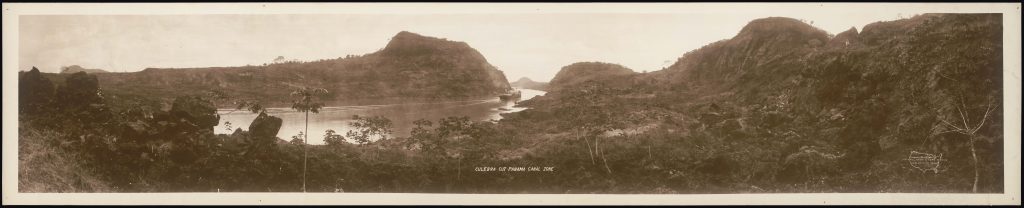
E.O. Goldbeck, Culebra Cut, Panama Canal Zone. Click on this link to view a larger photo in our digital collection, https://ufdc.ufl.edu/pcmi002610/00001 During the 1914 trip Goldbeck stayed at the Army-Navy YMCA in Cristobal and purchased cigarettes there to use as trade currency on an excursion to the San Blas Islands. He exchanged 60 cigarettes for 60 parakeets which he released in the courtyard of the YMCA when he returned. He said that when he came back years later, there were still parakeets living in the courtyard’s palm trees.

Real Photo Postcard, Army & Navy YMCA, Cristobal C.Z., II.2021.36.106 On another trip to Panama in 1930, Goldbeck photographed the first airmail flight from the Canal Zone to Washington D.C. and New York City – famously flown by Charles Lindbergh. Goldbeck shot video footage of the postmaster giving Lindbergh the mail and took still photos of the airplane taking off. The plane then came back and picked up the film, transporting it as part of the mail delivery. That same evening, the footage Goldbeck created was featured as part of the news broadcast about the flight.
We are fortunate to have these beautiful and important Goldbeck photographs in the collection. Thank you to our Conservation and Preservation Department and Digital Support Services for helping us preserve them!
Have you seen Goldbecks’s photographs before? Was your family member stationed in the Canal Zone in the early 20th century and possibly featured in one of the images?
The book The Panoramic Photography of Eugene O. Goldbeck by Clyde W. Burleson and E. Jessica Hickman is a wonderful place to learn more about his adventures and photographic process. You can also hear an interesting story about Goldbeck and his photographs on an episode of Antiques Roadshow. https://www.pbs.org/video/appraisal-e-o-goldbeck-panoramic-photographs-vofq3d/
-
Happy New Year! and the 10 for 10 review

Fireworks from Sosa Hill, c1960, 2007.072.001.002 We hope everyone had a wonderful holiday season. We are back in the office and catching up before the spring semester gets in full swing.
As promised, we wanted to share an update with you about the 10 for 10 campaign we completed at the end of last year. The goal was to raise $10,000 in 10 weeks to honor the 10 year anniversary of the Panama Canal Museum Collection coming to the University of Florida. The funds will be used to support the Oral History Program.
We are thrilled to say that with Albert and Jane Nahmad, Kathy Egolf, Carol Meyer MD, and Joe and Bev Wood leading the charge, we were able to raise $19,401, almost doubling our goal. Thank you to everyone that participated. This tremendous show of support will help us continue conducting oral history interviews and capturing the incredible history and priceless memories of those that lived and worked at the Panama Canal.
A special thank you to Albert and Jane Nahmad, who donated $15,000 for the Oral History Program! The Nahmads previously had generously provided the funding to establish the Panama Canal Gallery, which is dedicated to Albert’s classmates in the Balboa High School Class of 1958 (https://pcmc.uflib.ufl.edu/exhibits/gallery/).
Thank you for following the 10 weeks with us. Visit our Oral History Program page to keep listening to the amazing stories, https://ufdc.ufl.edu/collections/ohpcm.