-
Outside the Box

Stereograph 20882: Loading Drill-Holes with Dynamite, Preparatory to Blasting Near Empire on the Panama Canal Route. 1909. Gift of Bill Angrick. 2013.2.167. Note the wooden dynamite boxes. In the slideshow at the bottom of the Digital School Days blog post there is a photo of similar wooden boxes used to ship and carry explosives during the construction of the Canal being used as scrap material in a school shop class. This fall we are highlighting our past, present, and aspirational digitization efforts. Scanning two-dimensional documents and photographs can be pretty straight forward, but what about those atypical items or the incredible Panama Canal and Canal Zone artifacts that we have?
Audio Visual Recordings
One group of items that requires special treatment is audio visual (AV). These videos or audio recordings include official productions of Canal and Canal Zone documentation as well as home videos of everyday life, holidays, performances, events, and trips into many different regions of Panama. The ability to once again see and hear the sights and sounds of life in decades past adds a special layer. We receive items in all kinds of formats: 8mm and 16mm films, DVDs, VHS tapes, USB drives, and others. The older, film based items have to be digitized by a company that specializes in these materials and has the right equipment.
This video clip came from a home movie of an American family living at the Panama Canal, shot in between 1955 and 1965. It includes scenes of life and nature in rural Panama, the Chinese Gardens in the Canal Zone, the lottery, trips to Old Panama, and more. We had to edit the original 23 minutes down to a short 3:30 clip for the blog but you can view the full video in the Panama Canal Museum Collection digital collection.
Home Movie of an American Family or Group (possibly the family of Roy C. Stockham). c.1955-1965. Three objects in the AV queue that I am excited to see eventually made available online are: films of the Dillon and Rowley Families from the 1940s-1960s that include footage of holiday celebrations, nursery and Sunday school, and the Canal locks; home movies of William Hitchcock from 1930-1961 and a number of reels containing unknown audio recordings; and home movies of Edward Powell that include footage of life in Panama and the Canal Zone.
Do you have any movies from your time at the Panama Canal that you would like to share?
Panoramic and Large Format Photographs
Some of you might remember the 2023 blog post “Panoramic Panama” that detailed the return of some wonderful panoramic photographs from our conservation and digitization facility. A few of those photos were six feet long! It is not hard to understand how different the process of digitizing something of that size would be from a usual 4×6 family snapshot or 8×10 official photograph.
Because of the large and somewhat unwieldy size of many panoramic images they often come to us tightly rolled. They have to be flattened in a special process that slowly unrolls them without damaging the delicate surface.
The rolled photos on the right are safely stored together until they can be treated by our fabulous conservation team.

Watch the videos below to see the 24 hour process of flattening three PCMC photographs in about 1 minute!
Preservation Process Step 1: Humidity Chamber. Humidity is slowly introduced into the chamber which softens the curling of the paper.
Preservation Process Step 2: Flattening. Evenly distributed weight is used to flatten the paper.
A heartfelt thank you to Katie Smith, Jimmy Barnett, and April Helena of the Libraries’ Preservation and Conservation Unit who took these videos for us while they were working on our photos.
Check out their fabulous Instagram account @UFPreservation.

Panoramic Photo of Ft. Sherman, Canal Zone. By E.O. Goldbeck. Gift of Carol A. (Kellog) Cooley. 2000.92. Negatives and Slides
One great digital success is the availability of an album of negatives taken by A.G. Bedell during construction of the Canal. The negatives were scanned and you can view them as images in our digital collection. This allows people to see the pictures and it keeps the original negatives safe from repeated handling and use.
Bedell took selfies with his co-workers in their office, he took pictures of his adventures around the Canal Zone and Panama, and he appears to have had a good sense of humor. Click to view the full album, Panama Canal Negative Album by A.G. Bedell. Gift of Kenneth Roth. 2014.50.1.


We have 3 boxes of glass plate negatives, used in photography during the 1800s through around 1930. The fragile nature of the glass and the photo surface requires very special handling and scanning equipment.
On the right is a glass negative created by Frank E. Reed during the construction of the Panama Canal lock gates. 2012.1.1.


We have traditional 35mm slides too – approximately 10 more archival storage boxes like this one of slides waiting patiently to be scanned. There are incredible images hiding inside, but they don’t get much attention because of the time consuming process of looking through them one by one.
3D Scanning
Every once in a while we get to do something pretty fun with the UF Libraries’ Digital Services team. In 2022, they received an internal Strategic Opportunities Grant to purchase new equipment and test it out. Digital photographs would be used to create a 3D model through a process called photogrammetry. Below are three examples of objects from PCMC that were digitized using this method. Click on the images below to access the 360 view.
This baseball was signed by the 1955 Balboa High School Champs. Gift of Steward Brown. 2000.62.1.3.
Were you on the 1955 BHS baseball team? Do you have any stories to share from that season?
This Mindi Orange Drink Carton is one of the many food cartons that we have in the collection. Gift of Cleve Soper. 2001.119.1.3.
What memories can you share about Mindi Dairy?
This Carnival mask from Colon is one of two that came in as a gift from Elizabeth Brandenburg, II.2018.41.1. The other mask was too difficult to scan using this method because of the fine details – specifically the eyelashes!
We have so many amazing artifacts and items of outside the box sizes and shapes. We hope you enjoyed learning about some of our ongoing digitization efforts and dreams for the future. Stay tuned for more…
This post is part of a fall campaign to raise awareness about our two-year initiative to digitized more of the collection. The goal is to hire a new member of our team whose only job will be to digitize items related to the Panama Canal – that means more memories and research material online for everyone to enjoy! Click here to learn more about our digitization campaign.
-
Hidden Treasures in the Telephone Book

“The Panama Canal telephone directory is a gold mine of information. It’s an almanac, a history, and, if one wishes to be prosaic, it can even be used to look up a telephone number…it’s size and content have reflected the growth and organization of the Company…In a very real way, it tells the story of the Panama Canal.” – Panama Canal Review, Spring, 1975
This fall we are highlighting the digitization efforts of the Panama Canal Museum Collection. Every year we get numerous emails from individuals traveling to Panama that want to know the former addresses of friends and family that lived in the Canal Zone. The telephone books are usually our first stop. Because we know they could make such an impact, they are near the top of our priority list of items to scan and make accessible online.

E.N. Nelson. Gang No.1 Telephone and Telegraph Relocation. Gift of Linda Adelsberger. 2011.021.001. 
In 1882, the French company working to dig a canal across the Isthmus installed a telephone system. The U.S. inherited that system in 1904 when they took over the construction project. The first telephone models had wooden cases and used a crank to signal the operator.
In 1909 the installation of telephones in most residences was permitted. Apparently the phones were a big hit because in 1912 an order was issued that telephone calls must be limited to five minutes.
Image on left: Antique Magneto Telephone from Canal Construction Site. c. 1908. Gift of Shirley Million Muse. 2005.55.1.

Telephone Card of A.L. Robinson. Gift of Tony and Nancy Michel. II.2024.16.4 
Telephone Card of A.L. Robinson. Gift of Tony and Nancy Michel. II.2024.16.4 The first edition of the Panama Canal phonebook was printed in December 1915. It was a small 59 page pamphlet printed locally at the Panama Canal Press in Mount Hope. For two years the phonebook was printed twice a year but as the cost increased the decision was made to reduce it to only once.
These early books of course include recognizable names. If you wanted to call George W. Goethals, the Canal’s Chief Engineer, at the office, the number was Balboa 230. If it was a social call or after hours emergency and you needed to reach him at home, it was Balboa 300.
Multiple surnames appear in the telephone books decade after decade, documenting the second, third, and fourth generations of families that lived and worked at the Panama Canal.
The image on the right is from the Winter 1977 issue of the Panama Canal Review.


The earliest edition in our large collection of telephone books is 1941 so we are missing the incredible information printed in the first 25 years.
I am pretty jealous of Communications Manager James W. Riley’s complete collection, seen on the left in a image from the Panama Canal Review, Spring 1975.
Do you have any of the missing editions that you are willing to share with us? If so, contact us at jnemmers@ufl.edu.
As seen in an office photo from 1919, at that time the directories were required to have a hole punched in the corner and a wire loop provided so that the user could hang it on a hook near the telephone.


Panama Canal Review, Spring 1975 Our 1945 directory still has a loop attached to it, and in comparing multiple editions it looks like maybe 1961 was the last year that they punched holes. See the photo below of the 1945, 1961 and 1962 directories.


Significant features of the directory came and went. A decision to stop including the tide tables, a long debated issue, was finally made in 1965. In 1972, the telephone books became bilingual, printing information in both English and Spanish.
The maps appeared for the first time in 1959. Most directories contain maps of Canal Zone townsites, Panama City, and Colon.
In addition to the blank maps, our digital collection includes three sets of Canal Zone maps with the names of former residents written on the buildings where they lived. The map of Margarita on the right is from Hometowns of the Canal Zone. Hometowns of the Canal Zone: An Interactive Display, Memory Lane, and Mapping Memories.

The images below show people hard at work to keep the Canal and the Canal Zone connected. Move through the slideshow with the left and right arrows.
Did you every work on the telephone system or on printing the directory at the Panama Canal?
Below is a quick scan we made of the 1974 phonebook so that people can get an idea of what they are missing! (When our digital services team scans them the quality will be much better). Use the + sign on the top tool bar to zoom in or download a copy with the link below the document.
We hope you enjoyed this post about the telephone books. Once we are able to have them scanned they will be put into our digital collection and they will be text searchable – you can type in a name, place, or business and discover!
This post is part of a fall campaign to raise awareness about our two-year initiative to digitized more of the collection. The goal is to hire a new member of our team whose only job will be to digitize items related to the Panama Canal – that means more memories and research material online for everyone to enjoy! Click here to learn more about our digitization campaign.


-
Digital School Days

Balboa High School Yearbook 1958, Canal Zone College Yearbook 1964, Paraiso High School Yearbook 1962, Cristobal High School Yearbook 1980, Rainbow City High School Yearbook 1976 The U.S. school system at the Panama Canal was established around 1904 and ran, in various iterations, until the final class graduated in 1999. The Panama Canal Museum Collection includes materials that extensively document the history of the schools and the experiences of the students, teachers, coaches, and administrators that walked the halls.
You might know that many of the Canal Zone school yearbooks, old school newspapers, and creative writing publications can be read in our digital collection.
Maybe you even know about the handful of amazing photo albums about the schools that we have partially digitized online: Canal Zone Schools, Photo History, 1904-1953, Elementary Schools, Latin American or Local Rate Schools, Canal Zone Schools Buildings and Grounds, and others.
What you might not know is how much more we have to share! Scroll down to enjoy many different aspects of the school years of yesteryear.
In addition to the stories you can hear in our oral history interviews we have boxes and boxes of treasures about Canal Zone schools: photographs, programs, tickets, cheer books, invitations, decals, dance cards, old forms some of you might recognize, old forms some of you might want to forget…

Canal Zone Schools, Report of Progress. II.2019.999.493. 
Canal Zone Schools, Unsatisfactory Work Report. Gift of Robert G. Lanphear. 2000.73.38. Headed to School

Cristobal Junior High School Assembly Program, 1967. Gift of Joan Ohman. 2002.30.37.10. 
Panama Canal School Bus Service Ticket Belonging to Betsy Foster, 1949-1950. Gift of Elizabeth Astin. II.2021.45.5. 
Panama Canal School Bus Service Ticket Belonging to Betsy Foster, 1949-1950. Gift of Elizabeth Astin. II.2021.45.5. 
Canal Zone Schools Student Identification Card for Free Transportation Belonging to Joel Baglien, 1974-1975. Gift of Joel Baglien. II.2024.32.24. 
Directory of Schools, 1980-1981. Gift of W.E. Bondurant. 2004.25.17. 
Blank Registration Form for Canal Zone Schools. Gift of Alice McGann. 2002.152.34
Use the left and right arrows to move through this slideshow. Note on the back of one the bus tickets the bus driver is called a chauffeur.
It’s Football Season


What About Basketball…and Baseball…and Track…and Swimming

Canal Zone Junior College Invitational Basketball Tournament, 1956. Coach Stewart Brown Collection. 2000.62.12 
Interscholastic Swim Meet, April 25, 1980. Gift of Pat Beall. 2002.38.25. 
Pacific Little League Annual Banquet Program, April 27, 1956. Gift of Samuel Field. 2013.999.10. 
Curundu Junior High School Interscholastic Triangular Meet, March 11, 1977. Gift of Pat Beall. 2002.38.24.
Perhaps you Prefer Performances

Program for “An Evening of Band Music”, 1955. Gift of Judy Lindsay. 2003.96.7.3. 
Program for Twelfth Night, Presented by Balboa High School Drama Club and Thespian Troupe, March 1976. Gift of Teresa Tartar. II.2017.17.25. Note that Don Randel and Victor Herr are part of the evening’s entertainment during the Balboa High School Concert Band’s presentation of “An Evening of Band Music.” Click here to learn more about Don Randel’s memories of music and theater in the Canal Zone – Bonus: you will hear about Lucho too!
JROTC/ROTC


Souvenirs of School Dances

Dance cards were used to record the names of prospective partners at a formal dance. The pencils were attached to make the process of writing names easier.
This group of Cristobal High School dance cards from 1936-1939 belonged to Morag (Marion) McIntyre. Gift of Joanna Cole. II.2024.30.9.
This dance card is from the 1948, Balboa High School, Junior Senior Prom. Did you ever fill out a dance card?
It was a close race between Mike and “Boozy” for who got the most dances. Junior Senior Prom Dance Card, 1948. Gift of Jo Ann (Standefer) DeLoof. 2005.78.20.

Graduation and Baccalaureate Ceremonies

Cristobal High School Graduation Invitation, 1967. Gift of Joan Ohman. 2000.30.37.19. 
Baccalaureate Program for Paraiso High School, 1974. II.2019.999.101. 
Balboa High School Graduation Invitation, 1979. Gift of Charles Hummer. 2000.37.22. Elementary Schools Too

Balboa Elementary School Spring Music Program, 1969. 2003.36.8. 
Los Rios Elementary School Yearbook, 1987-1988. Gift of the Friends of the Panama Canal Museum Collection. II.2023.29.6. We Haven’t Even Talked About Photos Yet
Use the left and right arrows to flip through the slideshow of photos.
This post includes just a small fraction of the items we have related to schools in the Canal Zone, but we hope it was enough to get you excited about out efforts. If you attended one of these schools please consider donating originals or scans of your materials to the Panama Canal Museum Collection.
Follow the blog during the coming weeks to learn more about digitization in the Panama Canal Museum Collection.
This post is part of a fall campaign to raise awareness about our two-year initiative to digitized more of the collection. The goal is to hire a new member of our team whose only job will be to digitize items related to the Panama Canal – that means more memories and research material online for everyone to enjoy! Click here to learn more about our digitization campaign.
-
Happy Labor Day


Happy Labor Day! These photos document the 1908 and 1910 Labor Day excursions of a family living at the Panama Canal during construction. Unfortunately, we don’t know their names but are grateful to the donor who made sure these treasures found a good home here with us.
The caption on the back of the photo above reads, “Starting for Old Panama Labor Day 1908 Government Break”. Gift of Barbara L. Daniels. II.2022.80.4.
Take a cue from this family’s celebration and enjoy any trips or relaxing moments you can today. (However, I don’t recommend wool skirts on the beach and ties might not be necessary)

Panama Bay, Old Panama, Labor Day 1908. Gift of Barbara L. Daniels. II.2022.80.4. 
Labor Day, 1910. Gift of Barbara L. Daniels. II.2022.80.4 
Gathering Oysters, Old Panama, Panama Bay, Labor Day, 1908. Gift of Barbara L. Daniels. II.2022.80.4. 
Old Panama, Labor Day, 1908. Gift of Barbara L. Daniels. II.2022.80.4. Do you recognize anyone in the photos? Some captions include references to Mr. W and Mrs. W so that could be a hint to solving the mystery of who this construction era family is.
-
110 years ago this month…

S.S. Ancon during the official opening transit of the Panama Canal, August 15, 1914. Gift of Brad Wilde. II.2021.36.106 One hundred and ten years ago this month, the Panama Canal officially opened. On Saturday, August 15, 1914, the S.S. Ancon left Cristobal dock No. 9, and approximately nine hours and 40 minutes later, it arrived five miles out into the Bay at Panama, at the end of the dredged channel. On board were around 200 people including politicians, military officials, and high ranking affiliates of the Panama Canal.

Opening of the Panama Canal, S.S. Ancon passing Cucaracha slide. Looking north. August 15, 1914. Gift of Glenn W. Brandl. 2003.100.44.7. The August 15th, 1914 transit of the S.S. Ancon is the celebrated event, but there were other test voyages and “firsts” that occurred in the weeks and months prior, most notably the the August 3rd, 1914 trip of the S.S. Cristobal. Although it technically (and purposefully) did not sail the full length of the Canal so that the Ancon could claim that prize, Chief Engineer George Goethals wanted a ship to complete a trial run before the eyes of the world were on the Canal and the workforce that had labored for ten years to design and dig this new modern marvel.


A description of the test trip is included in the August 5th issue of the Canal Record.

John O. Collins shared his alternative theory of the August 3rd transit in the Society of the Chagres 1914 Yearbook, speculating that this “test voyage” was to give the individuals who had actually worked on the Canal the opportunity to experience it instead of outside dignitaries and press.
The Society of the Chagres was a organization created to “keep alive the pleasant associations and memories connected with the work in which they have each spent six or more years of their lives…who have earned the Roosevelt Canal Medal and two bars prior to the official opening of the Canal.” Their yearbooks are a great place to learn about some of the Americans from the construction era.
Move through this slideshow of images of the Cristobal‘s trip with the left and right arrows.

S.S. Cristobal in the 1st Chamber, Gatun Locks, August 3, 1914. Gift of Mickey Fitzgerald. II.2024.3.2016 
Goethals looking on as the ship is raised through Gatun Locks. August 3, 1914. Gift of Mickey Fitzgerald. II.2024.3.217. 
S.S. Cristobal crossing line of old French canal on way to Gatun. August 3, 1914. Gift of Mickey Fitzgerald. II.2024.3.118. 
S.S. Cristobal on Gatun Lake at dump #6 (near Mamei), on trip through canal. August 3, 1914. Gift of Karen Nadeau Price. 2012.115.85. 
S.S. Cristobal going through Gatun Locks, August 3, 1914. Gift of Mickey Fitzgerald. II.2024.3.240. 
S.S. Cristobal, Gatun Locks. August 3, 1914. Gift of Mickey Fitzgerald. II.2024.3.238. 
S.S Cristobal in Culebra Cut, Return trip from 1st passage through Panama Canal, August 4, 1914. Collection of Curtis H. Bliss. Gift of Mickey Fitzgerald. II.2024.3.182.
Did you know that there is debate about whether the August 3rd or the August 15th trip carried the 50,000 medals struck to commemorate the completion of the Panama Canal? Although the official opening was the 15th, they are often referred to as the “Cristobal Medal”.


This medal was a gift of Sara Collinge Ulrich, 2002.23.3.
But what about those other “firsts”…
The S.S. Alliance was the first ocean going vessel to make lockage at the Panama Canal. It happened at Gatun Locks on June 8, 1914.

S.S. Alliance in Gatun Lake, June 8, 1914. Gift of Brad Wilde. II.2021.36.106 The Santa Clara tested the lockage through Miraflores and Pedro Miguel later in June, 1914.

The Santa Clara during Northbound First Pacific Lockage, June 18, 1914. Gift of Brad Wilde. II.2021.36.106. 
An account in the Isthmian Historical Society Roosevelt Medal Holders’ Tape Recorder Guest Book references another first. It is unclear if Adrien M. Bouche is conflating two “firsts” or if he was mistaken about the year, but he recounts a unique experience he had watching one of these important events with Goethals himself. At the age of fifteen or sixteen Bouche watched the first lockage of Gatun Locks, a trip made by the tugboat Gatun on September 26, 1913.
Isthmian Historical Society. Roosevelt Medal Holders’ Tape Recorder Guest Book: The Word-for-Word Reminiscences of 35 Oldtimers Who Helped to Dig the Panama Canal. Recorded on Tape November 17, 1958.

Excerpt from the writing of Adrien M. Bouche. Isthmian Historical Society. Roosevelt Medal Holders’ Tape Recorder Guest Book: The Word-for-Word Reminiscences of 35 Oldtimers Who Helped to Dig the Panama Canal. Recorded on Tape November 17, 1958. 
Operation of Gatun Locks. First boat through Tug “Gatun” entering lower lock. September 26, 1913. II.2019.999.554
Do you have any stories about these Panama Canal “firsts”?
If you want to learn more about these and other early “firsts” at the Canal enjoy this series of articles that Bob Karrer, Bill Fall, and Tag Stewart wrote for the Isthmian Collectors Club (ICC) Journal’s in 2011 called “The First Transits”. You can read the articles here or download a copy below.
-
Leaving Left-Hand Driving Behind

Panama American, April 14, 1943 Did you know that cars in Panama and the Canal Zone used to drive on the left-hand side of the road?

Postcard, Gift of Brad Wilde, II.2021.36.106 At 4:57am on the morning of April 15, 1943 sirens and fire whistles across Panama blew for three whole minutes. Traffic came to a complete stop. At 5:00am vehicles slowly made their way to the other side of the road, leaving left-hand driving behind, and carried on with the day on the right side of the road. The transition went off without a hitch – the only issues involved two caramettas whose horses didn’t understand why they had to change their well-worn routine.
Speed limits were reduced for one month to mitigate the damage from any traffic mishaps.

Postcard, Gift of Brad Wilde, II.2021.36.106 The significant change to the rules of the road had been under discussion for over 20 years. With staunch supporters on both the left-hand and right-hand driving side of the debate, little progress towards consensus was made. However, with the construction of the Pan American Highway in the 1930s and the influx of workers and soldiers from the U.S. and other countries who were accustomed to right-hand driving, the decision was finally made to transition.
"It is important that the automobiles of Panama and the Canal Zone be transferred to the right side of the road before the Pan American Highway is opened if vehicular confusion, approximating the linguistic tangle encountered by the builders of the Tower of Babel, was to be avoided... Should this strip on the through route from Alaska to Patagonia retain the left side drive, the interesting result would be signs notifying motorists to transfer to the opposite side of the road when crossing the Panamanian border."
Panama American, 1931 (quote taken from the Panama Canal Review, Fall 1973)
Theories abound regarding the origin of left and right hand driving – usually tied to how people in the region controlled horse drawn carriages or drove animals for agriculture. Some archaeologists even suggest left-hand driving came from the ancient Romans, possibly for safety and the ability to wield a weapon with the commonly dominant right hand.
As to the origins of Panama’s history with left-hand driving we are left to speculate. One suggestion was that many of Panama’s early horse-cab drivers were from British colonial islands and that they brought the custom with them when they arrived.
Curiously, when we looked through the various guides to Panama in the collection, none of them mentioned left-hand driving. On the right is a small selection of the guides published before or in 1943.
Do you have anything that mentions left-hand driving?
Do you have any memories or stories about the switch from left to right-hand driving?

Use the left and right arrows to flip through the slideshow of left-hand driving in Panama and the Canal Zone.
And here is a classic street shot of Ave. Central in Panama City after the switch to right-hand driving.

Postcard, Gift of Brad Wilde, II.2021.36.106 Remember: if you are ever trying to date an old family photo in Panama or the Canal Zone, look at the cars…if they are driving on the left-hand side of the road you know the photo was taken before April 1943.
-
Making Waves with the First Ocean to Ocean Flight over Panama
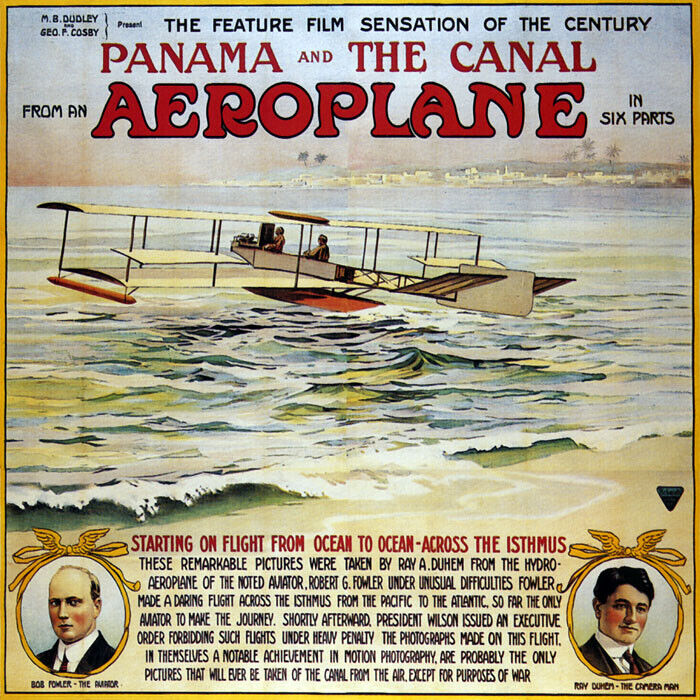
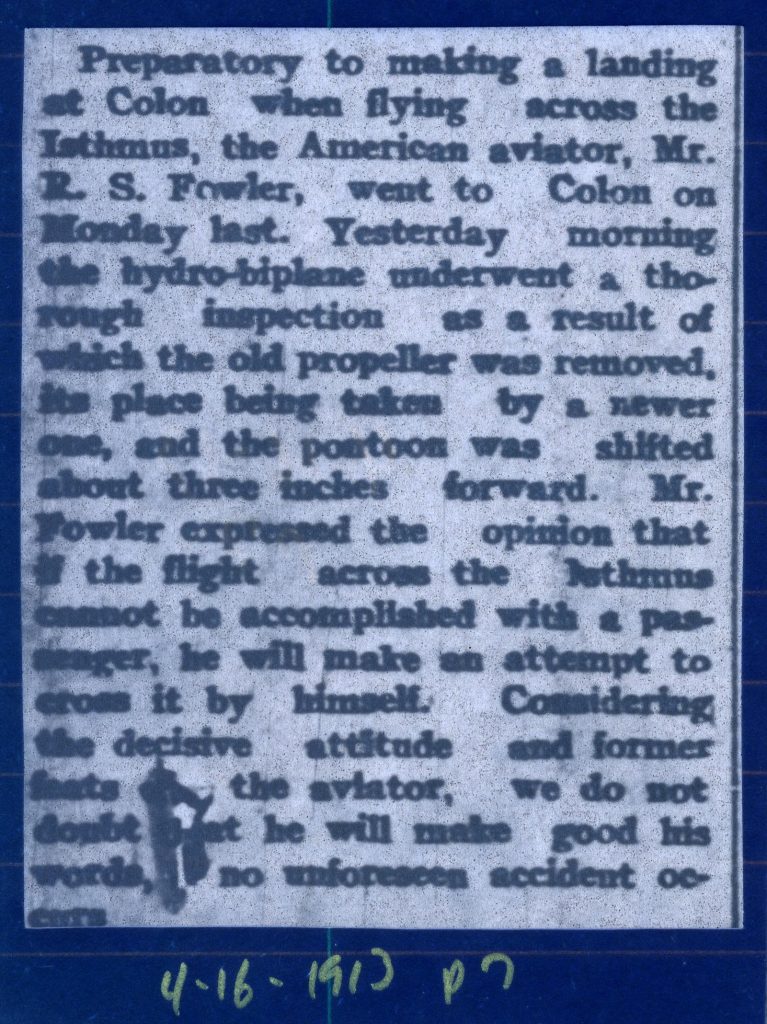
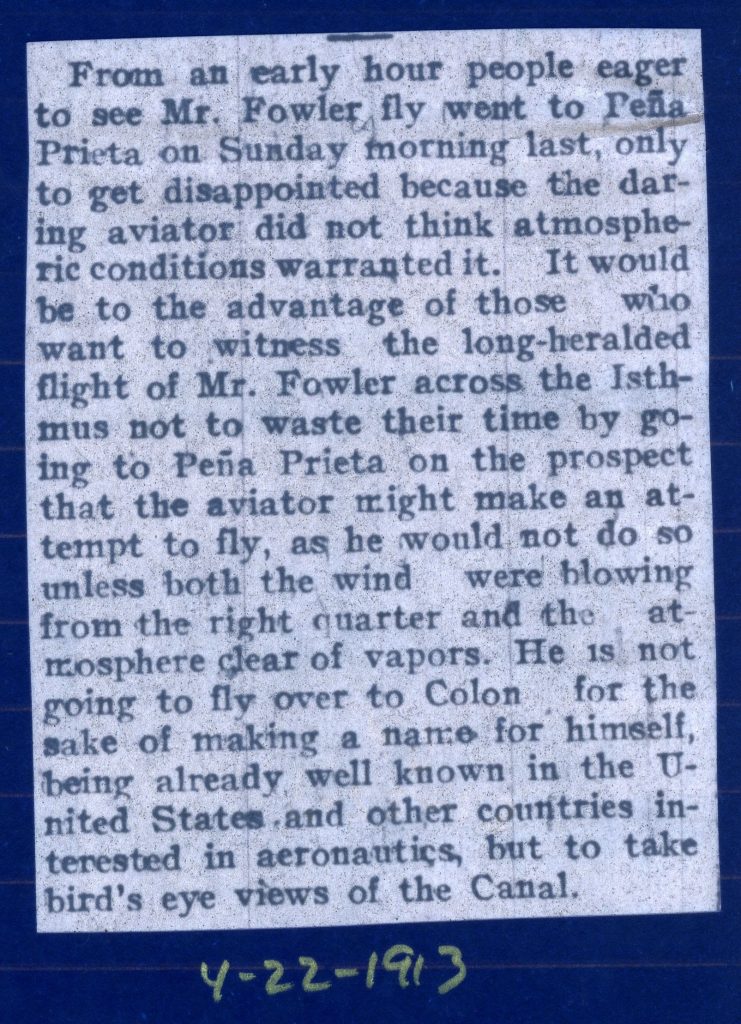
In April 1913 pilot Robert G. Fowler and cameraman Ray Duhem took the first non-stop flight across Panama, all the way from the Pacific to the Atlantic Ocean. Their adventure was big news on the Isthmus, and was covered in the local press for the duration of their three week stay. In addition to being the first to accomplish the flight, they shot six reels of film that were to be released in theaters.
Things didn’t exactly go as planned…but lets start at the beginning.
After becoming the first to fly coast-to-coast across the United States in 1912, Fowler started preparing for his flight across Panama. He and Jay Gage, a Los Angeles aeronautical engineer and aviator, collaborated on the design of a more powerful single propeller tractor biplane. Three significant design features were the passenger seat situated in-front of the pilot which would house the cameraman, the greater span of the upper planes on the wings, and the segmented manufacturing so that it could easily be crated for shipping to Panama. Because there were no airfields on either side of the route, wooden pontoons were affixed to the bottom, transforming it in to a hydroplane.
Note the dotted lines in the drawing which indicate where the planes of the wings could be cut for crating.1
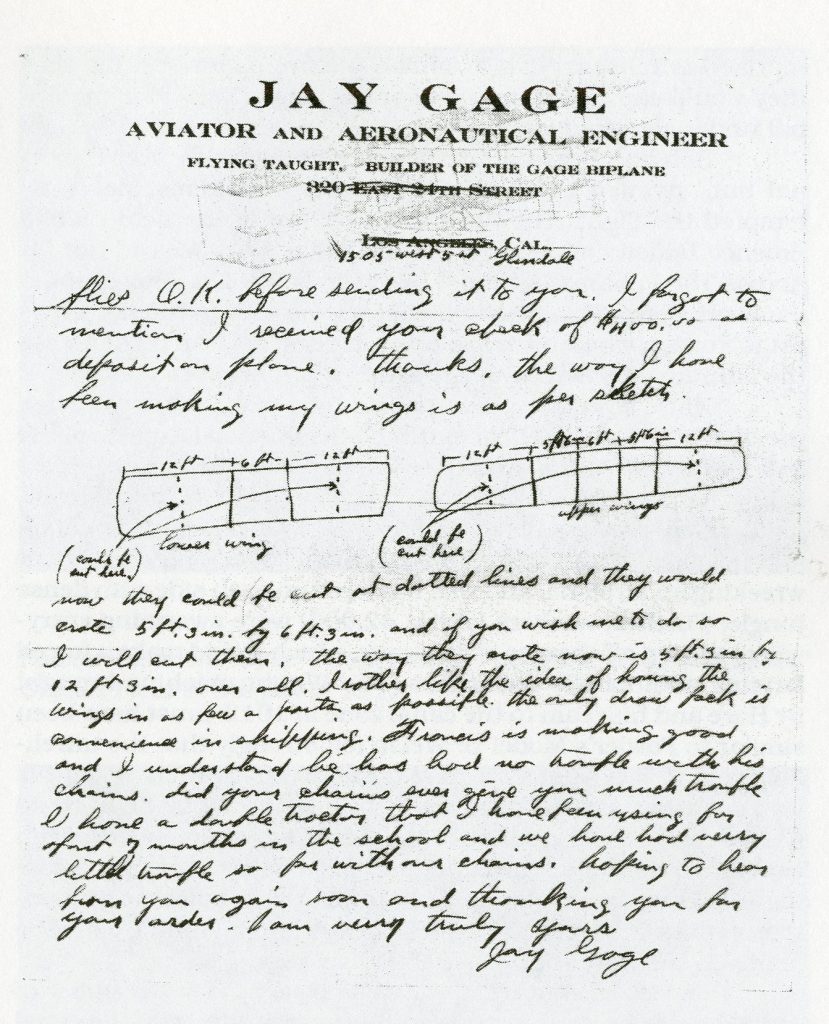
Days before his departure Fowler learned the high-test fuel that the plane needed was not available in Panama. He quickly asked the Union Oil Company of California to ship 50 gallons on one of their tankers headed that way. After his two week trip, Fowler arrived to learn that the heat in the cargo hold had caused the tin cans to rupture and his fuel had evaporated. Luckily, the Panama Fire Department donated some of their own high-test fuel so the flight could continue as planned.

Robert Fowler with his airplane crates after arriving in Panama. One of the wooden pontoons is in the lower left corner. II.2022.22.4. Gift of Brad Wilde The airplane was transported to Bella Vista beach where it was assembled. Fowler commented on the dramatic Pacific side tides, “One big trouble on the beach I had set up as base was the large tide movement. At this point there was a 30 foot tide change – when the tide was out my plane was a quarter mile from the water.”2
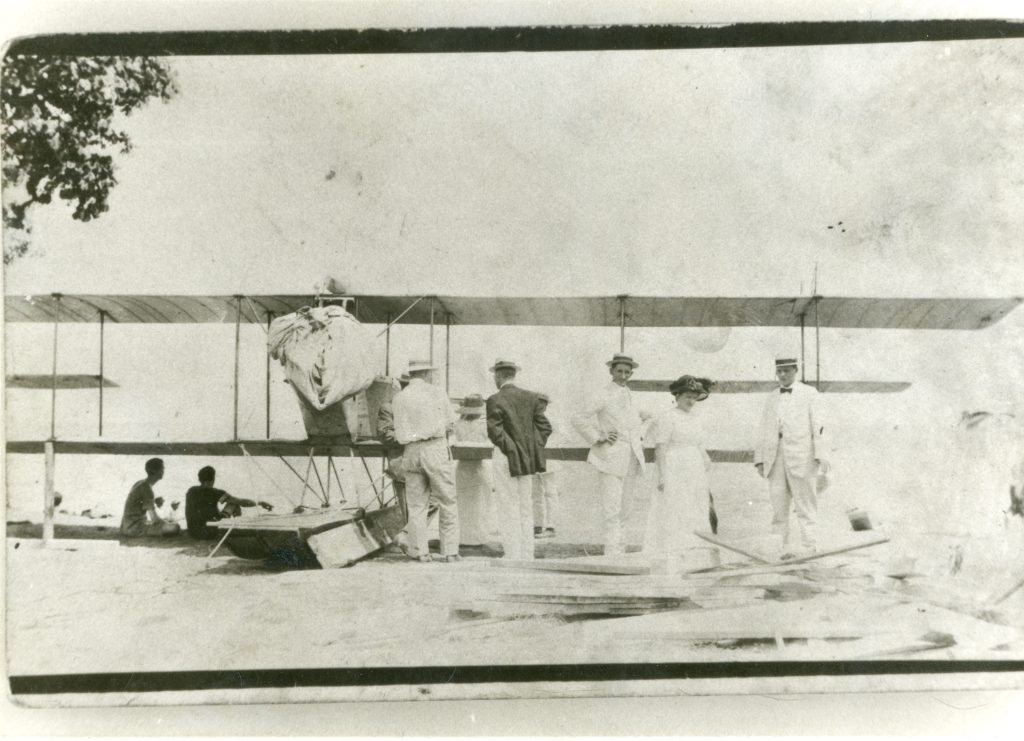
Robert Fowler’s plane being assembled on the beach. II.2021.36.49. Robert J. Karrer Papers Fowler began test flights shortly after his arrival which were reported in local publications. Some flights were more harrowing than others and included mid-air stalls, a flooded and broken engine, near collisions with the shore, and a nude Duhem out on the pontoon spinning the propeller to help Fowler restart the engine. The newspapers didn’t report on many of those details, so to learn more about the test flight mis-adventures read The Life of Robert G. Fowler by Maria Schell Burden.
Use the left and right arrows to move through the slideshow of clippings from the Robert J. Karrer Papers.
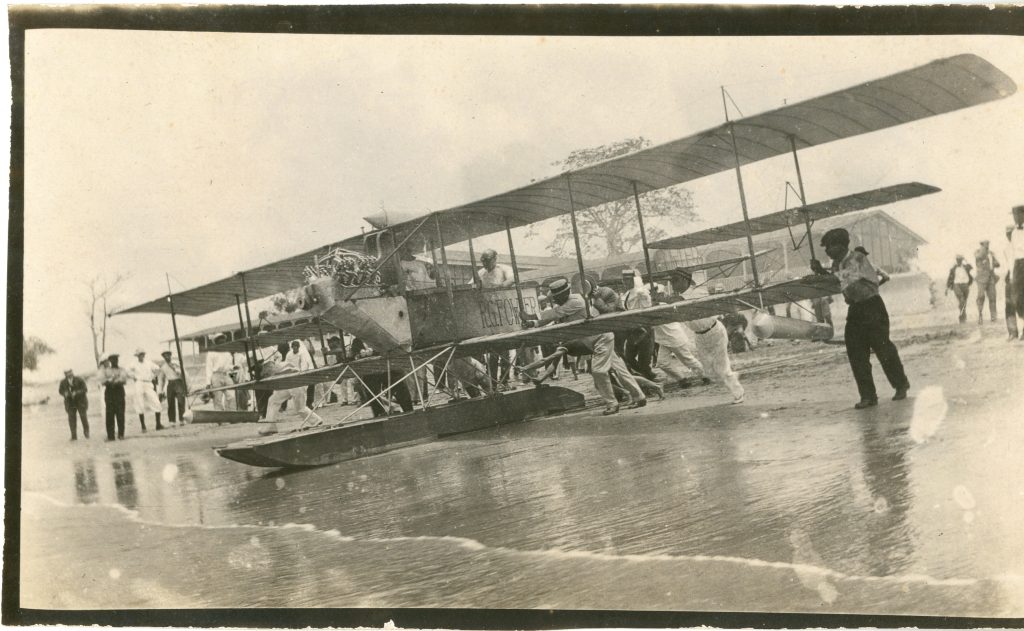
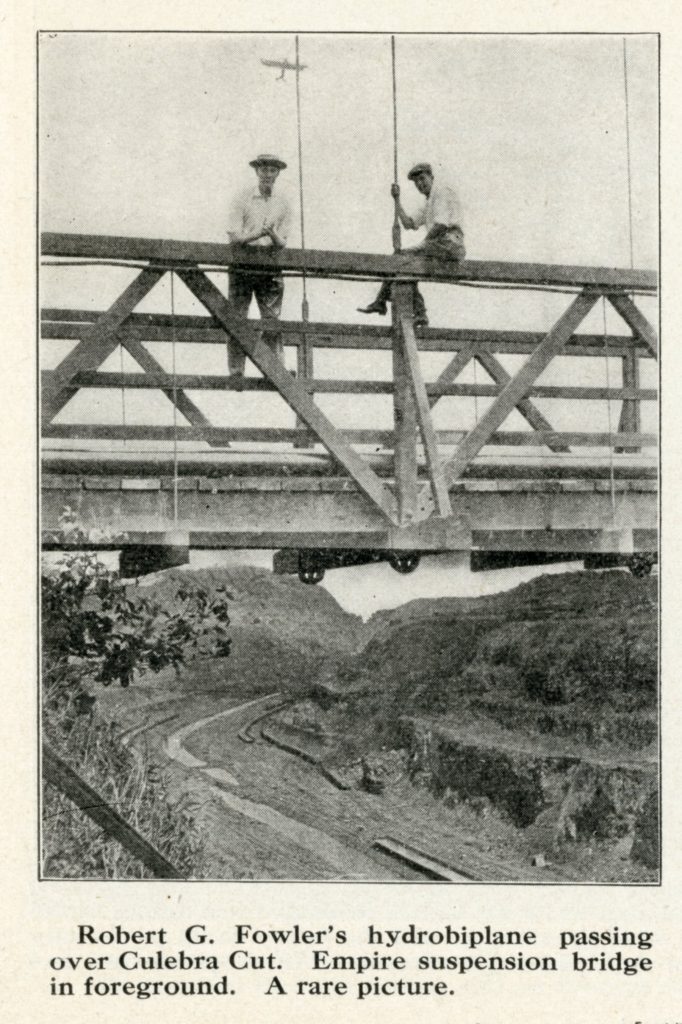
A group of men push Robert Fowler’s hydroplane into the water. From the Photo Album of Albert Christopher Garlington. II.2022.5.1. Fowler and Duhem made their historic trip on April 27th, 1913. While flying over Culebra Cut they were captured in the background of a photograph.
As they approached the end of their hour and 45 minute long flight, right over Cristobal, they ran out of gas and the engine stopped. Fowler was successful in guiding the plane to a landing spot in shallow water.
The image on the right is taken from America’s Triumph at Panama by Ralph Emmett Avery, 1913. Come check out the book in our Latin American and Caribbean Collection Library, https://ufl-flvc.primo.exlibrisgroup.com/permalink/01FALSC_UFL/6ad6fc/alma990227615780306597
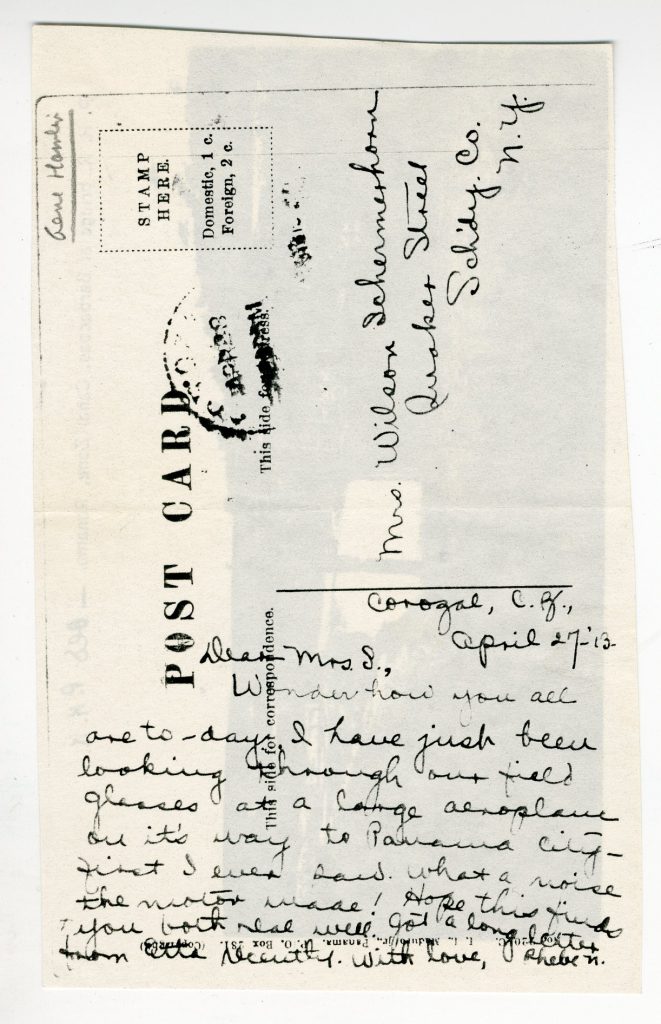
The note on the back of this postcard from the Robert J. Karrer papers mentions watching and hearing Fowler’s plane flying over Panama. This was the first “aeroplane” the sender had ever seen. II.2021.36.49. 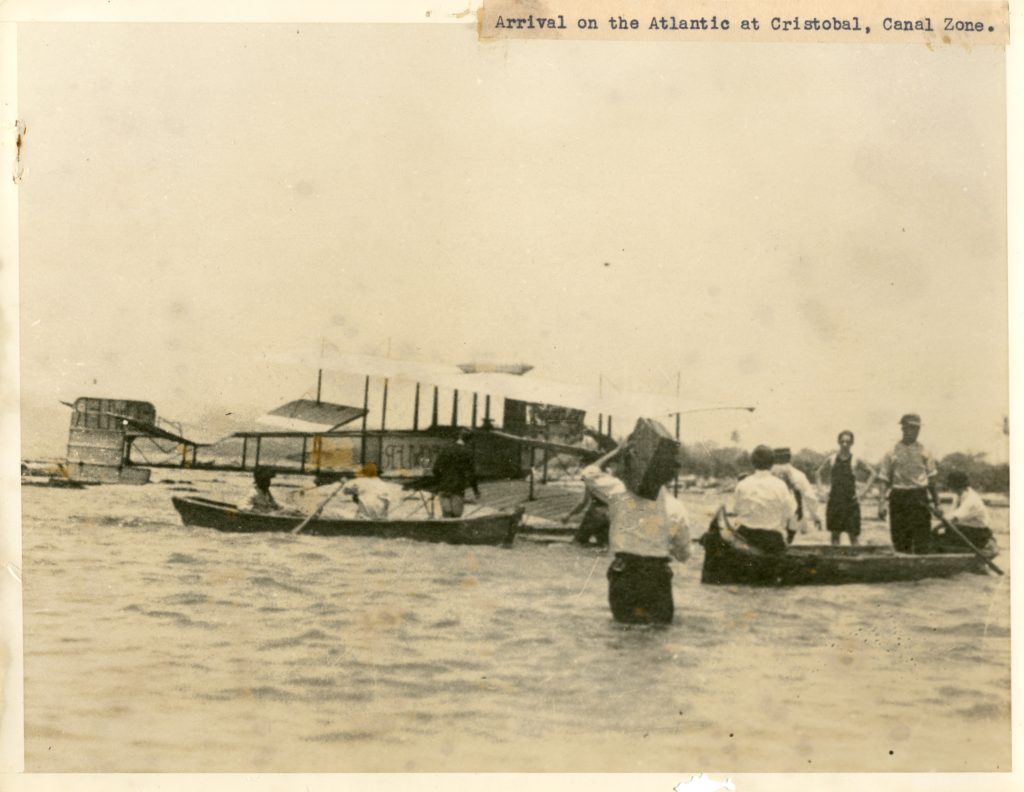
Fowler’s plane in Limon Bay near Colon. Duhem, the cinematographer, is in the foreground with his camera box on his shoulder. II.2024.164.1. Gift of Mickey Fitzgerald. Below is some of the footage that Duhem shot from the plane. You can watch them fly over Canal Zone towns and the construction site of the Canal. At minute 10:23 you can see the moment they run out of gas and the propeller stops in the film’s frame!
Near the end locals come out to greet them and help pull the plane on shore. The young ones have fun waving at the camera, just like they do today.
Panama by Air (Reel 4), Ray Duhem, 1914, Internet Archive Despite the harrowing achievement, the real drama was yet to come.
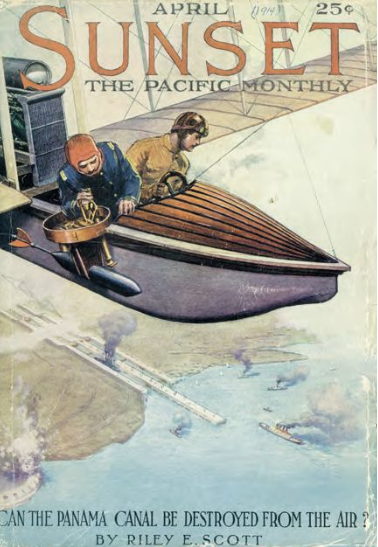
Charles Kellogg Field was the editor of Sunset The Pacific Monthly in April 1914 when the article about Fowler and Duhem’s flight was published. He and other aviation enthusiasts had concerns that Congress did not fully appreciate the importance and potential danger of airplanes. The author of the article, Riley E. Scott, was a West Point graduate and bombing expert who realized that their flight exposed a weakness in the Canal’s defenses. The cover caused quite a stir.
The image on the left is the cover of Sunset The Pacific Monthly, April 1914 issue. II.2019.999.249.
Three months after publication, at the request of the War Department, Fowler, Duhem, Scott, and Field were arrested and charged with spying by violating a statute that prohibited sharing military information. While filming the Canal’s construction Duhem had also filmed military installations. Scott included a still image of the future site for the 16-inch gun on Naos Island off the coast of Panama City in the article with a dramatic caption.
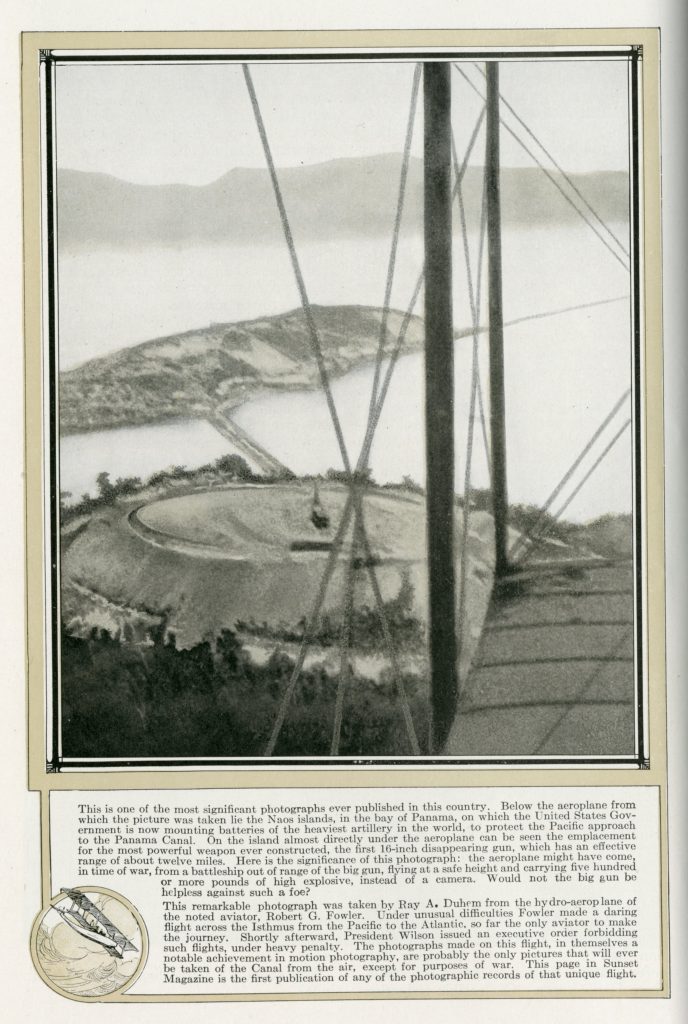
A page from Riley E. Scott’s article “Can the Panama Canal be Destroyed From the Air?”. Published in Sunset The Pacific Monthly, April 1914. II.2019.999.249. The men appeared in court and explained that they had been granted permission prior to the flight by both the War Department in Washington and by Colonel George C. Goethals, Chief Engineer of the Panama Canal construction. The case was dropped a year later.
The image on the right is taken from The Life and Times of Robert G. Fowler by Maria Schell Burden.

Fowler’s plane is on display at the Smithsonian National Air and Space Museum, Steven F. Udvar-Hazy Center in Chantilly, VA. (minus the wooden pontoons damaged during the crash landing)

The Fowler-Gage Biplane flown over the Isthmus of Panama in 1913. Gift of Robert Fowler. https://airandspace.si.edu/collection-objects/fowler-gage-biplane/nasm_A19510004000
Two other efforts had been made to fly over Panama by different parties: O.G. Simmons, Al Welsh, and James H. Hare from Collier’s Weekly and Jesse Seligman. Neither group attempted the crossing. The Collier’s group cited lack of viable landing sites as a critical part of their decision. Severe air crosscurrents and wind were also dangerous elements. Fowler experienced the significant winds first hand on his flight. In one event an air current flipped the plane around so that it was flying in the opposite direction, and in another an air pocket over Culebra sent the plane plunging 300 feet straight down.
These images are taken from an article James H. Hare wrote in the Aero Club of America Bulletin called, “Why We Did Not Fly Across the Panama Isthmus.”
Simmons and Welsh at the Culebra Cut 
James H. Hare Looking for a Landing Place -
George Stratford Seymour Cockburn
This post is part of a pilot student project created for the University of Florida class, Raising History from the Grave: Primary Historical Research in Literary Analysis and Public Humanities taught by Dr. Leah Rosenberg. The students focused on members of the Black Caribbean diaspora who worked on the Panama Canal or in the Canal Zone, the U.S. territory that surrounded the Panama Canal for much of the 20th century. These employees were originally classified as Silver employees because they were paid in silver currency as opposed to the Gold employees who were American citizens paid in gold currency. The term is still used today by both the community and scholars. The students worked with Pan Caribbean Sankofa, a community organization dedicated to preserving the history of Caribbean people in Panama, who identified community leaders as subjects for the project. Students consulted a wide array of archival materials in the Panama Canal Museum Collection and other institutions and learned how to use these resources to highlight individual accomplishments and connect lives to their larger communities through the digital humanities. For other posts, see Raising History from the Grave.
Introduction
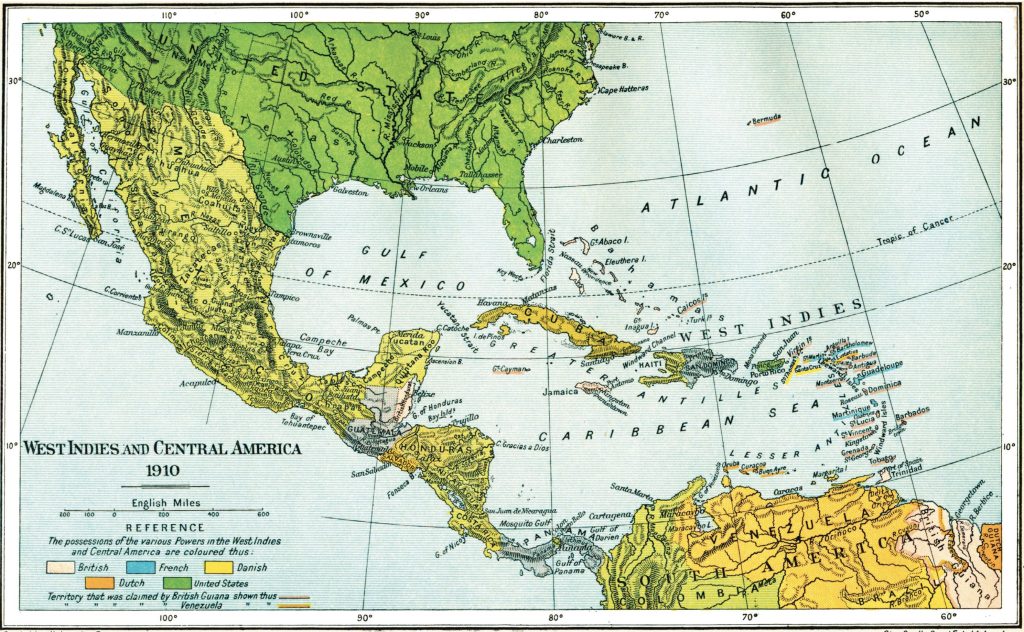
Map of Central America and Caribbean, 1910.
George Stratford Seymour Cockburn was born on March 9th, 1889 in Kingston, Jamaica, to Norman and Jemima Cockburn. He grew up as the youngest of three surviving siblings in an important decade of Jamaican history marked by both modernization and economic hardship, and he built his career as a young man during a transformative period of time in the Caribbean and South/Central America: the construction of the Panama Canal. This venture is rightly valued as an engineering marvel of the Western world, but it also relied on the underpaid labor of thousands of West Indian Silver workers, including George Cockburn himself. Mr. Cockburn relocated to Colón, Panama with his wife, Amy, in 1914, and began working within the middle class of the Isthmus, largely in clerical positions that protected him from the grueling physical suffering other West Indians had to undergo. He advanced through the ranks of the Receiving and Forwarding Agency. He likely worked first as a warehouse checker, where he would have possibly collected and recorded measurements of cargo, and later as a clerk. He and his wife raised eight children, but the elder Cockburns died in the late 1920s or early 1930s when many of their children were still very young. The Panama Cockburn clan eventually moved to Rainbow City (previously Silver City), where they contributed significantly to the community, which is part of the reason his memory lives on today.
Jamaica & Early LifeGeorge Cockburn was born in Kingston in 1889 (birth record) to Norman and Jemima Rebecca Cockburn; while the latter’s name has been recorded with several variations, we have determined through frequency and signature analysis that this spelling and organization is the most accurate. George’s parents married in 1882 and had two children before George himself: Ethel Daisy Beatrice, born in 1884 (birth record); and Norman Stratford Rudolph, born in 1886 (birth record). They also had another son, Edmund Cyril Stratford, who likely was born and passed away in the same year, 1891 (death record).
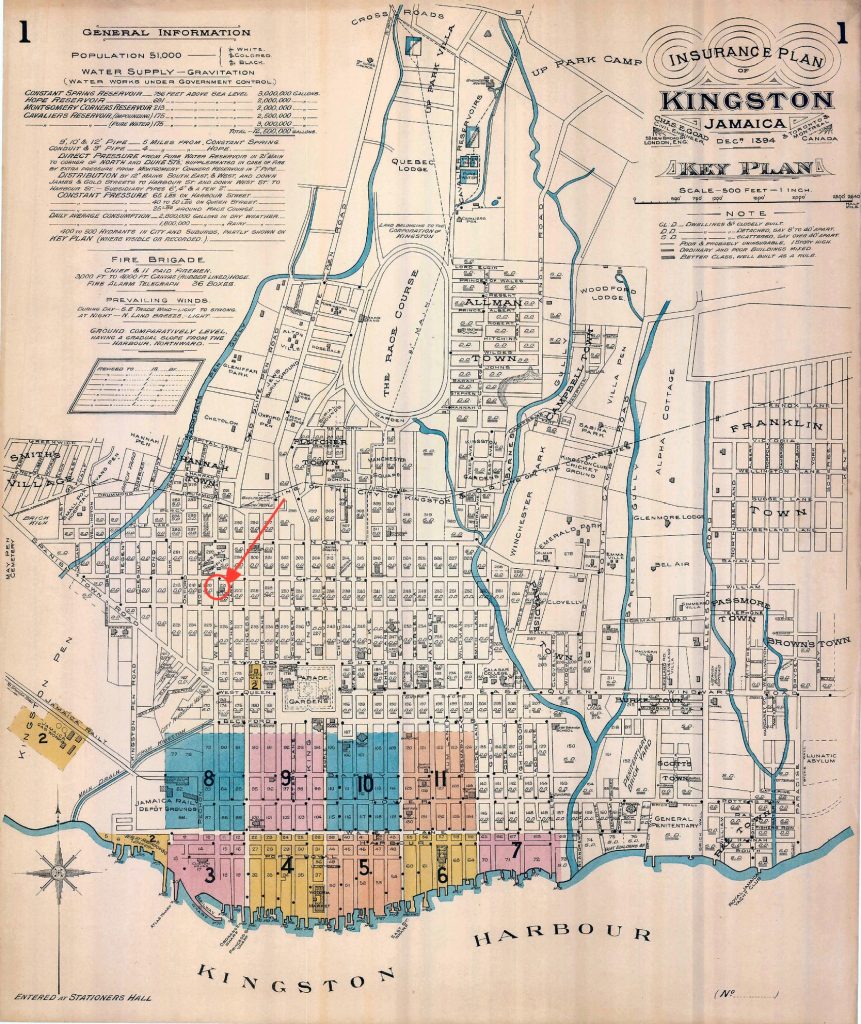
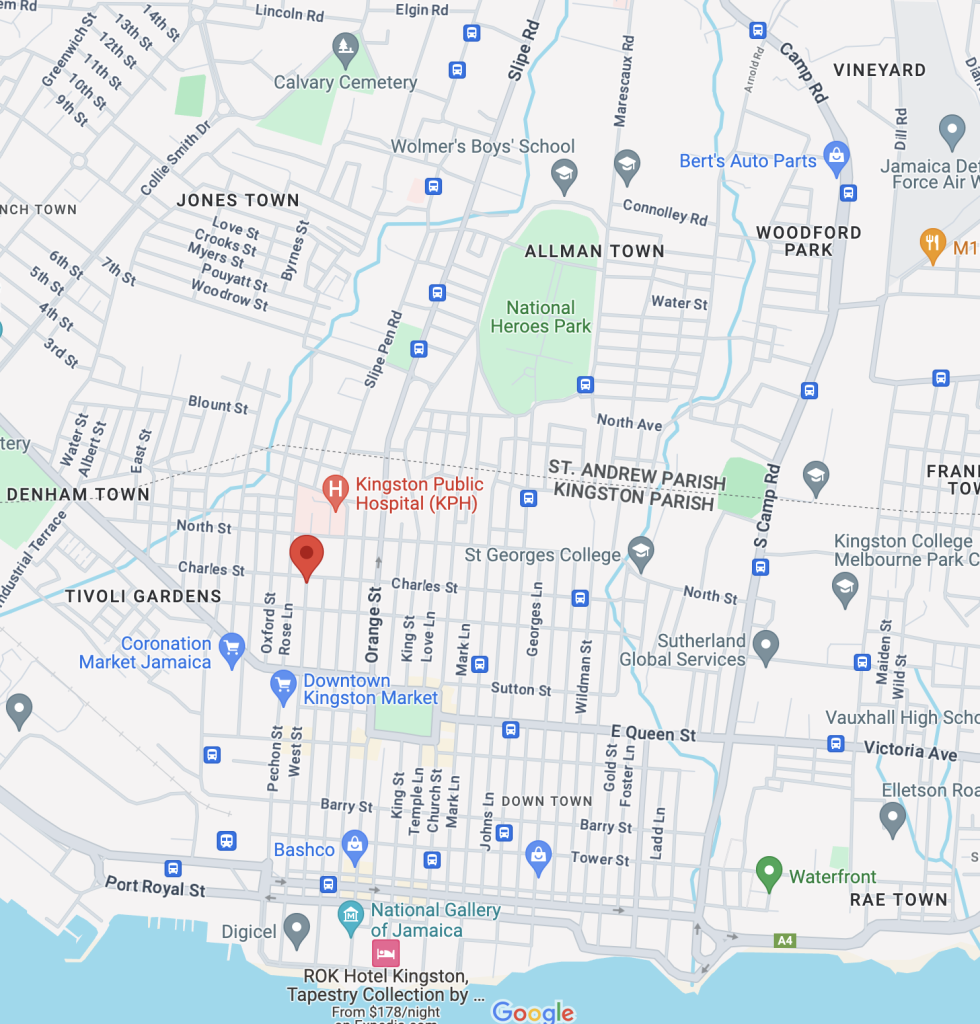
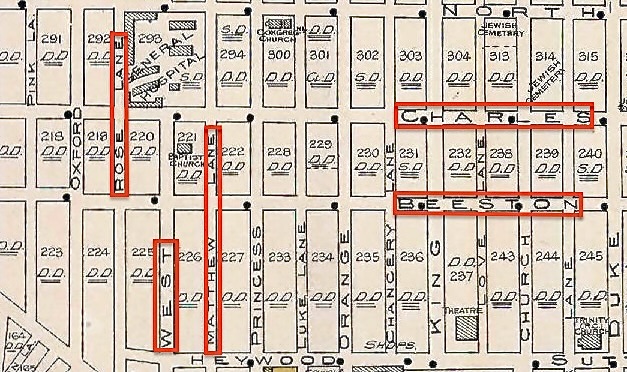
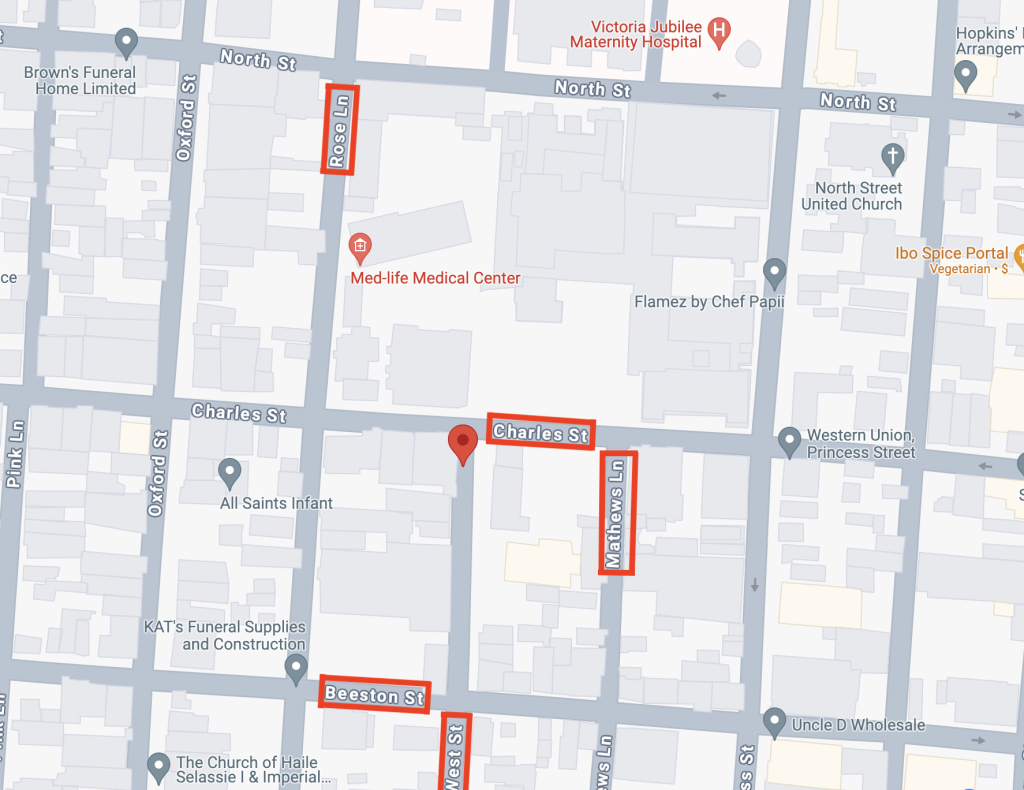
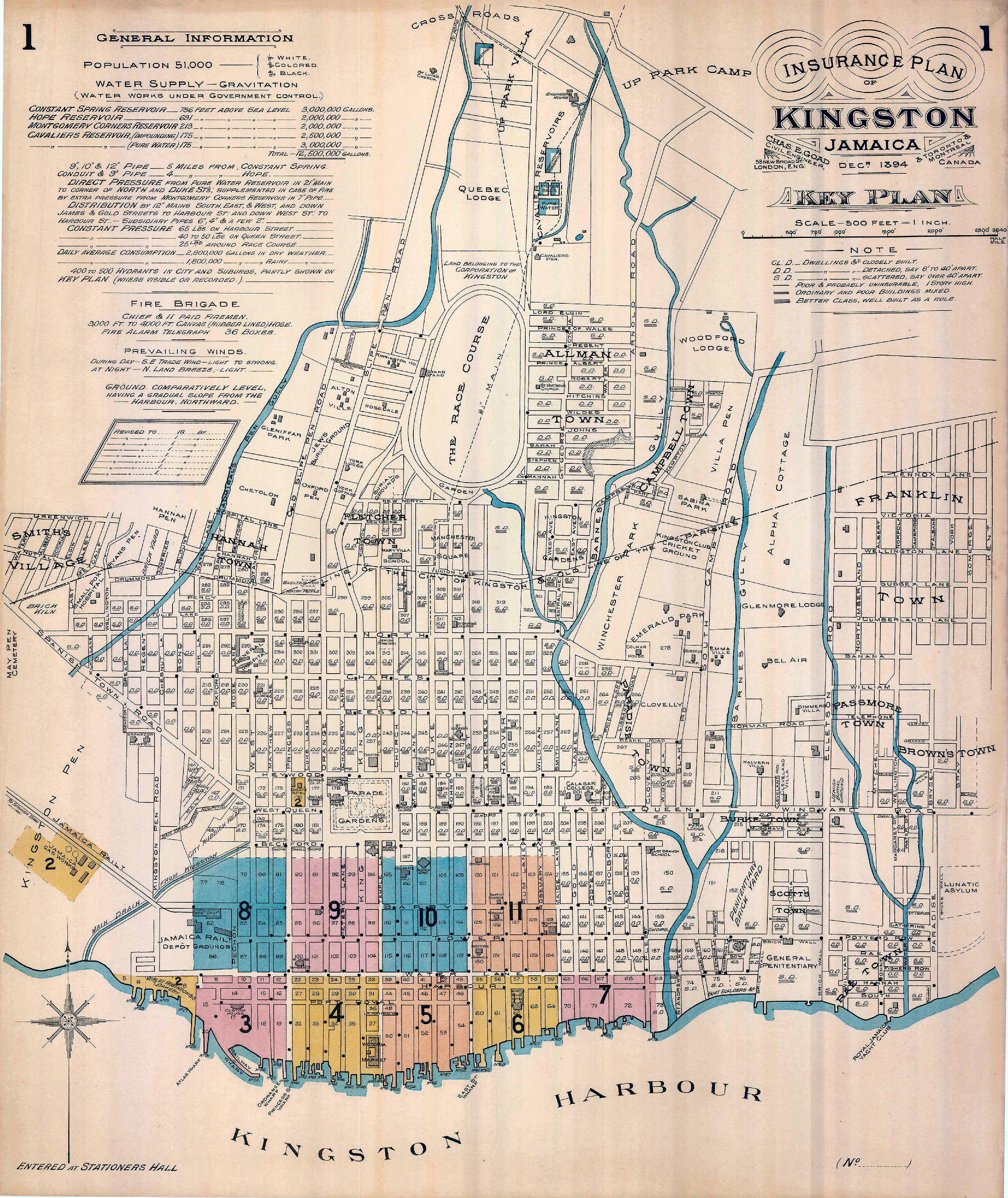
The Cockburn family lived at 145 West Street in Kingston, which can be seen on many of the documents provided. We were able to locate an 1894 insurance map (Insurance Map of Kingston, 1894) via Jamaican Family Search, which shows the entirety of Kingston as a city. By cross-referencing the street names with those on a current map of Kingston (accessed via Google Maps), we can determine that the Cockburns would have lived directly next to a Baptist church, the Kingston Public Hospital (est. 1776) and the Victoria Jubilee Maternity Hospital (est. 1892). Though the location is approximate, the two hospitals remain, and the neighborhood now seems to contain a funeral home and a clothing store as well.
As children, George and his siblings would have witnessed the decline of sugar and rise of banana plantations as Jamaica’s key industries (Modest & Barringer, p. 11), as well as diversification of the economy as other agricultural sectors began to rise with the flow of immigrants (Senior, p. 10). Some of the most important contributions to Jamaican society that would have affected George’s early life were the introduction of electricity, which occurred in 1892 via the Jamaican Public Service Company (Our History), and the Great Exhibition of 1891, which was intended to foster greater trade and communication between the United States and Jamaica (Jamaica International Exhibition, 1891).

Kingston, Jamaica in 1891. The Guardian. 
Carrying the wedding cakes, early 20th century. Senior, p. 510. Another interesting event of his childhood would have been attending the wedding of his sister Ethel to Walter James Marsden in 1905 (marriage record); this joyous occasion would have combined Anglican ceremonies with island rituals like the construction of arches made of palm leaves, traditional dancing and singing (Senior 21-22), and ‘carrying the cakes’ (Senior 510).
Olive Senior indicates in her book, Encyclopedia of Jamaican heritage, that despite the Anglicization of Jamaica, ‘country’ traditions, such as the usage of archways and festive cake-carrying, were notated as continuing as late as the 1930s (Senior, p. 21). This would have been an affair involving the entire family and church community, with everyone in the wedding party attending the next Sunday service to “turn thanks” (Senior, p. 511).
George and his family were members of the middle class in Jamaica and as such enjoyed a relatively rare social and economic status. His father, Norman Cockburn, was an Assistant to the Island Chemist, a municipal clerk position within the Department of Agriculture’s Government Laboratory. According to the 1921 Handbook of Jamaica, the Island Chemist worked alongside the Island Entomologist and Island Microbiologist to analyze data for medical and judicial purposes as well as for the public; the work of the Island Chemist was extended to involve agricultural research on sugar and rum in the early 1900s (Handbook, p. 221-222). Depending on when he began his position, Norman may have handled, categorized, and performed other clerical duties with the Royal Society of Arts and Agriculture’s articles on geology of the island, which was entrusted to the Island Chemist until the Public Library was formed in 1874 (Handbook, p. 226). Furthermore, Norman likely had amassed enough wealth to afford to legally marry his wife, Jemima Mack, which was also uncommon in a society marked more by domestic cohabitation than legal marriages due to the cost involved with the municipal proceeding and other financial expectations.

Marriage record of Norman Cockburn and Jemima Mack, 1882. FamilySearch. Norman’s unique economic position highlights the Cockburns’ special position within the social hierarchy of Jamaica, which was still quite stratified in the post-Emancipation period. But how did they rise to this station? Upon deeper research, we discovered that George Cockburn’s traceable roots extend far beyond this island. In the marriage register above, Norman’s father (and thus George S. S. Cockburn’s grandfather) is listed as George Alexander Cockburn. George Alexander Cockburn appears in a history of a Cockburn baronetcy of Langton in Berwickshire, Scotland entitled ‘The house of Cockburn of that ilk and the cadets thereof‘, a genealogical record of the family that shows the Cockburns’ migration to Jamaica and corroborates George Cockburn’s branch of the surname.
In the early 18th century, Doctor James Cockburn left Berwickshire behind for the tropical heat of the British colony and the fortune that lay in the sugar plantations that had, by then, reached their apex of profitability. It is important to recognize that the white Cockburns in Jamaica were certainly slave-owners–George S. S. Cockburn’s great-grandfather, Charles Seymour Cockburn, was listed in the Jamaican almanac as having 50 slaves on his St. Andrews plantation, Charlemount Penn, in 1833 (Jamaican Almanac, 1833). His son, George Alexander Cockburn, was the “heir presumptive” to the baronetcy, and was supposedly our George S. S. Cockburn’s grandfather.
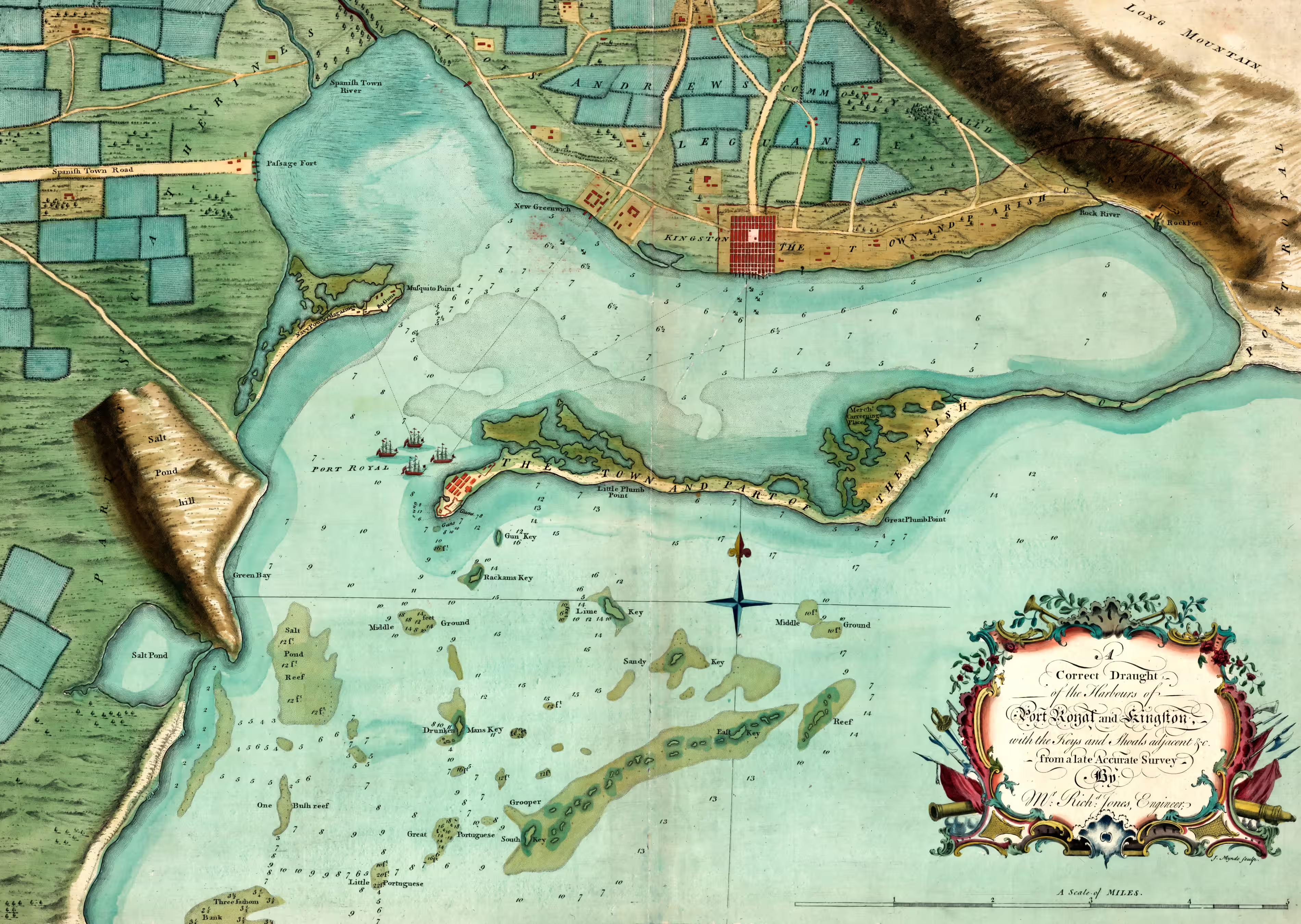
Map of Kingston and Port Royal harbors, ca. mid-1700s. The Guardian. For historical context, while slavery in the United Kingdom was abolished in 1808 and slavery in Jamaica was abolished in 1834 (The History of Jamaica), former slaves had to work in a four-year apprenticeship under their former masters due to the faux-benevolent idea of “equip[ping] formerly enslaved men and women to deal with their newly gained freedom as subjects (Modest & Barringer, p.5)”. Full emancipation did not occur until 1838, and economic disparities may have kept workers in their old jobs even longer than this.
While we do not know if she worked on the Cockburns’ plantations, we can speculate with fair certainty that Charles Cockburn’s son, George Alexander, had an extramarital relationship with an Afro-Jamaican woman, who gave birth to their son Norman Cockburn in 1854, George S. S. Cockburn’s father. Indeed, while the Jamaica marriage license lists Norman as George Alexander Cockburn’s son, the history of the Scottish “house of Cockburn” does not include Norman or his descendants (House of Cockburn 96-98), lending credence to the idea that his birth occurred outside of marriage. We hypothesize that George Alexander Cockburn assisted his son Norman by providing for the education necessary to become a clerk, and possibly offered further financial assistance; however, George Alexander Cockburn lived on the Charlemont plantation until his death (death record), while Norman moved away to the family home, so their relationship may not have been very close otherwise. However, George Alexander’s financial support would have allowed Norman and his children to avoid much of the persecution other Black working-class Jamaicans suffered in the post-emancipation period of Jamaican history.
Kingston and Jamaica as a whole modernized significantly between the time Norman was born and when George himself was growing up. However, in the early twentieth century, things for the Cockburn clan–and Jamaica as a whole–began to take a turn for the worst as the decade went on. In 1903, Norman, the family patriarch, died, leaving his son of the same name as the head of the house, as shown by his signing of the death document (death record).

Jamaica after the earthquake, 1907. The Guardian. Perhaps this was an indicator of things to come. In 1907, the Jamaican earthquake and subsequent fire struck. Englishman Vaughan Cornish described his own harrowing ordeal: “…the whole house was rocking violently; a fissure opened horizontally near the top of the west wall facing me, and a shower of brickwork fell near the threshold of the door… (Cornish, p. 246).” The devastating event caused tremendous damage to Kingston–approximately $2 million and twelve hundred lives were lost.

The Emigrants Protections Law of 1902 impacted US recruitment in Jamaica. NYT, 1905. Mr. Cockburn departed for Panama sometime in early- to mid-1912, likely with his wife, Amy Barrett, on a Royal Mail Steam Packet Ship for the Panama Canal. While what exactly spurred his journey is unknown, a good hypothesis is that, with the declining economy in Jamaica, he likely wished to be able to provide a better life for his wife and future family. A strong migration pattern had also been established between the two countries, beginning in the 1850s with the construction of the U.S. railroad system and continued in the 1880s during the French phase of Canal construction (National Library of Jamaica). It was also more likely for a man of his socioeconomic status to be contracted, as travel to the Canal Zone required a $5 deposit under the Emigrants Protection Law of 1902, which would have “hamper[ed] the operations of the recruiting agents of the Isthmian Canal Commission (New York Times, 17 December 1905)”.
Life in PanamaIn Panama, George Cockburn worked in various positions. He began his work in the Receiving and Forwarding Agency, commonly referred to as the R&FA (Photo Metal Check). R&FA was responsible for receiving and dispatching hundreds of thousands of tons of cargo from the time the Panama Canal opened throughout the period when Mr. Cockburn was in their employ (U.S. Annual Report 1921). During his time there, Mr. Cockburn worked in two different positions, first as a checker and then as a clerk. We concluded that this was the order in which he had these occupations, as we were able to verify his title of clerk six years after he came to Panama. In his position as a checker, Mr. Cockburn earned ¢.31 an hour (Metal Check). Instead of an hourly wage when he was a clerk, Mr. Cockburn earned $55 a month. Neither of these roles consisted of manual labor; rather, his job was mostly administrative in nature.
Holding a clerical position was relatively rare for West Indians – many of these roles were reserved for white Americans. This allows us to understand that, while Mr. Cockburn was a Silver worker and doubtlessly the victim of much discrimination, he nonetheless occupied one of the higher paying and desirable positions for West Indian workers at the time. Through a letter written from the Ambassador in Panama to the U.S. Secretary of State, we gain both general insight into the official government position towards West Indian workers and confirm that George Cockburn held a privileged position when compared to most West Indian workers at the time. The ambassador to the region, Seldon Chapin, wrote in 1954 that “although containing some minor clerical personnel, [West Indian labor] is largely composed of manual workers, both skilled and unskilled” (Office of the Historian). Despite the esteem of a higher ranked and important position, Mr. Cockburn was still limited to pay on the Silver roll (Photo Metal Check).

Taken from Mr. Cockburn’s Request for a Photo Metal Check (age: 29 years) His personal life in Panama was much more difficult to uncover. Mr. Cockburn was married to Amy Burnett; although we cannot verify exactly when or where they were married, it is likely that their marriage occurred before they left Jamaica. We do know that once in Panama, they had many children together and cultivated a large family. According to the Catedral de la Inmaculada Concepción records, we can see Amy, here spelled “Ami”, and George had their son, Erick Fitzgerald Cockburn, baptized in 1913, shortly after coming to Panama (Baptism record, 1913). In 1915, their son Leroy, officially Gilbert Carl Leroy, was baptized within the same church (Baptism record, 1915). Another child, Pearl Lera Cockburn, was born on June 14, 1917 (US Social Security, from Ancestry.com (subscription required)). A year later, in 1918, they had another son, Alden George, and in 1925, Lloyd Cockburn was born.
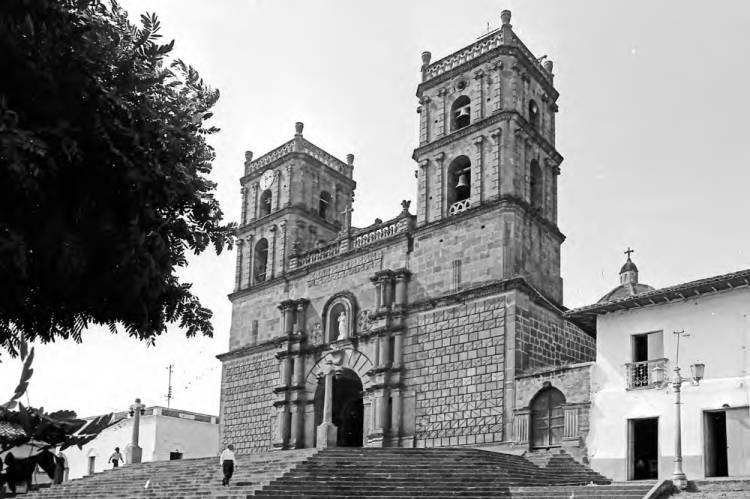
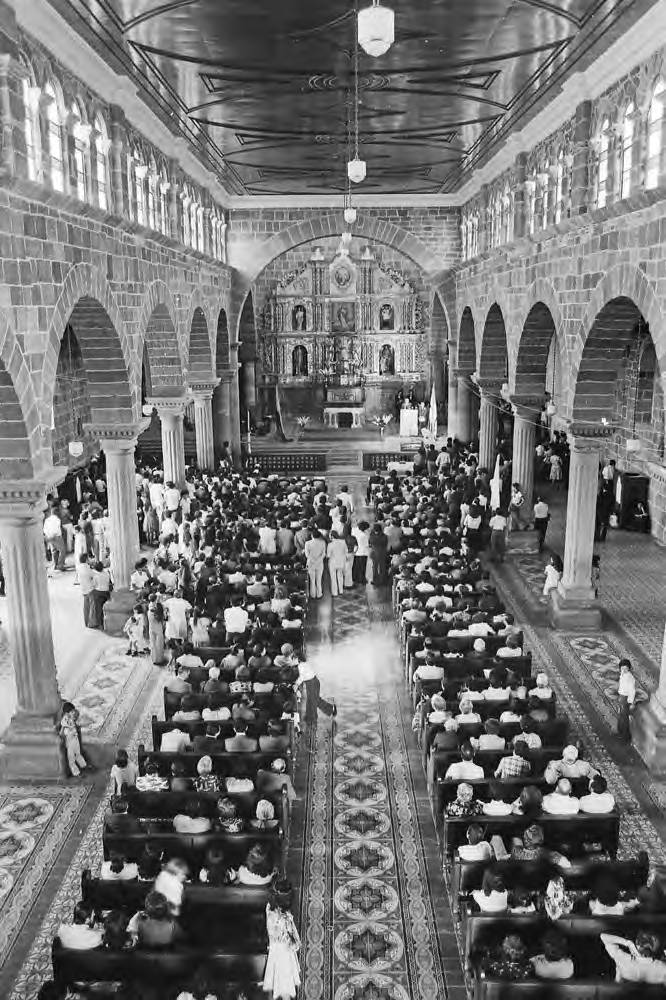
Photos of Catedral de la Inmaculada Concepción in Colón While we are unsure of exactly when Mr. George Cockburn passed, his son Leroy, then only 25 years old, was listed as the head of his household in 1940. In 1940, Leroy was listed as the head of a household made up of his siblings Alden, Amy, and Lloyd (1940 census, originally from FamilySearch), and Susan Hector, who may have been a maternal aunt. According to a personal interview with Canute Cockburn, George’s grandson, George and Amy ultimately had twelve children; however, at this time, these are the only progeny we have been able to verify. Additionally, an interview with George’s granddaughter, Casma Cockburn-Henlon, confirmed that only eight of the siblings survived past infancy.
While in Panama, Mr. Cockburn lived in Colón. As his residence fell outside of the official border of the Canal Zone, we do not have access to many records of that might show the exact neighborhood he lived in, his home, and other details. However, towards the end of his life, Mr. Cockburn was said to have moved to Silver City, Canal Zone (personal interview); we can estimate that this was no more than six years after the birth of his second son, Leroy, as the rest of his children were born in the Canal Zone (see above census). For the years after Mr. George Cockburn had passed and Leroy was designated head of household, more information about the exact location of his family exists. The building listed in the 1940 census was 185 Jamaica Street in Silver City, a home with three rooms and rent of $6.75 a month. Using the below map of Silver City, which we located via the University of Florida’s digital collection, and the information in the census from FamilySearch, we believe we were able to locate the precise location the Cockburns lived in in 1940: Apartment 6064F on Jamaica Street.
While we are not entirely sure when Mr. Cockburn passed away, a personal interview with Canute Cockburn asserts that the end of his life came when he was about 54 years old. This would have been sometime in 1943, but we have not been able to corroborate this date with paper data.
Mr. Cockburn’s Lasting LegacyMr. Cockburn was survived by many children and grandchildren, many of whom made significant contributions to their community. According to personal interviews with the grandchildren of Mr. Cockburn, his children were integral parts of many social advancements for West Indians. In Casma Cockburn-Henlon’s interviews, she stated that the surviving eight children were extremely close, in part due to their parents passing early in many of their lives. She noted that they looked up to one of the older siblings in particular: Mr. Leroy Cockburn, her father (47:40).
Leroy Cockburn was very involved both with his family and in the community. According to Mrs. Henlon, he began working as a “water boy” when he was thirteen (likely in 1928), probably to fetch drinks for Canal maintenance workers. As one of the eldest children, he took over as head of the household to provide for the rest of his siblings, as his older brother had left to attend seminary school in Jamaica. The 1940 census record also noted the family living with an aunt, Susan Hector. He married a woman named Dorothy and was depicted in this 1950 census as having had his first child, Lilia Cockburn.
Casma Henlon emphasized Leroy Cockburn’s community focus in an oral interview. “He helped so many people that I’m not aware of,” she said. “He was always encouraging someone, helping them to get on, to work with the [Canal] Company, or if they couldn’t do that trying to find a way that he could help them to improve their lot in life. He was everything in our church, from the door-opener to the accountant, a local preacher…, an organizer. He was active in the…local union, and a respected man. Everywhere that I went, they knew of the family, but they [really] knew of Leroy. And they respected him (46:36-47:34).”“Everywhere that I went, they knew of the family, but they [really] knew of Leroy. And they respected him.”
-Casma Cockburn-HenlonThere are many extant newspaper clippings that demonstrate Mr. Leroy Cockburn’s commitment to his community. He was an officer of the Civic Council of Silver City, in the Camp Coiner-Mount Hope District (Panama Canal Spillway 30 Oct. 1964, 4). He also served as an installing master–and perhaps in other posts–with the Moonlight Club, which seemed to be a social club associated with the Methodist Church (Panama American 28 April 1945, 3), to which Leroy was also very committed to. Indeed, he was a society steward for the church who “served without remuneration” and encouraged others to attend the administrative quarterly meeting of the church dedicated to “diffusing the gospel to the large Methodist congregation on the Isthmus” (Panama American 11 Sept. 1958, 3). Indeed, Mrs. Henlon stated in her interview that her father “enriched his life by his service to God (49:31-49:35)”, and her whole family was deeply involved with the Methodist Church, which she speculated George and Amy would have also attended.
Lloyd Cockburn, who was born in approximately 1921, was another of George’s children who made important contributions to the community. Throughout the 1960s, Lloyd Cockburn wrote numerous letters to the government and pushed for the rights of women to work on piers. Lloyd was also instrumental in bringing the National Maritime Union to Panama, which helped protect workers’ rights.
Along with Lloyd, another one of George’s children, Holden, belonged to and was active in both the union and civic council (Panama Canal Spillway, 5 Nov 1965, 4). Holden also served as a professor at Rainbow City High School.

Article featuring Holden L. Cockburn’s election to the Rainbow City District Civic Council, p. 4. 
Article featuring segment on Harmon Cockburn, p. 4. Finally, although we have been unable to entirely verify Harmon Cockburn as a member of George’s lineage, we surmise he was one of the children and know he also served as the Maritime Union Delegate from the wharfs (Panama Canal Spillway, 7 June 1963, 4).
We would like to extend special thanks to Mr. Cockburn’s grandchildren, Casma Cockburn-Henlon and Canute Antonio Cockburn, who have contributed invaluable information through their personal interviews. Alongside the extant archival information, their words have allowed us to construct a rich history of Mr. George Stratford Seymour Cockburn and the legacy he left behind. Should anyone be interested in listening to the full oral histories, please visit Mrs. Henlon’s interview and Mr. Cockburn’s interview, which should be available soon.Appendix: FamilySearch Documents
Due to FamilySearch requiring viewers to make an account to view their documents, we have decided to include an appendix of images we reference from the site in case viewers have trouble accessing them. We attempt to organize them here as they are referenced in the text.

Birth record of George Stratford Seymour Cockburn 
Birth record of Ethel Daisy Beatrice Cockburn 
Birth record of Norman Stratford Rudolph Cockburn 
Birth/death record of Edmund Cyril Stratford Cockburn 
Marriage record of Ethel Cockburn and Walter Marsden 
Marriage record of Norman Stratford Cockburn and Jemima Mack 
Death record of George Alexander Cockburn (grandfather of George SS Cockburn) 
Death record of Norman Stratford Cockburn (father of George SS Cockburn) 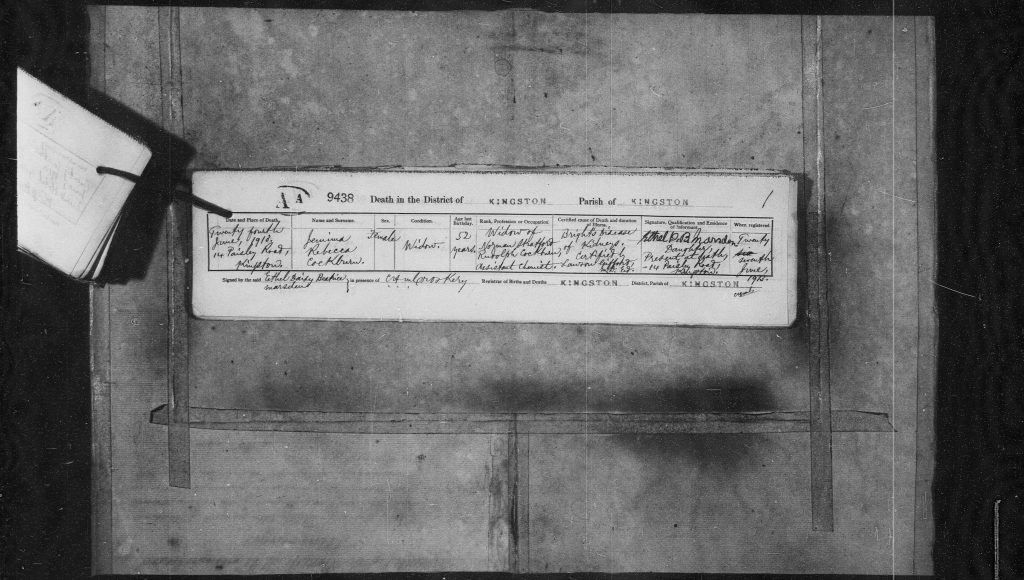
Death record of Jemima Cockburn 
Photo-metal check request of George SS Cockburn, page 1 
Photo-metal check, page 2 
George SS Cockburn’s request for a new photo-metal check 
Birth record of Erick Fitzgerald Cockburn 
Birth record of Gilbert Leroy Cockburn 
Screenshot of data from Pearl Lera Evering (nee Cockburn)’s Social Security (no digitalized image, from Ancestry.com) 
1940 Census, Panama Canal Zone 
1950 Census, Panama Canal Zone Source Information
Image Sources
Alamy. Mid-1700s map of Port Royal and Kingston Harbour. 24 Mar. 2016. The Guardian, Guardian News & Media Limited, https://www.theguardian.com/cities/2016/mar/24/story-cities-9-kingston-jamaica-richest-wickedest-city-world. Accessed 8 July 2024.
“Civic Council Slates Listed.” The Panama Canal Spillway, 30 Oct. 1964, pp. 1–4, https://dloc.com/UF00094771/00482/images. Accessed 8 July 2024.
“Civic Council Elections Nov. 9, 10.” Panama Canal Spillway, 5 Nov. 1965, pp. 1–4, https://ufdc.ufl.edu/UF00094771/00535/zoom/3. Accessed 8 July 2024.
Cleary, JW. Kingston After 1907 Earthquake, Jamaica. 2 Feb. 2017. The Guardian, Guardian News & Media Limited, https://www.theguardian.com/artanddesign/gallery/2017/feb/02/jamaica-in-the-1890s-in-pictures. Accessed 8 July 2024.
“Colon Methodists To Hold Quarterly Meeting Saturday.” Panama American, 11 Sept. 1958, pp. 3–3, https://dloc.com/AA00010883/02668/images/2. Accessed 8 July 2024.
Department of Operation and Maintenance. Town Maps of the Northern and Southern Districts – Silver City. University of Florida Digital Collections, University of Florida, https://ufdc.ufl.edu/AA00000074/00001/images/11. Accessed 8 July 2024.
Eslava Flores, Carlos Alberto. Catedral de la Inmaculada Concepción de Barichara – 1. Biblioteca Virtual Del Banco de La República, https://babel.banrepcultural.org/digital/collection/carlos-eslava/id/115. Accessed 8 July 2024.
Eslava Flores, Carlos Alberto. Catedral de la Inmaculada Concepción de Barichara – 2. Biblioteca Virtual Del Banco de La República, https://babel.banrepcultural.org/digital/collection/carlos-eslava/id/115. Accessed 8 July 2024.
“Gente En La Noticia.” Panama Canal Spillway, 7 June 1963, pp. 4, https://ufdc.ufl.edu/UF00094771/00410/zoom/3. Accessed 8 July 2024.
“JAMAICA TAXES EMIGRANTS.; $5 Required from Each Person Going to Panama Canal Zone.” New York Times, 17 Dec. 1905, pp. 22, https://www.nytimes.com/1905/12/17/archives/jamaica-taxes-emigrants-5-required-from-each-person-going-to-panama.html. Accessed 8 July 2024.
James Valentine & Sons. Street View, Kingston, 1891. 2 Feb. 2017. The Guardian, Guardian News & Media Limited, https://www.theguardian.com/artanddesign/gallery/2017/feb/02/jamaica-in-the-1890s-in-pictures. Accessed 8 July 2024.
Kingston Map 1. 2013. Jamaican Family Search, Jamaican Family Search Genealogy Research Library, http://www.jamaicanfamilysearch.com/Samples2/kgnmaps1894.htm. Accessed 8 July 2024.
“New Officers Take Posts at Meeting of Moonlight Club.” Panama American, 28 Apr. 1945, pp. 3–3, https://dloc.com/AA00010883/05572/zoom/2. Accessed 8 July 2024.
West Indies and Central America, 1910. 2009. Maps ETC, USF, https://etc.usf.edu/maps/pages/7600/7642/7642.htm. Accessed 8 July 2024.
FamilySearch and Ancestry.com Document Sources
Death of Edmund Cyril Stratford Cockburn – Kingston. Death Registers 1891, January 1892–September 1892 • FamilySearch. https://www.familysearch.org/ark:/61903/3:1:33SQ-G5VT-9RBP?view=index&personArk=%2Fark%3A%2F61903%2F1%3A1%3AKP1C-96S&action=view. Accessed 26 Feb. 2024.
Death of Ethel Marsden – Kingston. Death Records 1964, 1965 • FamilySearch. https://www.familysearch.org/ark:/61903/3:1:3QS7-994D-8LL1?view=index&personArk=%2Fark%3A%2F61903%2F1%3A1%3AQVSR-VS81&action=view. Accessed 26 Feb. 2024.
Death of George Alexander Cockburn, “Jamaica, Church of England Parish Register Transcripts, 1664-1880” • FamilySearch. https://www.familysearch.org/ark:/61903/1:1:6JLQ-F1QT. Accessed 8 July 2024.
Death of Jemima Cockburn nee Mack – Kingston. Death Registers , • FamilySearch. https://www.familysearch.org/ark:/61903/3:1:33SQ-G5VW-9419?view=index&personArk=%2Fark%3A%2F61903%2F1%3A1%3AKP1M-W2J&action=view. Accessed 16 July 2024.
Death of Norman Stratford Cockburn – Saint Andrew. Civil Registrations 1902, 1904, 1903 • FamilySearch. https://www.familysearch.org/ark:/61903/3:1:33S7-95JR-ZGX?view=index&personArk=%2Fark%3A%2F61903%2F1%3A1%3AKP13-F7J&action=view. Accessed 26 Feb. 2024.
Death of Norman Stratford Rudolph Cockburn – Cross Roads. Death Records 1953 • FamilySearch. https://www.familysearch.org/ark:/61903/3:1:3QS7-894D-HHPZ?view=index&personArk=%2Fark%3A%2F61903%2F1%3A1%3AQVSR-ZKKR&action=view. Accessed 26 Feb. 2024.
Erick Fitzgerald Cockburn Birth Record – Catedral Inmaculada Concepción. Baptism Records • FamilySearch. https://www.familysearch.org/ark:/61903/3:1:33SQ-GGBW-87R?view=index&personArk=%2Fark%3A%2F61903%2F1%3A1%3AQG6X-3P81&action=view. Accessed 8 July 2024.
Ethel Daisy Beatrice Cockburn Birth Record – Kingston. Birth Records 1884 • FamilySearch. https://www.familysearch.org/ark:/61903/3:1:S3HT-61X9-6RV?view=index&personArk=%2Fark%3A%2F61903%2F1%3A1%3AXF1H-82X&action=view. Accessed 26 Feb. 2024.
George Stratford Seymour Cockburn Birth Record – Kingston. Birth Records 1889 • FamilySearch. https://www.familysearch.org/ark:/61903/3:1:S3HY-6579-9TW?view=index&personArk=%2Fark%3A%2F61903%2F1%3A1%3AXF18-96D&action=view. Accessed 26 Feb. 2024.
Gilbert Carl Leroy Cockburn Birth Record – Catedral Inmaculada Concepción. Baptism Records • FamilySearch. https://www.familysearch.org/ark:/61903/3:1:33SQ-GGBW-Z78?view=index&personArk=%2Fark%3A%2F61903%2F1%3A1%3AQG6X-MF62&action=view. Accessed 8 July 2024.
Marriage Register of Ethel Cockburn and Walter Marsden – Kingston. Marriage Records 1905 • FamilySearch. https://www.familysearch.org/ark:/61903/3:1:33SQ-G5V6-Z5D?view=index&personArk=%2Fark%3A%2F61903%2F1%3A1%3AKP1V-CGB&action=view. Accessed 26 Feb. 2024.
Marriage Register of Norman and Jemima Cockburn – Kingston. Birth Record Indexes 1880–1896 • FamilySearch. https://www.familysearch.org/ark:/61903/3:1:33SQ-G5V5-QB9?view=index&personArk=%2Fark%3A%2F61903%2F1%3A1%3AKP1W-DRF&action=view. Accessed 26 Feb. 2024.
Norman Stratford Rudolph Cockburn Birth Record – Kingston. Birth Records 1885 • FamilySearch. https://www.familysearch.org/ark:/61903/3:1:S3HT-X3S9-6SF?view=index&personArk=%2Fark%3A%2F61903%2F1%3A1%3AXF14-Q99&action=view. Accessed 26 Feb. 2024.
Pearl Lera Evering U.S., Social Security Applications and Claims Index, 1936-2007 – Ancestry.Com. https://www.ancestry.com/discoveryui-content/view/30281541:60901?tid=&pid=&queryId=0c75ca51-1a83-4623-a9d4-db0787e32182&_phsrc=Owz41&_phstart=successSource. Accessed 8 July 2024.
United States Census, 1950: Cristóbal. Census 1950 • FamilySearch. https://www.familysearch.org/ark:/61903/3:1:3QHJ-5QH4-2SZK?view=index&action=view. Accessed 26 Feb. 2024.
United States Census, 1950: Cristóbal. Census 1940 • FamilySearch. https://www.familysearch.org/ark:/61903/3:1:3QSQ-G9M1-L7FW?view=index&personArk=%2Fark%3A%2F61903%2F1%3A1%3AK4K1-YC7&action=view. Accessed 26 Feb. 2024.
Other Sources
Barringer, T. J., and Wayne Modest. Victorian Jamaica. Duke University Press, 2018.
Chapin, Selden. “The Ambassador in Panama (Chapin) to the Secretary of State.” U.S. Department of State, U.S. Department of State, 2024, history.state.gov/historicaldocuments/frus1952-54v04/d640.
“Charlemount.” Centre for the Study of the Legacies of British Slavery, UCL Department of History, 2024, www.ucl.ac.uk/lbs/estate/view/1690.
Cockburn-Hood, Thomas H. “The House of Cockburn of That Ilk and the Cadets Thereof.” Internet Archive, Scott and Ferguson, 1 Jan. 1888, archive.org/details/houseofcockburno00cockuoft/page/n5/mode/2up.
Cornish, Vaughan. “The Jamaica Earthquake (1907).” The Geographical Journal, vol. 31, no. 3, 1908, pp. 245–71. JSTOR, https://doi.org/10.2307/1777429.
Cundall, Frank, et al. “The Handbook of Jamaica for …: Comprising Historical, Statistical and General Information Concerning the Island Compiled from Official and Other Reliable Records.” The Handbook of Jamaica for … : Comprising Historical, Statistical and General Information Concerning the Island Compiled from Official and Other Reliable Records., Govt. Print. Establishment, 1881.
Jamaica International Exhibition, 1891.Sciencens-15,217-217(1890).DOI:10.1126/science.ns-15.374.217.a
“Migration.” National Library of Jamaica Digital Collection, nljdigital.nlj.gov.jm/exhibits/show/colon-man-panama-experience/migration. Accessed 8 July 2024.
“Our History.” JPS, Jamaican Public Service Company, 2018, web.archive.org/web/20190209140743/https://www.jpsco.com/our-history/.
Senior, Olive. Encyclopedia of Jamaican Heritage. Twin Guinep Publishers, 2004, Internet Archive, https://archive.org/details/encyclopediaofja0000seni, Accessed 8 July 2024.
“The History of Jamaica.” Jamaica Information Service, 2024, jis.gov.jm/information/jamaican-history/.
-
Rose N. Grimes
This post is part of a pilot student project created for the University of Florida class, Raising History from the Grave: Primary Historical Research in Literary Analysis and Public Humanities taught by Dr. Leah Rosenberg. The students focused on members of the Black Caribbean diaspora who worked on the Panama Canal or in the Canal Zone, the U.S. territory that surrounded the Panama Canal for much of the 20th century. These employees were originally classified as Silver employees because they were paid in silver currency as opposed to the Gold employees who were American citizens paid in gold currency. The term is still used today by both the community and scholars. The students worked with Pan Caribbean Sankofa, a community organization dedicated to preserving the history of Caribbean people in Panama, who identified community leaders as subjects for the project. Students consulted a wide array of archival materials in the Panama Canal Museum Collection and other institutions and learned how to use these resources to highlight individual accomplishments and connect lives to their larger communities through the digital humanities. For other posts, see Raising History from the Grave.

Setting the Scene
The year is 1905. A young girl sits on a crowded boat – one of the only girls amid a myriad of young men chatting enthusiastically about the journey ahead. They speak of gold, work, and wonder about what lies ahead in “Panama.” To the girl, it all sounds like a dream – leaving her family, friends, and the only life she’s ever known to travel over 1300 miles across the open waters to this mysterious place … “Panama.”
For the men around her, it’s a country bursting with opportunity and riches – or at least that’s what they had been told. But what about the young girl? No recruiters had come knocking at her door, flashing shiny gold coins with promises that she, too, could earn this wealth. The ship’s horn bellows, jolting the girl from her musings. She lifts her gaze and sees that the ship has begun to depart, the shores of Grenada shrinking smaller into the horizon. She watches intently until it disappears from view, a silent farewell to her past life. Finally, she turns her back from the receding horizon and looks to the future and the new life awaiting her in Panama.
This is likely what Rose Nickles Grimes faced as she entered the Panama Canal Zone. She was a woman whose work and contributions to the development of the Panama Canal had been lost to time – until now.

Arrival at Cristobal of S.S. Ancon with 1500 Laborers from Barbados, Deck Scene, September 2, 1909. Panama Canal Museum Collection. Gift of George R. and Marion Goethals. II.2024.12.132 Introduction
The voices and histories of Black women in the Panama Canal Zone are among the many that have been lost to time. For decades, the glory of the canal was reserved for America, a feat that launched the country towards its status as a world power. Only in recent times have the stories of the West Indian men who built the canal begun to be told, but women’s voices are still missing from the narrative. Behind the image of young and spry men laying the foundation for what is considered to be one of the “Seven Wonders of the Modern World,” were the women who laid the foundation for it all. Our team of three undergraduates has been researching Rose Nickles Grimes, a woman who moved to the Canal Zone from Grenada in 1905.
Her personal narrative, a document telling her story in first person as dictated to a granddaughter Valina, provided us with key facts about her life, such as her young years working as a midwife in Grenada, her marriage to Samuel Grimes, and her experience as a Black woman and mother in the Canal Zone. This narrative is the source for many of the facts provided here and gave us a jumping off point that led us to understand the broader context of the way West Indian women were essential to this American project. The many times we reference events from her life we are pulling information from this document. In this case what was not recorded told our team more than the records we did find about women. Most of the primary sources from the Canal Zone were written by men and focused on the male workforce. When women were mentioned, they were washerwomen, homemakers and healers. West Indian women were rarely mentioned. When they were, it was as low-level service provider, washerwomen, homemakers, and “maids.” The white U.S. government officials in the Canal Zone clearly saw West Indian women as of no importance. Yet, as Joan Flores-Villalobos argues in her book The Silver Women, West Indian women like Rose made it possible for the Canal to be completed by providing necessary labor and goods to the West Indian men workers and to the white U.S. employees and their families. They supported everything behind the scenes. Without West Indian women the Canal could not have been completed. The Black women white government officials and their wives looked down on were the backbone of the Canal’s creation.

St. George showing Fort George from Council Chamber, Grenada, West India Island. 1895. Early Years – Grenada, Traditional Healing and Spirituality
Rose was born in Grenada, during a period of widespread migration. Starting with the emancipation that occurred in Grenada in 1838, many people were looking to leave their past behind and search for a better life. Migration trends changed over the years, and “between 1885 and 1920, their preference was for Cuba, the Dominican Republic, and Central America and Panama” (Phillip). This shows a broader trend of migration. For Rose, the push factor was her dad leaving to go to Panama to work on the canal when she was 14 years old. Then, in 1905, when Rose was 19 years old, her father called for her, feeling as though she could make more money in Panama. She was excited to finally get to go out and explore something away from home, and was on her way to Panama within six months.
Traditional healing practices and spiritual beliefs were also prevalent throughout the country in which Rose was raised. Based on scholarly studies of healing practices in Grenada and on her family’s oral histories, we know that these cultural experiences throughout her early life had a big impact on who she was as a person throughout her early life. In Grenada, healing practices often intertwine with strong spiritual beliefs. Patsy Sutherland’s article “Traditional Healing and Spirituality Among Grenadian Women” reveals that in Grenada, healing is not merely a physical act; it is also deeply intertwined with spiritual practices and beliefs. Sutherland looks at the major beliefs concerning healing across all of Grenadian history. She summarizes her holistic approach with the insight that healing is about bringing balance to the body, mind, and spirit, using what the earth provides. The article also discusses the reverence often held towards ancestors and their wisdom. Sutherland’s findings help to explain the profound significance of Rose’s healing practices for her family and community. This knowledge, combined with the work she did as an apprentice to a doctor, led to her developing the skills necessary to become the village midwife.
Much of the documentation we have on midwifery in the late 1800’s and early 1900’s are in the form of books on rules and regulations. This is an indication that government officials were in the process of pushing women out of this important medical profession and establishing doctors, usually men and often white, as the only legal providers of childbirth health care. Thus, an article from The Lancet titled “America’s triumph in Panama Three Years’ Medical and Sanitary Record in the Canal Zone” shares how “Miss B.M. Broadwood, honorary secretary and director of the Cottage Benefit Nursing Association, said that in starting the association she was advised of the undesirability of introducing certificated midwives into the country who might be tempted to take the place of medical men” (Leigh).

Another example of this type of regulation is the 1911 Executive Order issued by canal authorities that banned the practice of midwifery without proper licensing. Thus, whether medical men were ‘losing job opportunities’, they wanted to exert more control over the potential midwives of the community, or even just for sanitary concerns- this change would have directly impacted Grimes’ future.
Panama Canal Record, 1941. V. 1-34, no. 9; page 154
Rose continued to use her healing knowledge to treat her family and community despite these prohibitions. She used a lot of natural ingredients from the land to create remedies, as was more common back then. Additionally, she taught these skills to her children and grandchildren, and so her family went most of their lives without needing to go to the doctors. Her descendant, Art Walker, discusses these practices as he shares Grimes’ deep influence on his mother, and the lasting impact she has had on his life as his great-grandmother.
As for her spiritual beliefs, Rose did not believe in going to church. However, she did regularly invite the local priest over to discuss religious matters with him. She was very spiritual, though she did not identify with any particular religion. Art Walker discusses this further in this additional clip from his oral history:
You can view the entire interview here: https://ufdc.ufl.edu/AA00082255/00001/videos

Departure of laborers from Barbados for the Panama Canal Creating a New Life in the Panama Canal
Arriving at the Canal Zone at just 19 years old, Rose faced a difficult task: finding a job. In Grenada, Rose had been trained as a midwife and was confident in her abilities. However, as she went door to door offering her skill to potential employers, they simply laughed in her face. Unless she redid her entire education, Rose was out of luck for work in her sole profession. This was a grim reality Rose and many other educated Black women faced in the canal. She needed work, and quickly. With options severely limited, Rose settled on work as a laundress.
Many Black women in the Panama Canal found work in the service industry – often, this was the only valid route of employment available to them. Yet, once they overcame the hurdle of securing employment, they encountered an even greater challenge: racism, discrimination, and mistreatment. Joan Flores-Villalobos’ book, The Silver Women: How Black Women’s Labor Made the Panama Canal, details such issues. Unsurprisingly, Black women often found work in the hands of wealthy, White American employers, filled with the ignorant misconceptions of people of color they had carried with them from the States. A recipe for disaster, Black women were often overworked, underpaid, and under-appreciated, but their work was vital for the construction of the Canal and the laundering industry was no exception.
Laundry services in the Canal Zone held critical significance for several reasons. For one thing, they were imperative for maintaining the health and hygiene of workers in a tropical environment plagued by diseases like malaria and yellow fever. Clean and dry clothing helped prevent the spread of illness among the workforce, ensuring a safer working environment. It also provided comfort and boosted morale amidst the challenging conditions of the construction site – hot, humid, and miserable weather.
While laundry seems a simple task, The Silver Women highlights the physicality involved. Unlike today, washing machines were a rarity. So, women were often seen washing other people’s clothes by hand, using soap and water in basins or tubs, or washing by rivers. This was highly frowned upon by White women and used as another reason to belittle Black women. Although the exact details of Rose’s experiences in this toxic environment are unknown, she faced many of the challenges associated with it.
Nevertheless, Rose persevered through low pay and arduous labor for two years until 1907, when she found a job at a bakery. In 1911, Rose met a man named Samuel Grimes. Described by Rose as a tall and handsome man, Samuel had recently moved from Barbados – one of the thousands of young men who flocked to the Canal Zone in search of work. In fact, Samuel was one of the pioneering Barbadians to enlist in the Canal workforce, as the recruitment station in Barbados was established in 1905, just one year before his arrival. After two years of courting, the couple married and moved in together. Soon after, they had their first children, and following the customs of the time, Rose quit the bakery and began the arguably more demanding job of a wife and mother – child rearing, cooking, and cleaning were just a few of the responsibilities she had to take on.
Establishing a Home in Paraiso
Rose’s family likely called Paraiso home between 1919 and 1936. The date she moved to the town is unclear, but her husband was working in the area by 1919. There are no further records after 1936 tying her to Paraiso. The family of Rose informed us that by late 1936, Samuel and Rose were able to buy acres of land and build a home in a small town called Chilibre (information provided by Carmen Grimes Eccles). Below is pictures of Samuel Grimes’ request for metal check issue, an application for photo metal check and a picture of the Pedro Miguel Post Office, where Samuel applied for his metal check.
Rose’s family likely lived in Paraiso because of her husband’s job in the town of Pedro Miguel. Pedro Miguel was home to a large set of locks on the Pacific side of the Canal used to keep ocean liners and container ships moving through the Canal. In the 1920 census, his job is listed as “Machine Helper.” According to Samuel’s metal check from February 1919 he worked with the Municipal Engineering Department as an Artisan “C”, earning 24 cents an hour. He was about 32 at the time. The Workman says Artisans are, “employees performing the duties of shop, building, construction, and other machines and artisans.“ It covers positions like blacksmith, molder, painter, drill runner, lineman, printing, carpenter, machinist, and mason. Samuel must have been trained and experienced to obtain this position.

In the July 1919, The Workman reported a wage increase for Artisan C to 27 cents, more than both Artisan A and B. The article says, “This rate may be granted only after the artisan has demonstrated that the quality and quantity of work is such as would, in the opinion of the foreman in charge, entitle him to a higher rate than that for Artisan B.”
Image: excerpt from the “New Rate of [Pay] for Colored Employees,” The Workman, 19 July 1919, p. 8
It is the highest-ranking position mentioned in the article. Later, in a 1930 request for a metal check issue, his age is listed as 44; he was still working for the Municipal Department as an Artisan. This time he is making 32 cents an hour.
Panama Canal Map, 2012 Prior to 1919, when Rose likely moved to Paraiso, the town had been prominent – home to many Gold and Silver employees. The designation of Gold employee was largely reserved for American citizens and reflected the fact that they were paid in gold currency. Silver employees were predominantly West-Indian and were paid in silver currency. Rose’s family like arrived after 1918, when the white, Gold employees departed, and Paraiso became a Silver town. Located just north of the Pedro Miguel Locks, it served many purposes throughout its history. Paraiso was originally established by the French railroad which used it for light repair to trains and excavators during the French canal project. During the US Construction, Paraiso hung on the edge of excavation, so landslides were common. As work moved west in 1908, the town became mostly residential for employees working on the Pedro Miguel Locks and railroad workers. Two U.S. Presidents stopped in Paraiso during their visits to the Panama Canal – Theodore Roosevelt in 1906 and William H. Taft in 1910. In July 1913 the Canal was nearing completion as the Dredging Division decided to make Paraiso their headquarters. By 1918, most Gold workers had moved from Paraiso to Pedro Miguel, and the town became a segregated “Silver” town. Rose and her family lived here during this time, and could have been one of the more affluent families. Samuel’s job was the highest paid artisan position, while Rose contributed to the family financially through taking in laundry. Even though Samuel worked in the Pedro Miguel Locks, Paraiso was home to the silver employees. In 1936, the Dredging Division moved to Gamboa, which after a short abandonment, became a military post in 1939. Camp Paraiso, tasked with defending the Canal, closed in 1943 leaving behind barracks that were converted into family housing. During the 1950’s, Paraiso was considered one of the Canal Zone’s most modern communities. The town history provides context for Rose’s experience in the town and shows that it was an important location during the construction of the Canal. To see the locks Samuel worked on, use the arrows to view the slideshow.
The building circled on this census map is where Rose, Samuel and their family lived during the 1930 census in apartment G and H. The map is from the 1940 census, but we assume the numbering stayed the same between the two records. By 1940 the Grimes’ lived in a home they built, so it isn’t on this map.

Census Enumeration District Map, 1940 Some documents pertaining to Rose and her family mentioned they lived in Red Tank, another name for the Paraiso area. The origin of Red Tank is blurry. In a December 1953 edition of The Panama Canal Review, reports the town was then deserted but shares an account of how it may have gotten its name. In 1904, a timetable for the Panama Railroad showed a stop named Pedro Miguel Tank. At this stop, there was a big water tank, painted with red lead according to, “old timers, like William Jump.” The three towns, Red Tank, Paraiso and Pedro Miguel, seem to blur together in old articles and accounts of the area. The pictures below show examples of Silver housing.


Pictures of Paraiso from the Panama Canal Collection at the University of Florida Family Life
All of Rose’s children were born in Paraiso, according to census data. The oldest of six, Silvia Valina Grimes Tappin, was born in 1916, followed by George (1918) and John O. (1919). The second three children were James O. (1920), Mabel L. (1923), and Alice B. (1924). The Grimes’ family continued to live in Paraiso at least until 1930 when the household appears on the 1930 census. We were unable to find any additional official documents with Rose until her death certificate. During this time, several chaotic world-wide events took place – World War I, a big strike, a coup in Panama in 1930, and the Great Depression. Through it all, Rose was able to help her neighborhood. Rose explained to her granddaughter that she was called “Señora Rosa” by her community and that the name was, “bestowed by the many people I was able to help during the depression era.” She raised a family, contributed to the household financially, and was a pillar of the neighborhood. This time was not without trial though. She says, “When the crash came in 1929, I lost every cent that was in the bank.”
Even though the world around her was tumultuous, Rose’s responsibilities did not end – her children still needed to be fed. While Rose had originally stopped working outside the home once she and Samuel began raising a family, she resumed taking in laundry as an independent contractor. According to Flores-Villalobos, many Black women took this route as independent contractors, not just in laundering, but with selling food or other goods. As Flores-Villalobos writes, “West Indian laundresses often set their own prices and could reportedly make as much $6 in one day, equivalent to a Silver laborer’s weekly pay. For comparison, a white Gold Roll nurse earned $50 a month” (pp. 117). This provides key insight into how much Rose contributed to her family home as a homemaker. Of course the labor that involves is already a full-time job, but in addition she brought income as a laundress – characteristics of a self-determined, driven, business-savvy, and intelligent woman! In the midst of her already demanding schedule within her own family, Rose also provided food for those in need from her community. She said, “if anyone came to the house asking for food, there was always something for them… Regardless of how much or little we had, it would [be] shared,” truly embodying the beloved title of Señora Rosa.

Panamanian Forest, 1870s (Angrick) 
Map of Panama Canal with Chilibre marked When the banks returned the money their family had lost in the 1929 crash, Rose and Samuel started building their own home in Chilibre. Chilibre, at the time, was a bushy or forested area which was good for the farming of grains, vegetables, fruit trees, root vegetables, bananas, cane, and yucca. The couple raised cows, goats, chickens, bees, and ducks in addition to the produce previously mentioned (information provided Carmen Grimes Eccles). They built a house here, which was finished in 1939 and celebrated Christmas in their new home. Rose notes that the hardest part was building the well – the men spent 6 months working on it. Her adult sons contributed to the construction of the home; son James O even added his carpentry skills. Finished in 1939, the house took 18 months because most of the material was acquired from the American government in the Canal Zone. The government has strict specifications. If the material and equipment they bought did not meet regulations the government would throw it away, even though it was nearly new. Most families lived in government housing, so this is unique. Units were built for bachelors, single women, and families by the US government, not by the individual families themselves. Due to Samuel’s higher position and Rose’s income that allowed them to build a home.
After her family moved into the new house, her granddaughter Valina moved in with her. Rose extolls all of Valina’s equalities, showing her to be a doting and loving grandmother. Valina, like her grandmother, leaves everything she knows to immigrate to a new country for opportunity. On Christmas Day 1956, Valina announced she was going to university in the United States. Like Rose leaving her homeland, never to see family in Grenada again, Valina repeated history by taking a brave step away from home. Her plane took off August 7, 1957 and Rose never saw her again. Rose closes her personal narrative saying, “Thursdays child has far to go.” She believed in her granddaughters potential and knew Valina would be resilient in a new place, just like herself.
A Lasting Legacy

We know Silvia married a man named Bindley B. Tappin (Social Security Numerical Identification). Together, they had three children – Valina C. Tappin Walker (1937), John E. (1939), and Joel W. (1941). Their second child George O. married Ivy Whittier and were parents to seven children. John O. marries Violet and they had 6 children. James O. and Carmen also have 7 children (their daughter Carmen Grimes Eccles has gifted the Grandmother Rose Grimes story to the University of Florida for us in collaboration with this research project). Mabel L. had no children and Alice B. had three with Baltimore Brown. This family tree shows Rose’s extended family and all the lives her legacy touched.

Rose passed away on the 12th of November, 1970 in Panama City, Panama (Gorgas Hospital Mortuary Registers). Her grave can be found Corozal cemetery in grave number 4.
We would like to thank Carmen Grimes Eccles for all the support and information she shared with our team as we wrote this post. It was invaluable to us during the process and provided insight that allowed us to understand Rose better. Thank you so much!
You May Also Like

George Stratford Seymour Cockburn
-
Luther McDonald Hartley
This post is part of a pilot student project created for the University of Florida class, Raising History from the Grave: Primary Historical Research in Literary Analysis and Public Humanities taught by Dr. Leah Rosenberg. The students focused on members of the Black Caribbean diaspora who worked on the Panama Canal or in the Canal Zone, the U.S. territory that surrounded the Panama Canal for much of the 20th century. These employees were originally classified as Silver employees because they were paid in silver currency as opposed to the Gold employees who were American citizens paid in gold currency. The term is still used today by both the community and scholars. The students worked with Pan Caribbean Sankofa, a community organization dedicated to preserving the history of Caribbean people in Panama, who identified community leaders as subjects for the project. Students consulted a wide array of archival materials in the Panama Canal Museum Collection and other institutions and learned how to use these resources to highlight individual accomplishments and connect lives to their larger communities through the digital humanities. For other posts, see Raising History from the Grave.

Commissary Pick-up Train at Gatun. June, 1911. Panama Canal Museum Collection. Gift of Mickey Fitzgerald and Carol Miller. II.2019.49.1. Beginnings

1920 Census 
1930 Census 
1940 Census Luther Hartley’s parents were from Clarendon, Jamaica, a rural parish famous for its beauty and its varied agricultural crops. However, in the second half of the nineteenth century when Luther’s parents were likely living in Clarendon, the circumstances were very difficult. Planters refused to sell land to peasants, and the Jamaican colonial government did not invest in the roads, schools, or hospitals ordinary Jamaicans needed to transport their crops or raise their children. Jamaica’s sugar industry was in collapse and bananas had yet to emerge as the country’s major industry. Wages were low and unemployment high. Many Jamaicans were poorly housed. Many suffered from malnutrition. These circumstances may have influenced Nathan Hartley and Susana Williams to leave for Panama (James 19-21).

Frankfield Lutheran Church, c.1890-1914, Clarendon, Jamaica. National Library of Jamaica. 
Most of the tobacco exported from Jamaica is grown in Clarendon. Source: A field of tobacco, May Pen, Jamaica. [Date not indicated] Keystone-Mast Collection. Owning Institution: UC Riverside, California Museum of Photography. Calisphere. April 26 2024 
St. Peter’s Anglican Church is one of the Heritage Sites left standing in Clarendon, Jamaica from 1715. Source: Edwards, Kitty. “St Peter’s Anglican, Alley, Vere, Clarendon.” Jamaican Ancestral Records, 12 Mar. 2014. Accessed 26 Apr. 2024.
In addition to his reputation as a center for agriculture, Clarendon is known as the birth place of prominent Jamaicans such as the early Rastafarian leader Leonard Howell (1898-1981) and the author Claude McKay (1890-1948) (The National Library of Jamaica).

Claude McKay was an influential leader during the Harlem Renaissance who was a native of Clarendon. Source: Wilson, James Matthew. “Claude McKay’s Harlem Shadows and the Light of Faith.” The Catholic World Report, 8 Apr. 2021. Accessed 26 Apr. 2024. 
Leonard Howell was also from Clarendon, and is still a symbol of the Rastafarian Movement in both Jamaica and around the world. Source: “Leonard Howell: Jamaica’s First Rasta.” Article, Accessed 26 Apr. 2024.
Life on the Railroad

Source: Ernest Hallen (American, 1875-1947), Culebra Cut. Looking North, between Contractor’s Hill and Gold Hill. June, 1911. Panama Canal Museum Collection. 2014.160.16. Hartley joined the workforce of the Panama Railroad when he was around 18 to 20 years old and remained on the workforce for over 40 years, until he retired in 1954. He worked as a Brakeman, a flagman and “track shifter,” or” “switchgear” (Arcelio Hartley). The Panama Railroad was one of the most important and dangerous aspects of the Canal’s construction. In 1904, the Panama Canal Railroad recruited workers to remove the “spoil” – mud, rock, and other material – from the Canal site so work could continue uninterrupted. The numerous trains moving both people, freight, and debris across the zone each day, the heat, the noise, the necessity of continually moving the tracks, and danger of landslides all made Hartley’s job perilous.
In 1910, the trains carried over 2.25 million passengers and 1.25 million tons of commercial freight. The trains also carried nearly 40,000,000 tons of debris away from the construction zone. At this time, the Panama Canal Railroad was the busiest railway in the world, with 574 trains passing by each day (The Panama Railroad). This was impressive, yet nonetheless made work particularly treacherous.
Each job on the railroad was dangerous due to the number of trains and the conditions in which the men worked. The responsibilities of these workers, which included shifting tracks and directing trains amid the environmental rumble of the famous Culebra Cut, were daily challenges. Landslides were also common factors in deaths or injuries. An estimated 5,609 laborers were killed during the project, and an even higher amount of life-changing injuries occurred (“The Panama Canal’s Forgotten Casualties.”). Accidents were so common that the Panama Railroad Company Committee had “a comprehensive and continuous accident prevention program” (Panama Railroad Company Committee). The possibility of being injured or killed on the job was very high.
This video from 1912 depicts the American mindset towards the workers of the Panama Canal and the scope of the project. To the filmmakers, the Canal was not as dangerous as it was “famous” and “powerful.” They mention the statistics of the shovels made in America to build the Canal, but do not mention the lives lost during construction. Additionally, they speak in awe of the Culebra Cut and Cucaracha Slide’s fame without mentioning how each was responsible for the death of many workers. The language used to describe these two included the words, “annoying and disturbing.” Additionally, Theodore Roosevelt is documented as a project manager, despite only having visited the Canal once before it’s completion. The video displays little regard to the project’s effects on the workers and the environment, ultimately narrating from a substantially limited perspective. Brakeman and Flagman

Luther Hartley’s metal check certificate. This document indicates his occupation, location, and rate of pay while working on the railroad. All employees had a metal check issued to them. Image Source: “United States, Panama Canal Zone, Employment Records and Sailing lists, 1905-1937,” database with images, FamilySearch, Luther McDonald Hartley, 10 Nov 1930; citing piece/folio 32538, Metal Check Issue Cards,1930-1937, 7226555, NARA record group 185, National Personnel Records Center, St. Louis, Missouri. In the report of a 1911 accident, Hartley is listed as a brakeman; on his metal check, dated nearly two decades later, he is classified as a flagman. The Panama Railroad Rules and Regulations (1912) indicates that these were very closely related positions: the Rear Brakeman was also known as the flagman (148). Both were classified as “trainmen” and reported to the Train Master and served under the conductor while on the train. The Head Brakeman was responsible for the front of the train and the flagman was responsible for the rear of the train. In addition to “tending to the brakes,” brakemen had many responsibilities, including displaying signals, attending to lighting and ventilation for all cars, assisting the conductor with the passengers (including making sure that they did not violate regulations) and in all things pertaining to the safety of the train, including stopping the train if parted and the reuniting of the cars (148-149). (See the description from Panama Railroad Rules and Regulations below.)
It is his duty to attend to the brakes; take care of and properly display train signals; attend to the lighting and ventilation of all cars and assist the Conductor … in all things requisite for the prompt and safe movement of the train and the comfort of the passengers

Passage from Rules and Regulations that explains that the Rear Brakeman “is known as the flagman.” (p. 149). This indicates that Hartley may have held the same position before and after his accident as he was listed as a brakeman in the report of accident and as a flagman on this metal check created almost two decades later. If the train should part, he must immediately stop the rear portion and send forward the most reliable person he can secure to make STOP signals until the front portion comes back while he protects the rear.
Flagmen like Luther Hartley used specific flags and lamps to indicate the direction, time of day, and whether workers were present while the train traveled. The colors were green, white, blue, and red (Panama Railroad Company Committee 56). For example, the flagmen would display a blue flag to signify that men were working around the train; due to the high risk of danger surrounding the job, workers were the only ones permitted to remove it (Panama Railroad Company Committee 56).

Workers at a rock slide in Culebra Cut, one of the most common reasons for injuries among railroad employees. Landslides often caused equipment and train cars to fall, causing even more injuries. Image source: Ernest Hallen (American, 1875-1947), Culebra Cut. Toe of Rock Slide, South End of Gold Hill, Showing Wreck of Steam Shovel #224, 1913. 2003.100.43.53. Note the man in the center of the photograph is missing an arm. Disabilities within the Workforce of the Panama Canal

A train on the Panama Railroad passing through Pedro Miguel, 1904-1914. Panama Canal Museum Collection. Gift of Brad Wilde. II.2021.36.106 At 10:52 am on December 16th, 1911, at the age of 21 years old, Hartley was working as a brakeman when an accident occurred at Pedro Miguel that crushed his foot. As a result, his leg was amputated (Personal Injury Register Book). Arcelio noted that his grandfather lived on the Atlantic side of the Canal in Colon, and the accident occurred on the Pacific side of the canal and demonstrated how far workers might travel in the course of their work. Hartley was one of over 5,000 workers the Canal authorities reported as injured on the job in 1911, the year with the highest recorded number of worker injuries during the construction (Leiffers).
This traumatic event altered the rest of his life both physically and financially. In addition to the physical pain, Hartley had to navigate the legalities and payments of his prosthetic. Luther Hartley faced many difficulties in addition to the physical pain, including petitioning the Canal administration for a prosthetic leg. Hartley retired from this position as a flagman in 1954 at the age of 64 (Arcelio Hartley). He worked with a prosthetic leg throughout his career of 40 years. Aside from the prosthetic, he did not receive disability compensation.
Audio clip: Arcelio Hartley speaks on Hartley’s struggle to obtain compensation for a prosthetic leg after the accident (Hartley). This account highlights the constant dangers and discrimination workers faced while on the railroad. Hartley paid for his first prosthetic leg, despite the Isthmus Canal Commission’s responsibility for supplying prosthetics needed for work injuries. This prosthetic was described as a ‘cork leg’ and he received it about a year after the accident. (Arcelio Hartley).
In a letter dated 1917, Luther requested that he be provided a new artificial leg for free. Another letter from the late 1920s indicates that he received a new leg in 1922 but that he suffered pain because numerous components of the leg were broken. In 1952, Hartley had to, once again, request that his prosthesis be replaced.
Click on the letters below. Thank you to the Hartley Family for sharing them with us.


Prosthetics in High Demand
Due to the substantial amount of accidents, the Isthmus Canal Commission anticipated the need for prosthetics in the Canal Zone. In 1904, a steady increase of extreme work-related injuries began. Instead of altering working conditions, Canal authorities focused on improving the availability of prosthetics in order for the employees to continue routine work (Guffey and Williamson 61).

Image Source: Photo Album of Fred Lyon. II.2022.48.2. Panama Canal Museum Collection. Gift of the Sturges Family. II.2022.48.2. “Operation Room-Colon Hospital,” 1910. This photograph depicts an operating room from Colon Hospital. Hartley’s amputation would have occurred in a room similar to this. Several companies provided prosthetics to injured Panama Canal workers. One company in particular, A. A. Marks, was a prominent supplier for Canal workers. Though they had previously produced prosthetics, A. A. Marks found it imperative to modify their products for Canal workers (NYAM: History of Medicine and Public Health).
An indication of the prevalence of workplace injury among Black workers, also called Silver workers because of their classification as non-American employees paid in silver currency, is the fact that A. A. Marks produced prosthetic limbs for Black and Brown workers (Guffey and Williamson 65). Historically, white has been the most prevalent skin tone for prosthetic limbs, but in advertisements referencing the Panama Canal that was not the case.

Image Source: Johanna Goldberg, NYAM Center for History, 2014. A. A. Marks Co., Manual of Artificial Limbs, 1906. In 1906, A. A. Marks Co. published Manual of Artificial Limbs, which served as both a manual and advertisement for the company. One caption says, “He retains his balance with no perceptible effort or awkwardness.” Railroad companies would take particular interest prosthetics that would not interfere with workers’ duties and/or efficiency. Two years later, the Isthmian Canal Commission started supplying these artificial limbs to Canal workers. By 1912, over 200 prosthetics had been distributed to workers suffering from work-related injuries (Guffey and Williamson 64).

A. A. Marks’s success at the Canal eventually provided them with an opportunity to advertise their product nationwide – doctors could even specifically request their company’s prosthetics for use.
A.A. Marks prosthetic advertisement to the Panama Canal that circulated in the early 1900s. (American Medicine 19 no. 5, May 1913: 5 cited in Leiffers)
There were several preconceptions of these commonly used prosthetics. One of these is the use of the term “cork leg.” However, according to A. A. Marks, the term “cork leg” was a misnomer because cork was never used as a prosthetic material due to its insufficient resistance to external forces. The term ‘cork leg’ was used synonymously with prosthetic leg and was possibly derived from peg legs, one of the first versions of the prosthetic leg. Cork was often used as insulation to the peg (Marks 18). Hartley’s prosthetic more than likely had rubber. By using rubber, A. A. Marks was able to increase durability, and they used it in all prosthetic models available at the time of Hartley’s accident. As the popularity of prosthetics spread, an increasing number of workers were able to return back to work.
Workers Compensation in the Canal Zone
The U.S. policy on benefits for disabled workers was complex and changed over time. The Isthmian Canal Commission began giving compensation to Silver workers for disabilities caused by work accidents in 1907 when workers were offered 30 days of pay. The ICC increased these benefits in 1908, 1914, and 1916 when employees were offered up to 2/3 lost earnings if the worker could prove that he was not at fault for the injury and that it occurred during his work time. In 1917, a special fund for “alien cripples” was established, but it required that employees return to their home countries, which many were unwilling to do, especially as the funds offered were often relatively small in comparison to the injury sustained and the men’s long-term financial needs (Leiffers).
The U.S. Congress repeatedly debated the policy for compensation and pensions for disabled Canal workers and changed the policy several times during Luther Hartley’s lifetime. There are no records indicating that Luther Hartley received monthly compensation as a result of his disability while he worked.
Audio Clip: Arcelio Hartley recounts that his grandfather received $5 a month and a box of dry food items such as powdered milk after he retired in 1954. This was not in recognition of his disability but rather provisions made for Silver workers who were not included in the official pension system. 1936 Hearing
After much delay, the issue of compensation for disabled workers was brought to the attention of a United States Congressional Committee. In February of 1936, there was a Congressional Hearing on the Superannuation Disability Pay and Disposition of Certain Lands within the Panama Canal Zone. They considered which workers would be eligible and how much they would be compensated. Superannuation Disability Pay is compensation for retired workers who were disabled on the job; this was often done by taking the current base pay and adding a lump sum on top.
The issue was that disability compensation was not technically mandatory for relief; it was on a “may pay” basis for disabled workers. The hearing discussed this may pay to become “shall pay,” with a goal of guaranteeing $125 a month to retirees and an additional $1 – $25 a month for individuals with disabilities (United States Senate 1936).

Image Above: A page from the U.S. Congress Committee 1936, where disability pension was discussed for one of the first times in the Canal Zone. Source: United States Senate. Panama Canal, Superannuation Disability Pay and Disposition of Certain Lands. Congressional Hearing, Jan. 31, Feb. 13, 1936.
Audio clip: : Arcelio Hartley explains that Luther was able to work after his accident. Casma Henlon who interviews him notes that Luther’s situation was somewhat unusual. The U.S. often “discarded” Silver employees who were injured on the job rather than offer disability compensation (Hartley). 1953 Hearing

In 1953, a congressional hearing was held on “Increased Benefits to Disabled Alien Employees of the Panama Canal.” Representatives of the Panama Canal Company met on July 23, 1953 in an attempt to pass H.R. 5861. If passed, the bill would increase the amount of relief paid to disabled alien employees of the Canal Zone government from the present rate of that time at $1 per month for each year of service to $1.50 per month for each year of service. There would be an increase in the maximum benefits from $25 a month to $45 a month.
Payments before this were under the act of July 8th, 1937, which made disabled employees serve at least ten years of work before getting relief (United States Senate 1953). The hearing of 1937 was quite similar to the hearing of 1936, because 3,200 disabled workers were receiving $25 a month (United States Senate 1937). It is unlikely that Hartley was one of them.
Source: United States Senate. To Amend the Act Approved July 8, 1937, Authorizing Cash Relief for Certain Employees of the Canal Zone Government. Congressional Hearing, 1953-07-28. N.p., 1953. Print.
A major push for change was enacted in part by the concern that if individuals did not receive a beneficial amount, they would leave and cause a decrease in the number of available workers. The actual process of establishing this policy was long, and not everyone saw its effects. It is important to understand the slow-moving progress of equality for Canal workers with disabilities and equally important to recognize that so many who were disabled, like Luther Hartley, did not receive what was promised.
Luther Hartley’s Legacy
Despite facing hardship at the Panama Canal, Hartley lived a successful and vibrant life. He was married to Ethel Walters of Jamaica and had three children: Eveline, Hanrow, and Gornett. Luther enjoyed hunting and had a property in Rio Rita where his grandchildren played.
Gornett Hartley, Luther’s son, followed in his father’s footsteps and worked on the Panama Railroad for many years. In an article for The Panama Canal Spillway he describes starting as an “errand boy” in 1939 and holding several other positions – “always…with the Panama Railroad.” (The Panama Canal Spillway, April 2, 1979)

Gornett Hartley, Certificate of faithful service during WWII, 1946. 
Gornett Hartley, The Panama Canal Spillway, April 2, 1976. https://ufdc.ufl.edu/uf00094771/01067 Arcelio Hartley, Gornett’s son and Luther’s grandson, spent his career with the Panama Canal on the water instead of the rails. Arcelio rose to the highly regarded and difficult rank of Panama Canal Pilot, earning the respect of his colleagues and community. But his work outside the monumental waterway that his grandfather helped build was perhaps his greatest tribute to the generations that came before him. In 1997, then Port Captain Hartley, was honored for his contributions to the Atlantic-side community, described by others as “counselor”, “mediator”, “father”, “godfather”, “advocate”, and “friend”. He continues to give his time and expertise to organizations committed to preserving the history of the West Indian community in Panama, currently serving as the President of SAMAAP, the Society of Friends of the West Indian Museum of Panama, the Vice-President of CGM, The Corozal, Gatun, Mt. Hope Cemetery Preservation Foundation, and is a Director of Pan-Caribbean Sankofa.
Two of Luther Hartley’s grandchildren, Armando Hartley and Arcelio Hartley, have greatly helped this research project by lending documents and vital information. With this information, we were able to learn who Luther Hartley was, document his legacy, and understand situations other workers like him had gone through.
Luther McDonald Hartley passed away in a hospital in Coco Solo, on February 4th, 1962 before real change could be made (The National Archives). His final resting place is located in Mt. Hope Cemetery in Colón, Panama.

Source: Find a Grave. Mt. Hope Cemetery in Colón, Panama. EST. 1908., 29 July 2009, Accessed 26 Apr. 2024. Print. Words of Thanks and Dedication
We would like to thank the Hartley Family for all of their help, information, and stories they shared with us as we created this blog. We would also like to thank Dr. Leah Rosenberg, as well as Dr. Betsy Bemis and Mr. John Nemmers at the University of Florida’s Special and Area Studies Collections, for their invaluable guidance and aid in creating this historic blog. A very special thanks is due to Dr. Caroline Leiffers who provided the information about Luther Hartley’s injury from her research of the Personal Injury Register Books held in the Records of the Panama Canal at the National Archives.
Our work is dedicated to Luther’s ancestors, the many others who are connected to the Panama Canal’s construction, and those who seek the truth regarding one of the biggest projects in history.
Sources:
A field of tobacco, May Pen, Jamaica. [Date not indicated] Keystone-Mast Collection.
Owning Institution: UC Riverside, California Museum of Photography. Calisphere. April 26 2024
Permalink: https://calisphere.org/item/ark:/13030/kt7n39p9zr/Edwards, Kitty. “St Peter’s Anglican, Alley, Vere, Clarendon.” Jamaican Ancestral Records, 12 Mar. 2014, jamaicanancestralrecords.com/parishes-2/clarendon-2/st-peters-anglican-alley-vere-clarendon/. Accessed 26 Apr. 2024.
Ernest Hallen (American, 1875-1947), Culebra Cut. Toe of Rock Slide, South End of Gold Hill, Showing Wreck of Steam Shovel #224, 1913. 2003.100.43.53.
Find a Grave . Mt. Hope Cemetery in Colón, Panama. EST. 1908., 29 July 2009, images.findagrave.com/photos/2009/209/CEM47067481_124886326191.jpg?size=photos1024. Accessed 26 Apr. 2024.
Goldberg, Johanna. “A. A. Marks Company.” Books, Health and History, NYAM History of Medicine & Public Health, 19 Dec. 2014, nyamcenterforhistory.org/tag/a-a-marks-company/. Accessed 19 July 2024.
Hartley, Arcelio. Arcelio Hartley Oral History Interview. Pan Caribbean Sankofa and the Panama Canal Museum Collection. (2/1/2024).
Hartley, Armado. Armado Hartley Oral History Interview. Pan Caribbean Sankofa and the Panama Canal Museum Collection. (2/17/2023).
Hartley, Luther. Letters Requesting New Prosthetic Legs. Panama Canal Museum Collection. Gift of the Hartley Family.
Heald, Jean Sadler. Picturesque Panama, the Panama Railroad, the Panama Canal,. [Chicago, Printed by C. Teich & company, 1928. Print.
Hearings before the Special committee on the Investigation of the Panama Railway Company. February, 13, 1905.
Isthmian Canal Commission. Personal Injury Book, January 11, 1906 – October 1 1907
James, Winston. “Becoming the People’s Poet: Claude McKay’s Jamaican Years, 1889-1912.” Small Axe, vol. 7, no. 1, 2003, p. 17.
Leiffers, Caroline. “Hurted on the P.C.: Disability and Community on the Panama Canal.” Memory Lane Symposium, U of Florida, 13 September, 2022. Available online: https://www.youtube.com/live/sL-a4TsgzRM?si=FSLkQb_LqxBpxyb-
“Leonard Howell: Jamaica’s First Rasta.” Article, jamaicagleaner.com/gleaner/20140202/news/news41.html. Accessed 26 Apr. 2024.
Lewis, H. Edwin. American Medicine. Vol 19. 1913.
Making Disability Modern : Design Histories, edited by Bess Williamson, and Elizabeth Guffey, Bloomsbury Publishing USA, 2020. ProQuest Ebook Central, https://ebookcentral.proquest.com/lib/ufl/detail.action?docID=6276164
Marks, George Edwin. A Treatise on Artificial Limbs With Rubber Hands and Feet. New York city, A. A. Marks, 1901. Pdf. Retrieved from the Library of Congress, <www.loc.gov/item/01030342/>.
Miscellaneous. “Luther Hartley Employment Record.” Familysearch.org, 10 Nov. 1930, www.familysearch.org/ark:/61903/3:1:3QSQ-G9X3-L2G8?i=1090&cc=2193241&personaUrl=%2Fark%3A%2F61903%2F1%3A1%3AQVSH-77XM.
Nichols, Aurin Bugbee, and Tirzah Lamson Nichols. Panama Canal Collection, 1846-1923 (bulk 1906-1914). Vol. 48, Jan. 1911, p. 58.
Publisher: Panama Rail Road Company. Rules and Regulations for the Government of Employees of the Operating Department, revised 1912. https://ufdc.ufl.edu/pcmi012189/00001.
Senior, Olive. Dying to Better Themselves. University of the West Indies Press, 1 Sept. 2014.
The Best Film Archives. “Panama Canal Construction in 1912.” Duhem Motion Picture Company, 20 Mar. 2016, youtu.be/YKj42vXeFus?si=FgjgtsGg4-FiWNma. Accessed 16 Apr. 2024.
The National Archives. “Gorgas Hospital Mortuary Death Records, 1906-1991.” Archives.gov, The National Archives, 6 Feb. 1963, aad.archives.gov/aad/record-detail.jsp?dt=363&mtch=1&cat=all&tf=F&sc=9258,14174,9262,9265,9266,9268,9270,9279&q=Luther+Mcdonald+Hartley&bc=sl,fd&rpp=10&pg=1&rid=17084.
“The Panama Canal’s Forgotten Casualties.” The Institute of the Black World 21st Century (IBW21), 23 Apr. 2018, ibw21.org/editors-choice/the-panama-canals-forgotten-casualties/. Accessed 16 Apr. 2024.
United States Census . “Luther M. Hartley Census .” Familysearch.org, 1920, www.familysearch.org/ark:/61903/1:1:XCVB-8SP.
United States Senate. Increased Benefits to Disabled Alien Employees of the Panama Canal. Congressional Hearing, 1953-07-23. N.p., 1953. Print.
United States Senate. Panama Canal, Superannuation Disability Pay and Disposition of Certain Lands. Congressional Hearing, Jan. 31, Feb. 13, 1936. N.p., 1936. Print.
United States Senate. Superannuation Compensation for Certain Employees of Panama Canal. Congressional Hearing, Mar. 10, 22, 1937. N.p., 1937. Print.
United States Senate. To Amend the Act Approved July 8, 1937, Authorizing Cash Relief for Certain Employees of the Canal Zone Government. Congressional Hearing, 1953-07-28. N.p., 1953. Print.
University of Florida, George A. Smathers Libraries. “Operation Room, Panama-Colon Hospital,” Print., 1910. Accessed 23 Apr. 2024.
Warshaw Collection, Archives Center, National Museum of American History, 1893. Print.
Wilson, James Matthew. “Claude McKay’s Harlem Shadows and the Light of Faith.” www.catholicworldreport.com, The Catholic World Report, 8 Apr. 2021, www.catholicworldreport.com/2021/04/08/claude-mckays-harlem-shadows-and-the-light-of-faith/. Accessed 26 Apr. 2024.
You May Also Like
George Stratford Seymour Cockburn